Sunday, September 29, 2013

Late Season Cow Dipping


While calendars tell us summer is over and fall has begun, hordes of giant dragonflies ride still-warm breezes and wasps hover over ripe fruits. Summer birdsong tricks us into believing there’s plenty of time for a second round of ripe tomatoes and okra or many late season dips in a lake or pond. The reality is that frosty mornings are not far off. It won’t be long before summer tunes are silent, insects and birds will vanish, green leaves will turn to dry husks, and ice will crust ponds and lakes.

Driving to school in the shadow of a setting harvest moon on the final day of summer reminded me that morning sunrises would soon silhouette bare branches instead of peep through foliage. Currently, on my morning route, gold tones tint cottonwood leaves. Flocks of vultures congregate on elevators and tall antennae but no longer stretch wings to welcome sunrise. It’s too chilly. Mist or low lying clouds rise and float just above stubble fields and farm ponds, telling me ground and water temperatures differ from those of morning air. 

Despite signs that we are on the cusp of seasonal change, most of us enjoy the moment and postpone thoughts of icy roads and water tanks, snow covered driveways and sidewalks, and winter heat bills. We turn our faces to capture last warm rays and savor final cicada serenades. Some creatures literally immerse themselves in these last moments.

While cool temperatures created a smoke-on-the-water effect over a big pond on my morning path, by the time of my late afternoon return, those mists were long gone. The sun’s reflections glittered on the steel blue water as a heron stood sentinel on a dead tree branch. It was so pretty I stopped to take pictures.

Backlit by fall’s bright yellow sun, a herd of black cows crowded the water’s edge, mucking about in mud. Suddenly, one stepped into the pond and continued heading west. In the way that only cows know, the rest chose to follow their leader.

At first, the train of bovines waded in knee (do cows have knees?) deep. Slowly, water covered those ungainly bodies to the point I saw only ears and noses moving forward. Several times, even those dipped below the surface until I wondered who saved drowning cattle. Although I had been a lifeguard decades ago, I knew these huge beasts were beyond my rescue abilities.

Despite my concern, V’s of ripples continued moving across the pond until two black ovals and a big black squared reappeared from each. A bit at a time, the rest of those cumbersome forms emerged, shaking water droplets from their hides. Each spray reflected sunlight until it looked as if diamonds splintered off the black shapes.

I only watched the first members of the herd complete their swim across the deep pond before I drove off, smiling. It won’t be long before that water is too cold or too frozen for even thick hided Angus to cross. Watching cow dipping was a great way to enjoy my last day of summer 2013. 


Sunday, September 22, 2013

Hummingbird Saved from Praying Mantis Ambush


Despite the hot temperatures that scorched yards and fields up until a few days ago, autumn is in the air. One reason for that involves behaviors of birds and insects. 

While more bees hover over late-blooming plants to gather end of season nectar, cicadas sing louder each evening, trying to squeeze last notes out of their noisy carcasses. Cricket choruses are also more evident inside and outside the house. Vultures gather in ever-larger groups to prepare for autumn journeys south. Birds we normally don’t see in this region wing through. One of those migrating species is the humming bird. Those with feeders out are seeing action for the first time.

While mountain residents enjoy hummers all summer long, Western Kansans enjoy a short visit sometimes in the spring and often in the fall as the tiny birds make their way to and from nesting territory. I’ve maintained a feeder all season in hopes I’d see these little migrants. Changing that sugar nectar finally paid off. Two or three iridescent green tornadoes have drained the feeder fluid levels the past few days.

The first day I saw my flitting visitors, I also noted a praying mantis. It posed solemnly along the edge of the clear container full of sweetened water that I offered to lure in long awaited guests. If I hadn’t seen a photo on the internet showing how these large, Martian-looking bugs kill and eat hummingbirds, I wouldn’t have given its presence a second thought. However, I’d read the headlines even though I hadn’t viewed the gruesome photos. I also observed the tiny calliope hummingbird hesitating before it approached the plastic flowers at the base of the bottle.

Time for Grandma to intervene. A thunk of a broom handle sent that brown, 5-inch long predator tumbling to the ground, scurrying for cover. I added a few whacks with the bristle end of my weapon to make sure he didn’t want to set up c amp again on my hummingbird feeder.

Normally, I encourage these garden sentries who protect my veggies from damaging insects. Just looking at that triangular head with those strong jaws lets you know this guy means business when it comes to devouring prey. A close look at its legs to see how the mantis uses them to spear or confine its dinner reveals sophisticated abilities to disable victims. This is one powerful insect. It’s understandable why a tribe in Africa deified such a critter.

According to the internet site where I first saw these common garden protectors threatening hummingbirds, the mantis waits patiently for the hummer to come close. The insect then spears the small bird with a powerful foreleg. After killing the hummer, it dines on its soft belly side. Someone videotaped this predator vs. prey incident and posted it on YouTube. I couldn’t bear to watch the entire video, but I saw enough to know I wanted that big, ol’, ugly bug back in the cabbage patch.


Over decades, I’ve learned autumn is the time of year when I’ll see insects, birds, and animals most focused on their own survival. They don’t have long to store ample reserves to make it through winter’s dark, cold months. Despite knowing this, I say hummingbirds are off limits. Their visits are too infrequent to allow a predator make a meal of one.

Sunday, September 15, 2013

Uninvited Guests


Nothing is more satisfying than frying chicken, making potato salad, cutting up carrots and celery, and baking a pan of brownies for a family picnic. While I’m at the stove, I imagine the perfect spot to place our blanket or cover a table so that we can savor blue skies, warm sun, and laughing kids while we feast. My fantasies about perfect outdoor meals are always ruined by uninvited guests—ants. An army of marching three-part bodies always finds the goodies and sends me scrambling to store lunch safely out of their and my reach. I recently discovered ants aren’t nature’s only uninvited guests.

To lure feathered creatures into our yard, my hubs and I set up birdbaths and hung feeding stations near the back porch. It wasn’t long before our efforts paid off with finches, orioles, robins, grackles, and sparrows visiting several times a day for drinks and snacks. 

I could watch their acrobatics from my shady porch swing, or I could hide in the sunroom where they couldn’t see me. Over the summer, hours flew by as I spied on splashing robins and timid house finches hiding among leaves. Small creatures perched on the edge of our pooches’ water bucket and tipped into it to sip delicately like one of those old-fashioned toys where the bird toppled forward and then popped back into place. At our woven net feeder, up to six tiny creatures would cling to the webbing as they ate and chattered. I’m not sure, but I think birds can talk with their mouths full.

With a small investment of money and time, I received a revolving show that ran all hours of the day. Unfortunately, uninvited guests appeared and put a damper on my fun. Not only do birds like fresh water daily, but wasps do also. 

Before long, those lazy bird watching sessions turned into wasp dodging adventures.  On the way to my corner swing, I would see hordes of striped, yellow wasps flying around the patio. At first, I thought they were just buzzing through, and then it became apparent they lived in the neighborhood and their numbers were increasing. My husband noticed as well, and, being braver than I, began to hunt for the source. 

Not only did I have a soft swing to make the patio my own little getaway, I decorated with baskets of flowers so there was plenty of nectar to sweeten the deal for the unwelcome invaders. I placed hollow yard art around the borders to add visual interest to my surroundings. Who would have thought last April as I decorated my little escape area that those wasps would find the water, blooms, and hollow statues a perfect home for themselves.

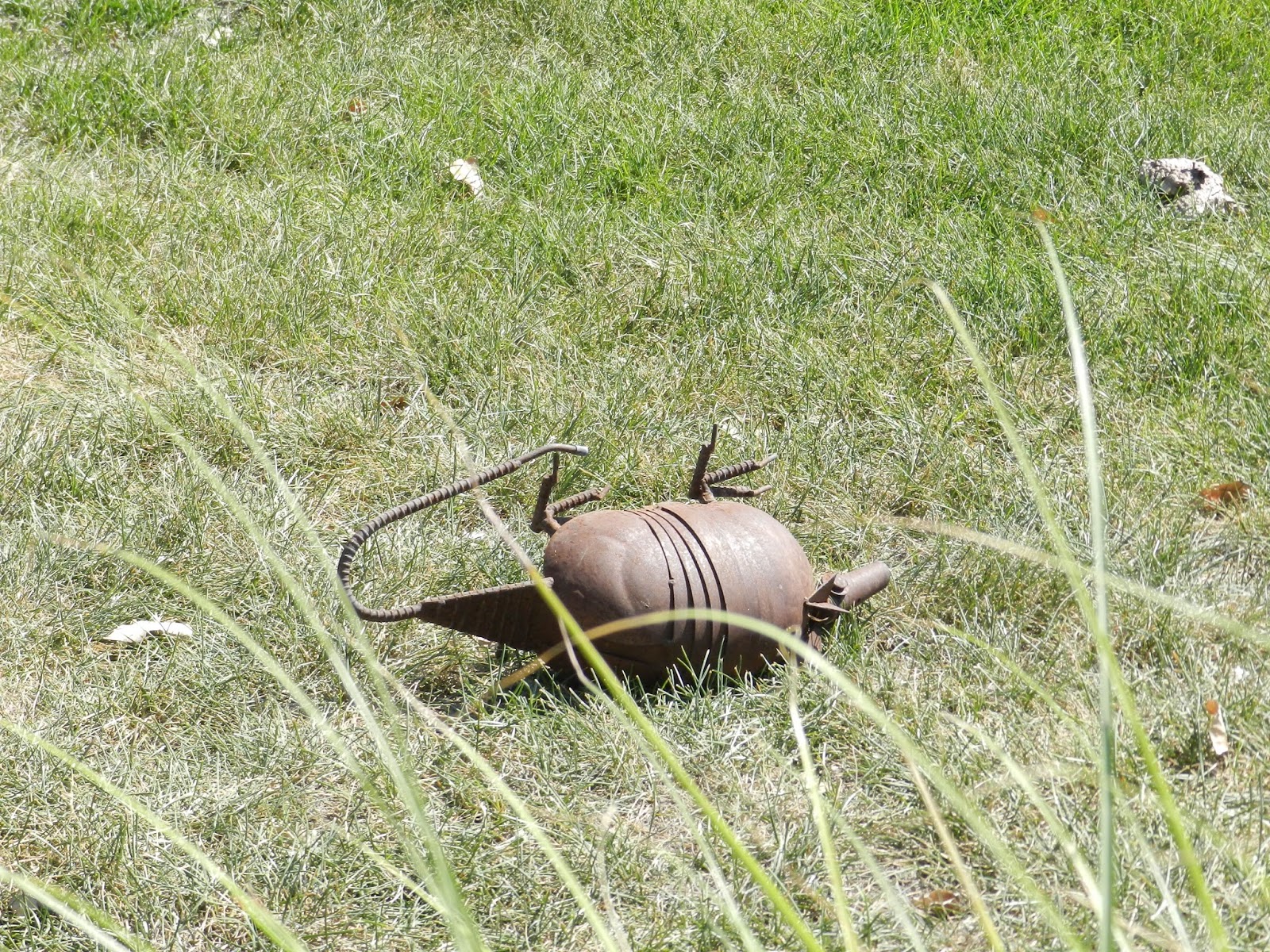
My fearless spouse watched these floating dive-bombers long enough to realize they’d colonized my favorite armadillo sculpture sitting on an old ice cream parlor chair for effect. He knew he’d have to move fast if he wanted to escape unharmed so while I was gone and the dogs were safely in the house, he dashed into trespasser territory and wreaked havoc. 

By the time I returned from work, my rusty armadillo lay on its back in the yard with a jillion little wasp apartments filling its innards. The upended chair rested nearby with a few more insect apartments glued to its underside. A can of hornet spray sat on the picnic table amidst winged carcasses. 

To discourage survivors from returning, my husband dumped the birdbath and water buckets we’d put out to encourage birds to visit. It reminded me that nature seems to frown on simple enjoyment of her pleasant side. If you have a picnic, ants will come. Apparently, if you welcome feathered friends, wasps think they’re invited too. 


Stalking a Hummer


If you watch the news, you’re aware that stalking has a negative meaning. You learn about creepy people who obsess over public figures and lurk in alleys or near back windows to sneak peeks. Possessed photographers trailing Princess Diana contributed to her fatal car accident. Hollywood loves the stalker theme and banks big bucks developing thrillers to keep us on the edge of our seats to discover whether the victim escapes in time.

While each of the previous examples sends a shiver up my spine just thinking about the topic, nature photographers have to borrow stalker skills so they can capture shots that make viewers say, “Wow!” Hiding in a bush, tree, or ghilley suit is sometimes the only way a shutterbug can snap an image of a beast, insect, or bird going about normal business. 

I recently got caught stalking hummingbirds in Meeker, Colorado. During our entire vacation, I wore my camera like a clunky necklace or carried it attached like Edward Scissorhand’s extra appendages. I wanted a picture of a hummer sipping nectar from a real flower, not a plastic bloom. Trying to capture a natural shot like that is much harder than you’d think.

Stopping in the city park so my husband could make phone calls while we had good reception began my adventure. As I waited for him to complete his contacts, I spied a nearby garden of spiky hollyhock stems, planted just west of the men’s restroom. Hummingbirds do love these tropical looking blooms, so I zeroed in on this locale.

Hidden in the front seat of the car, I noted a couple of torpedo shapes with needle beaks weaving in and out of the flowerbed. Not wanting to seem creepy and hang close to the door of the boy’s bathroom, I tried shooting pictures from the west and south sides of the garden. Unfortunately, the light was wrong, and all I collected on my SD card were washed out, blurry images of these summer charmers.

Gradually, I edged around the hollyhock bed ‘til I found just the right rays to capture clear pictures of zipping hummers. Waiting and watching for perfect shots took a toll on my back. To relieve the crick that was developing, I propped myself against the nearest available wall, not thinking about where I was or what someone might think.

For about 20 minutes, repeated camera clicks and whirs made it sound as if I were a National Geographic professional capturing one photo after another of delicate birds and blooms. This was a nice fantasy until a city employee interrupted my reverie and stared at me oddly.

It dawned on me that I was leaning against the boy’s restroom with camera in hand. Stammering with embarrassment, I explained I was shooting hummingbirds with my Nikon. Thank goodness, the man was a hunter and understood the concept of stalking game so he didn’t think I was a weirdo. I did see him walk away, shaking his head and smiling.

After I got home and uploaded my pictures on my computer, I discovered I took better shots than expected. Examining those hummingbird photos thrilled me. I realized I’d caught tiny feet resting on delicate petals, wings whirring in a dizzying blur, and long beaks sipping nectar. 

The results were worth that awkward moment when I saw the maintenance man wondering whether he needed to call in a stalker.


Sunday, August 25, 2013

Efficiency at Its Peak


We’ve enjoyed a lush garden this summer with tall corn, big cabbages, sweet potato vines that should be art, and towering tomato plants. Imagine our horror when we visited the garden one morning to find an interstate of raised trails weaving in and out our plantings. This was my introduction to a live mole.

Frankly, I didn’t know much about these creatures, other than that they don’t have much for eyes. I had no idea that in one night, a six inch mammal could tunnel through long rows of corn, cabbage, tomatoes, and potatoes. If I’d been betting, I’d have told you an army of mole engineers had worn themselves out moving all that earth. I’d have been wrong.

After we discovered our visitor, I did some research. They don’t eat roots, they eat insects—earthworms are a particular favorite menu item.  They are loners. The only time they get together with other moles is in February and March to, well, make other moles. Socialization is very low on their activity list. One source suggested five moles an acre would be a crowd.

Though they are small, a six inch torpedo-shaped mammal, they’re efficient.  As I first observed, these  critters are digging machines.  Their front feet look like miniature ping  pong paddles with Freddie Kruger nails. Apparently the muscles attached to these pink shovels are especially strong as these long nosed critters have a “lateral digging force equivalent to 32 times its body weight.”  An expert explained this compares to a 150 lb. man exerting a 4800 lb. lateral force.That’s some serious earth moving ability.

Not only can these guys tunnel earth at 18 feet per hour, their respiratory systems adapted to their underground existence.  They have twice as much blood and red hemoglobin as another mammal of their size. This enables them to thrive underground in a world with low oxygen and high carbon dioxide ratios.

Since they can’t see so well in their dark world, they don’t have much for eyes. In fact, looking at one, it’s hard to see an resemblance of these orbs that most humans take for granted.  If they can’t see potential food, they have to do something. And they do. Their noses work at optimum capacity, allowing them to smell an earthworm and latch onto it in no time. Their saliva contains a toxin to permit them to paralyze their prey so they can eat it lat their convenience.  As I noted earlier, they are a miniature model of efficiency. 


Knowing more about these dirt throwers gives me a new appreciation for them and their capabilities.  However, I don’t want to see their craftsmanship in my  garden, even if they aren’t eating the roots to my thriving greenery.

Friday, August 16, 2013

Leavenworth Pikes Peak Express


The scenery along   Highways 9 and 36 challenges many people’s belief that Kansas is flat and treeless. Even in western Kansas, the road undulates over rolling hills and trees line meandering waterways that lead into either the Solomon or the Republican Rivers. This lovely grass covered country makes it easy to understand why native inhabitants fought so hard to continue hunting and living in its sheltered valleys.

Even today, it’s clear to anyone who’s traveled the stark dry and treeless Santa Fe Trail across southern Kansas into Colorado that this northern route has more trees and fresh water. That would explain why partners who successfully ran Majors, Waddell, and Russell freighting business between Leavenworth and Denver would organize  a stage line for travelers to the gold fields 1859 using this trail . They named their brainchild the Leavenworth and Pikes Peak Express and charged passengers $125 one-way for a quick one to two week journey to the Rockies (amazing how the definition of quick has changed with the advent of cars and airplanes).

The surveyed course had 26 stations that provided meals, lodging, new horses, and fresh drivers.  Unique in this business, the company allowed station operators’ families to join them at these remote outposts located near either the Solomon or Republican Rivers. Little documentation of actual sites exists, but George Root and Russell Hickman jointly published an article in the Kansas Quarterly in 1944 providing some record of these locales.

Station 12 was located  “In Smith county, probably a little south of the forks of Beaver creek, about seven miles southwest of present Smith Center.” One diarist recorded the following fact about this site, “At Station Twelve where we dined, the carcasses of seven buffaloes were half submerged in the creek. Yesterday a herd of three thousand crossed the stream, leaping down the steep banks. A few broke their necks by the fall; others were trampled to death by those pressing on from behind.”

Down the road was Station 13, near present day Kirwin.  Newspaperman Horace Greeley describes a tent lodging in a journal entry of his trip on the Express. “I write in the station-tent (having been driven from our wagon by the operation of greasing its wheels, which was found to interfere with the steadiness of my hastily-improvised table), with the buffalo visible on the ridges south and every way but north of us.”

It was a hard day’s journey to Station 14, which was located approximately “12 miles southeast of present Norton and about four miles north of the North Fork of the Solomon River.” There was no description of the building’s construction, but a diarist mentioned the lack of water and trees. One noted, “To-day we have been among prairie-dog towns, passing one more than a mile long. Some of their settlements are said to be twenty miles in length, containing a larger population than any metropolis on the globe. . . . This evening we supped on his flesh, and found it very palatable, resembling that of the squirrel.” Perhaps this abundance of tasty mammals led to the naming of Prairie Dog Creek.

Travelers today can see a replica of Station 15 near Highway 36, on the west edge of Norton, Kansas.  According to a Mr. Richardson traveling through in in 1859, “We spent the night at Station Fifteen, kept by an ex-Cincinnati lawyer, who with his wife, formerly an actress at the Bowery Theater, is now cooking meals and making beds for stage passengers on the great desert three hundred miles beyond civilization. Our road, following the valley of the Republican River, is here two thousand three hundred feet above sea-level. . . . Day's travel fifty-six miles.” 

According to Horace Greeley’s notes, this was the halfway point between Leavenworth and the goldfields. It took his stage a week to get to this point, and he expected to take another week to reach his destination. Nowadays, we could make this trip easily in nine hours. It’s hard to imagine thinking two weeks was a swift journey.

The Quarterly article details encounters with the Arapaho, Cheyenne, and Kiowa as well as stage coach wrecks and buffalo related traffic jams. While you’re making good time cruising smooth asphalt, remember those adventurous souls who traveled the Leavenworth Pikes Peak Express, hoping to hit pay dirt in the Rockies.


Sunday, August 4, 2013

County Fair Time

Sometimes Western Kansans get so caught up in getting through a day or the week, they forget something special occurs toward the end of summer. Those unique events are area fairs, which began a few weeks ago and wrap up over the next few weeks. They provide opportunities to socialize, eat good food while supporting local organizations, and explore 4-H and open class entries in categories from fashion review to animal showmanship. It’s a time for kids and adults to showcase favorite projects.

Growing up in a city, I didn’t participate in 4-H adventures.  However, during visits to my grandparents in SW Kansas, I’d see friends racing to complete sewing, cooking, and animal projects to submit before the entry deadline. This wannabe country girl loved watching farm buddies give calves, pigs, and sheep spa treatments as they trimmed, sheared, shampooed, blow dried, and combed out hair before polishing newly trimmed hooves. 

I loved when my summer visit overlapped the start of the Meade County Fair so I could wander up and down the exhibit aisles.  I longed to be a rural kid so I too could enter a freshly scrubbed critter or a platter of exactly- the-same-size-cookies made from a favorite family recipe.  Jealousy nearly ate my heart when friends would authoritatively state they had to clean a stall or groom their show animal. Though I laugh at my response now, those chores seemed exotic and grown-up to this gal.

Years later, after I became a Kansas country mother, my husband and I encouraged our daughters to raise 4-H sheep. The girls worked with a  handicap since neither parent had been childhood club members, but we muddled through building pens, buying feed, perfecting morning and evening walks down section roads to make well-muscled lambs.

We learned sheep don’t like to be alone, so we convinced our more reluctant daughter to join the fun with a lamb of her own.  I loved seeing my young Bo-Peeps in their nighties and wild bed hair as they paraded their flock of two up and down the long drive in the early morning coolness.

Fellow club members and their parents walked us through the list of preparations to get our daughters’ lambs to the fair. First we had to shampoo the critters. It’s only logical that you’d wash fleece with Woolite for the best effect, right? One young man brought his sheers to the house and showed us how to trim wiry wool into a lovely do.  Then he explained how to polish sharp little hooves to a dark shine.

The cleanliness ritual became fair fun as youngsters from various clubs took turns spritzing hot creatures on scorching August days and then drying and brushing their coats til they gleamed.  Not only were animals soaked, giggling big and little kids wandered about sporting drenched hair and t-shirts. 

While the rearing and preparation of the animal for judging was mostly fun, show time is all seriousness.  Club mentors coached our girls’ clothing selection as well as their interactions with judges, including possible questions they might ask.  On top of these stresses, most of these events occurred when the thermometer was well-over 100. These kids and their animals had to maintain composure in a furnace.


For our family, fair time was mostly about finishing projects and enjoying the experience.  The girls never won coveted ribbons. However, each has a slew of stories about this summer  ritual to tell their children.

Sunday, July 28, 2013

Insects Inspire Designers


Time for confession: I’m a female missing the fashion gene. While I love creativity, I prefer to wear plain jeans and t-shirts. Ironically, I sometimes watch What Not to Wear, but I’d drive Stacy and Clinton insane. I don’t always like the designs and patterns they convince the person-in-need- of-improvement to buy. Although I don’t always like the styles these fashionistas promote, I love interesting looking insects.

Since I began lugging a camera everywhere I go, I’m on the lookout for photographic subjects. I’ve snapped pics of squirrels and bunnies on morning walks until I have a full folder. I wanted something different--something fun to manipulate with editing software. My mom always said be careful what you ask for, which might be true in this case. I began noticing bugs--not just common creatures, but fantastic special-effects quality insects. Not only did I spot them, but also they let me take photos from various angles so I could use software to play with their appearance. 

Squirrels and bunnies are cute, but it’s hard to make their pictures unique. They’re good for an aw, how cute, and that’s it. Insects, on the other hand, have interesting parts.  Sometimes their wings constructions rival the windows in majestic European cathedrals. In addition, their mouths and antennae are often complex enough to crop into interesting compositions that  display only that body part.

After paying close attention to these overlooked critters that share my neighbhorhood, I’m certain their coloration and design configurations would delight the WNTW duo. They’d be over the moon when they saw the striking black on white of a cottonwood borer. If they looked at this creature under a microscope to note the white was actually fine hair, they’d want to reproduce the positive/negative relationship as well as the texture into a garment one of their clients would model. I can see Stacy capturing the sheen of the legs and antenna in a stylish handbag or fashion boot.

Dragonflies might also inspire creativity in New York’s garment district. First, using the array of jewel-tones on these insects would brighten clothing racks in every national clothing chain. Even I would buy dragonfly blue or ruby-hued shirts to top my denims. Recently, a coral, cream, and brown species skimmed ahead of me. As I watched it dance lightly above waving brome grass, I imagined buying sheets and a comforter capturing those warm colors.

A cicada isn’t as delicate or lovely as a dragonfly, but it’s worth examining closely. With unaided vision, I saw only dull green and black. However, its intricate wings looked like fine leaded glass. When I magnified my picture, hints of crimson, topaz, emerald, and sapphire emerged, making a bejeweled Hollywood monster. Tiffany glass manufacturers would   gladly claim the wings.


Forget buying current fabric designs. After seeing what some of the bugs in my neighborhood wear, I know they’d make the staff of What Not to Wear do a happy dance. Even I’d go shopping for more stylish duds. 

Sunday, July 21, 2013

The Force: Music


It’s interesting how certain tunes and lyrics transport our minds from the present to another time and place. I can’t listen to “Jeremiah Was a Bullfrog” without finding myself traveling backward through time to age fifteen when I rode shotgun up and down the main drag of a small southwest Kansas town. With our windows rolled down, summer breezes riffled our hair until a comb could hardly pass through it. Oncoming drivers blared horns to greet one another as part of the nightly ritual. These discordant sounds disrupted KOMA tunes that established the rhythm of our popping bubble gum.

To this day, listening to oldies triggers an out of body experience for me. It’s impossible to believe more than four decades have passed since those notes first burned their way into memory, making a recording more permanent than any 8- track tape or vinyl disc that spun round and round on a turntable. Every one of those songs is a treasure trove of almost forgotten sensory experience: sights, sounds, smells, and feelings.

Though I’ve been happily married for nearly forty years, I can’t listen to the Moody Blues sing “Nights in White Satin” without thinking of every broken heart I ever survived. Oddly, I don’t think it’s the words that elicit those memories. That wavering, haunting melody plucks my emotions as if they were strings on a big old Irish harp, leaving me wrung out and raw as if a break up just happened.

It isn’t just old rock songs that have this effect on me. Sitting in church on Sunday morning listening to “Rock of Ages” or “How Great Thou Art” carries me back to five- year-old me perched next to my Grandma in the pew. I feel the remembered warmth of morning sun coming through emerald, crimson, and amethyst stained glass that depicted Bible stories I was learning in Sunday school. I smell my Grandma’s floral scent and see her hands holding a worn hymnal. I hear her tremulous voice singing those beloved words. When I hear those hymns, she’s with me still.

A song that distances me from my own lifetime is “The Battle Hymn of the Republic.” I can’t listen to its arresting rhythm without tears filling my eyes. As its notes wash over me, the stanzas send chills up my spine. I envision tent-lined camps filled with homesick, scared young men fighting for life and country. I see them sitting around flickering cook fires, running roughened fingers over pages in treasured Bibles, seeking comfort and strength for whatever was coming. I see lightning and hear trumpets. Juliet Ward Howe’s imagery turns me to jelly every time I hear it.

The same thing happens when I hear “Oh, Danny Boy.” The words and music capture the sorrow of every Irish mother and lover that sent her man into battle or off to America seeking a better life. I don’t know of a more poignant combination of lyrics and melody. If someone plays it on the bagpipes, I’m a goner. No one carries enough tissue to sop up my tears.

Music is a powerful force. It reminds us of who we were and inspires us to be more than we are. 


Sunday, July 14, 2013

Fireflies Looking for Love


            A hip-jutting, bold-shouldered posture made famous by actor James Dean, a flick of a hand through hair, extended eye contact, and a lingering second glance suggest a human’s interest in romance. Researchers have written entire books about body language people use when they want to hook up.
Not surprisingly, other species’ signals read just as obviously. In this region, we watch the spring strut where male turkeys fan tails and rattle feathers to attract hens. In a few remote locales, you might spy a prairie chicken dancing and booming to catch the eye and ear of his ladylove. Sitting outside on a summer eve, you hear nearby frogs trilling and croaking love songs to woo female amphibians.
On warm June and July nights, love is everywhere, even in the fireflies flitting about my backyard. Recently, I discovered these insects’ blinkers flash in search of romance. These light--then dark--then light beacons that enthrall me have everything to do with reproduction and nothing to do with my delight in their strobe effect. A little research helped me understand how fireflies control their lights. 
A scientist mentioned this insect’s ability to glow involves the chemical nitric oxide, which coincidentally helps control human heartbeats and memories. It’s interesting that a chemical that brightens a summer night also has something to do with maintaining brain cells that replay movies of times past. Humans may not glow and flash as fireflies do, but the elemental bond they share with this charming insect plays a critical role in their well-being.
It also intrigued me to learn that the two hundred species of fireflies each have unique signals that differentiate them from another variety of firefly. Using their specifically designed beacons, they attract appropriate mates. This is critical, considering the short time they have to find a partner.
While I’ve enjoyed fireflies for years, I didn’t realize their nightly Morse code involved propagation of their species. Those tiny flickers are nature’s way to make sure my favorite summertime insect continues to exist. In addition to discovering fireflies use their flashers to look for love, I also learned they spend two years in a larval state. In contrast to this long incubation, they exist for only two weeks in their beetle/firefly stage. It’s during this short period that they mate and lay eggs, according to a Tufts University study.
 Two weeks is not much time to start a family. Finding this out makes me feel guilty for the years I collected fireflies in glass jars to admire in a dark bedroom and for the summers I allowed our daughters to enjoy this childhood ritual. Though we released our insects the following morning, we reduced their baby making opportunities. 
This information has created a new resolve at this house. Those glowing bugs can have their whole beetle stage to find love and make more nighttime wonders. From now on, I won’t interfere in their romances. However, knowing these facts makes me feel like I invade their privacy when I watch their summer light shows.


Sunday, July 7, 2013

Imagine Going into Battle with a Song as Your Weapon


If you tune into the news, you’ll see people and nations disputing boundaries. These disagreements may involve guns, artillery, and bombs, or they may be legal wars that wind their way through courtrooms for years before anyone gets a definitive answer regarding who owns what. Since the beginning of time, humans have wrangled over property lines. After watching two male cardinals duke it out last week, I’ve decided people ought to settle their differences the way birds do—with song.

As a kid, I thought birds sang because they were happy. When I grew up, I learned they generally sing to attract mates or to establish and defend territory. Scientists who study such behaviors can tell you exactly how many tunes an individual species sings. According to one observer, brown thrashers produce 2,000 different songs while the Henslow sparrow has a repertoire of only one. That’s a lot of watching and recording to determine what’s going on in the bird world. 

In North America, we hear mostly male birds because they typically initiate courting behavior and establish or defend territory. Researchers discovered that playing a recording of another male house wren’s song triggers hostile behavior in listening wrens. They also know that if they remove these guys from their native habitat and play recorded territorial songs, a transplanted bird rarely invades the new region. The other fella’s melody establishes clear boundaries without bloodshed or violence.

Recently, I saw this in action. While rambling about town, I heard competing cardinals calling back and forth across a street. I’ve wanted to photograph these scarlet beauties so I stopped to look for the source of the racket. One chap hid among the leaves of a tall tree while his opponent clung defiantly to a wire strung between telephone poles as they hurled insults back and forth. 

As I watched, their volume increased. If bird body language is anything like that of humans, the creature on the line was agitated. He wanted that other guy GONE. I observed their trilling for five minutes until I realized their duel could go on all day. I returned the next morning to see if the warbling warriors were still sparring, but silence reigned over the neighborhood. The feud ended without a single casualty.

While I finished that morning stroll, I had much to consider. What if humans sorted out their differences through song? Would folks like me who can’t carry a tune but possess a loud voice have an advantage? Would others give in to shut us up? Maybe the contest would be like TV shows where celebrities declare a winner.

In the human world, I’m sure a third party would settle the issue, but I’m uncertain whether scientists know how birds determine a victor. They only know that birds select mates and settle territorial conflicts through song. 


It makes me wonder what John Lennon thought about as he wrote these lyrics, “There’s nothing to kill or die for” in his song “Imagine.” Perhaps he too watched birds settle differences by trilling memorable tunes and imagined settling disputes without violence. 

Friday, June 28, 2013

Pickin’ Potato Bugs ‘n Livin’ the Dream

Deep in every woman’s heart, no matter how practical she is, lives a die-hard romantic. That’s the reason commercials promote products displayed against a field of wind-blown wildflowers, stunning sunsets, or white sand beaches bordered by intensely blue waters. All the while, a simple but sweet tune plays behind the scenes if it’s a TV ad. These commercials aren’t designed for men. Trust me.

After the early dating years, much of the romance that attracts lovers in the first place gets lost in daily survival. It’s hard to set a candlelit table for two when a ball game begins at 6 p.m. or cattle need fed before the winter sun sets. It’s difficult to maintain that passionate gaze that connected you and your sweetie back in your courting days while a toddler and infant throw their evening hissy. As a couple adds anniversaries, a few special occasions have to make up for a lot of get-through-the-day-chaos.

Despite messy, unpredictable reality, the essence of the sweet young thing who wanted Prince Charming to swoop her away on his white charger keeps fanning her ancient dream. Why else would so many women keep romance novelists busy writing and selling books enough to fill jillions of library shelves? Why else would Hallmark devote an entire channel to happy-ever-after endings? 

Folks, mostly female, reading those novels and watching those programs are typically between the ages of 30 and 54. According to one source, the Hallmark Channel’s family friendly programming was listed number 1 with 96% audience retention. Those viewers are loyal too.

So what’s a long-married guy have to do to add sizzle to his true love’s life? According to my husband, he should invite her potato bug picking. He’d tell you timing was important because both dusk and dawn add that special ambience. If you make it a contest, that really spices up your together time.

I guess it must work because we met in the garden the other evening for a round of insect collecting. I wasn’t familiar with the nymph stage of these hungry critters so he graciously showed me several of the little orange and black squishy bugs before the competition began.

Once I understood what to look for, we each took a section of potato plants and began searching. Remembering that I appreciate chivalry, he was ever the gentleman and let me have the area with the most obvious snacking creatures. While those were easy pickin’, I quickly learned to scan the undersides of leaves to increase my chance of winning.

He already knew this species is particularly fond of hidden regions of potato plant anatomy and had significantly more bugs in his jar. Seeing his half-full container inspired me to double my efforts. I swished potato plants so wildly that the objects of my hunt tumbled from their dinner table to the ground below. 

The extra time I spent searching for lost prizes gave my darling more time to increase his Kerr jar’s contents. Soon, I had to admit I’d lost the game. 

While that might have upset a more competitive woman, I looked up to see the moon rising against the fading blue eastern sky. Evening’s cooling breeze blew my hair away from my face and riffled through the oat field behind the garden, making rolling waves. Birds flitted past, adding their simple but sweet songs to our evening. While standing knee high in potato plants, I realized I was living the dream those advertisements promote with the best fella a girl could find.


Sunday, June 23, 2013

The Beholder’s Eye


Living in the same region and sharing roads, doctors, schools, and hair stylists doesn’t mean people see a common experience from the same perspective. Everything that’s happened to individuals prior to those events colors their interpretations. It’s true of two kids who grow up in the same house with the same parents but tell two different stories about their upbringing. People spin their own explanations. 

A recent reminder of how humans see the same occurrence differently resulted from a post in a group including urban and rural Kansans. A member published stunning photos of musk thistle flowers. The photographer meticulously shot multiple views of purple blossoms, displaying them in full bloom and as compact buds. She edited artfully to accent color variations and focus on petal filaments or the green casing containing all those seeds-in-development. She added a note explaining how beautiful she found them.

I wasn’t sure how to respond. I liked her art, but my brain focused on the difficulty of removing those weeds from a pasture. I dealt with my conflict using avoidance—I didn’t make a comment pro or con about her eye-catching photos. However, others more certain of their feelings clicked the like button to tell this artist she’d won their approval. Some, country folks I bet, respectfully shared that it’s hard to look at a musk thistle blossom appreciatively, no matter how attractively displayed,  if you’ve spent time digging those prairie pests.

Several participants seconded that opinion. All worded their responses kindly, but they made it clear they didn’t see those flowers with the same affection the photographer did. A noxious weed was a noxious weed no matter how attractive a camera and editing made it appear.

A second reminder followed the first within a few days. It also involved plants. A friend who grew up in a large farm family thought people used their green thumbs to grow wheat as a cash crop and big gardens to fill dinner plates throughout the year. Spending time grooming a luxuriant yard wasn’t on that family’s radar. As a result, she thought a lawn punctuated with flowers, wild or cultivated, was pretty. For her, these colorful bonuses brightened drab buffalo grass.

When she married, she discovered another way to look at this situation. Her husband dreamed of having a manicured lawn. He didn’t like weeds interrupting the green turf surrounding their home, explaining how mad it made him when a neighbor’s wildflowers invaded his yard. I’d like to have seen his face when she responded, “But it’s so pretty. Don’t you love the colors?”

If you’re around long enough, you learn no one sees life the way you do. What one person sees as lovely may disgust another. This is certainly clear at the table. One sibling loves broccoli and another gags thinking about it, proof that value lies in the eye of the beholder.


If that photographer had dug much musk thistle, she might have taken its picture, but she probably wouldn’t have focused on its beauty. On the other hand, if a rancher’s grandkid grew up in a city, thistles might be pretty flowers that make artists smile.

Monday, June 17, 2013

Best Dining in the Region


City friends sometimes ask if I miss dining at popular chain restaurants. When I first moved to rural Kansas, I did miss running to Olive Garden or Red Lobster. Now days, I’m happy to wait until a local organization hosts a foodie fundraiser. I’ve learned that’s where you find homemade-by-neighbors fine dining. These cook’s reputations are on the line, so they don’t serve just anything.
Once a month in an area town, the Eagles organization fries up a chicken dinner that competes with my Grandma Lottie’s best Sunday feast. I don’t know how much preparation goes into feeding hundreds of hungry customers, but cutting up, breading, frying, and serving chicken for a hungry horde must consume most of those good-hearted volunteers’ weekends. 

If the focus of the meal weren’t delight enough, they also serve old-fashioned green beans simmered with bacon and onions just like Grandma made alongside real mashed potatoes and gravy. None of those instant flakes for these fine cooks. They top off this sampling of heaven with homemade hot fudge drizzled over vanilla ice cream. The endless line of diners outside the door from the time they open til they close shouts their success to anyone driving by.

I salivate just thinking about fried chicken Sunday, but the true delight of this event is how the profits from thousands of poultry dinners support individuals and programs in that community. I wonder if anyone has counted the graduates who’ve gone to college on chicken dinner-generated scholarships or the struggling families and local organizations supported by these individuals’ hard work. A nearby town recently began a similar tradition to support their youth. It’s great to help people reach goals while sending smiling diners home patting satisfied bellies.

Fried chicken isn’t the only menu item that makes taste buds pop. During Lent, Knights of Columbus members in area towns fry fish and hushpuppies, accompanied by homemade coleslaw, and other local treats for friends and neighbors. Once again, participants enjoy visiting over a delicious, fresh food made by people who care. Good eating doesn’t get better than that.

Throughout the year, little towns in western Kansas offer the opportunity to stand in line for a hot bowl of homemade soup. Get ready to sample some of the best chili, chicken noodle, or vegetable soup you’ve enjoyed since you last visited your favorite cook. Not only is the main course delicious,  these dinners usually include a pie table that’ll drive you nuts when you have to choose between fresh apple, cherry, chocolate, lemon meringue, or coconut cream flavors. These fundraisers often support a specific person or cause so when you attend one, you help a neighbor in need.


Add fair food booths that sell handmade bierocks, ham pockets, galuskies, buffalo burgers, or freshly grilled brats to this list, and it’s easy to see that locals don’t lack good eatin’ opportunities. Notice I didn’t mention homemade cookie, cake, and pie stalls. It’s nearly impossible to stay on a special diet at these events.

Friends who think I live a food-deprived life are wrong. Good eating in this region may require delayed gratification and intentional scheduling, but I frequently sample some of the best eats in the country. That ought to be a Food Network show.


Friday, June 7, 2013

“School’s Out, School’s Out! Teacher Let the Mules Out!”


The words “Tag, you’re it,” or “You push first,” carry on breezes floating to my patio from a nearby playground. Laughter and repetitive sounds of metal chains swaying back and forth accompany high-pitched voices enjoying sunshine and freedom from desks and fluorescent lighting. It’s like hearing echoes of me in those first heady days after a school term ended fifty some years ago. Vacation meant exploring or testing our wheels. The essence of simpler times hasn’t changed in little towns dotting Kansas maps.

In those intoxicating weeks after class ended, my friends and I re-explored our neighborhood. Another year older, we tested how much higher we could climb a nearby tree. Once we reached our limits, we’d either play Tarzan and swing down the branches or investigate bird nests to see whether they held any eggs.

After challenging our fear of heights, we’d tromp to the nearest creek. This required rationalizing because our moms told us not to go near water. If we stopped at the mud on the creek bank that couldn’t be considered near water, right? I suspect our parents would’ve interpreted that rule differently than we did. Anyway, we’d try to guess what tracks belonged to what animal or gross one another out by picking up and extending stinky fish or crawdad carcasses toward our squalling buddies. 

A good stick made any creek side exploration better. We tested mud’s depth by shoving our stick in until it hit solid ground. Sometimes we already knew how deep it was because we’d sunk up to our knees into it. We’d see who could throw the farthest or have imaginary sword fights. Once our gooey adventure ended, we used our handy tools to scrape off evidence of trespassing in forbidden territory.

As the sun rose higher throughout the day, we needed a change. Out came adjustable silver skates or bicycles. Toys were simpler then, so putting on skates meant latching four wheels to a shoe with a key worn on a shoestring around the neck. Once we got our sea legs on those primitive transportation devices, it was bumpity bump bump bump down a cracked and uneven sidewalk. We quickly learned to fall without hurting ourselves because we had plenty of tumbles. If I remember right, I think I even tied a pillow on my fanny to soften my landings.

Bicycles weren’t any higher tech than skates except we could push backward on the pedals to brake. It seemed as if every bike I ever saw was big. At six or seven, I had to put all my energy into controlling the handlebars or pushing the pedals. It was one lesson after another about levers and torque. Now days, youngsters go through a series of size-appropriate bicycles so managing them is easier. 

Bikes led to races, daredevil tricks, and parades. It didn’t take long to discover who had the fastest bike or the strongest legs, so contests didn’t occupy much time. However, I loved putting my younger brother either in my bike’s basket or on the bumper over the back wheel and taking off down the highest hill we could find. We’d build up so much speed I had to hold my legs stretched away from the spinning pedals to prevent an injury. Neither of us realized that if we’d crashed, we could’ve killed ourselves.

Bikes weren’t only about adrenalin rushes. Nothing was more fun than planning a parade. We’d weave colorful crepe paper remnants between wheel spokes and tie them in streamers to our handlebars. No one worried about color schemes, so our parades were eye catching for sure. Looking back, I don’t know who watched because we all rode. Apparently, we didn’t care.

Listening to neighborhood kids enjoying their first weeks of summer, I hope they find the joy my friends and I did in those distant, carefree days. May they discover a good tree to climb, some skates to test their balance, and at least one parade to show off a vividly decorated bicycle.


Saturday, June 1, 2013

Barbie’s Bouquet Ready for Pickin’


Only a Grinch could hate spring’s arrival. What’s not to like about warmer days, leaves unfurling, grass greening, tulips and daffodils bursting into bloom, lilacs perfuming breezes, and white blossoms exploding on Barbie’s wedding bush. This plant is really called spirea, but for little girls playing dolls, this shrub provides bouquets enough for a hundred wedding ceremonies--hence its nickname.

I hope cascading branches loaded with clusters of tiny white blossoms still trigger little girls’ imaginations. When I was a seven-year-old, the moment our neighbor’s huge bush exploded into a frothy, white wall of flowers, I began constructing bridal clothing for three Barbie dolls and their redheaded friend Midge. 

My mom’s ragbag wasn’t safe. If we’d had paper towels or napkins back then, I’d have used them as well. Ones that come in tidy squares would’ve served this wanna-be wedding designer perfectly to make stunning one-use outfits. Without the availability of handy paper products, I creatively turned worn out washcloths, tea towels, hankies, and leftover fabric into long trained gowns and flowing veils. If I could’ve used mom’s nice fabric remnants, those outfits would’ve dazzled kings and queens. However, I knew better than to get into her good stuff.

As it was, I snagged onto any piece of cloth big enough I could use a needle and thread to turn it into a gathered skirt with my gigantic, looping stitches. Once I completed my dolls’ dresses, I looked for filmy material to turn into lovely headpieces and extensions that trailed behind plastic brides and attendants. Sometimes the best option involved toilet paper. It romantically floated behind the bride as she walked to meet her groom.

Nowadays, little girls accustomed to buying couture fashions off the internet for their Mattel fashion toys would turn their noses up at a bride going down the aisle in a terry cloth skirt and a TP veil. However, fifty years ago was a simpler time, and my friends and I thought the ensembles we painstakingly created were elegant.

The highlight was the bouquet. In my neighborhood, at least one resident grew a big, old spirea bush. He or she would permit polite little girls to fill pockets or pulled out shirt bottoms with miniature nosegays that once ornamented those flowing stems.

I suspect that one of the reasons May and June originally became popular wedding months had to do with the availability of beautiful spirea sprays brides could carry on their march to the altar. Who needs a florist when nature provides so richly? 

Once our Barbie’s wedding attire was completed to our satisfaction, we’d tuck perfectly sized nosegays into our dolls’ tiny hands to complete the effect. Back in our bedrooms, we’d create a lovely chapel with a colorful ribbon to guide Barbie and her groom to the front of our little sanctuary. Along the way, we’d strew left over flowerets from the tiny bouquets. Each Barbie’s perfectly round bridal arrangement must have dazzled her handsome groom almost as much as her designer gown and creative veil did.

Homemade dresses and seasonal spirea sprays made for many lovely spring weddings. It’s too bad there was only one Ken and that he had to marry each Barbie in a separate ceremony. At least his tiny boutonniere matched each of his brides’ perfect bouquets. No paid florist could have done a better job. 


Sunday, May 26, 2013

Another Checkmark off the Bucket List

Several years ago, my students created bucket lists to share. Once we posted them around the classroom, it was fun to hear seniors say, “Skydiving’s a great idea,”  or “Yeah, I want to ride a zip line across the top of the Amazon rain forest,” or “I need to add bungee jumping to my list.” As I read each series of twenty-five life dreams and listened to responses, I realized many teens would find my expectations too tame for their tastes. Despite a distinctive lack of danger, I was thrilled to check off one of my listings recently.

My series of dreams included seeing a grizzly bear in the wild, watching a whooping crane, and photographing prairie chickens booming.  Two years ago, I scratched ursus horribilis off after spotting a humped silvertip following a young buffalo in Yellowstone.  The next year I observed a distant whooper visiting Quivira Wildlife Refuge.

Now I can say I spent an hour watching prairie chickens perform their spring ritual.  Though I wasn’t risking life and limb to shorten my checklist, adrenaline flowed and my heart rate raced when I first noted two sharply pointed crests and bright orange inflated skin patches on football-sized feathered creatures.

Over the past decade, I’ve joined several outings to different leks or booming grounds in Ellis County.  Each time, I saw birds, but they didn’t show the least interest in performing the dance that brought them fame. Once I spotted a hen flying near my home in eastern Trego County, but she must have been passing through because it was a one-time incident. A few years later, I spied two hens flying near an old barn in Phillips County as I drove to art class. Again, just airborne birds—no fast footwork with eye-popping special effects.   

On my bucket list check off day, I rose with the sun to observe some herons as they made early morning forays from their nests. I hoped to get photos of these elegant blue-gray birds silhouetted against a prairie sunrise. Once in place, I realized I couldn’t get the shots I desired so I opted to visit a nearby waterhole, hoping to see these long legged shied pokes breakfasting in the shallows.

Before I arrived, I got distracted.  Instead of seeing ripples in a pond, three elliptically-shaped bodies strutting around a fourth hunkered down bird caught my attention. Focusing more closely, I recognized unique spiked headdresses any native dancer would be proud to showcase in a ceremonial presentation.

 By then, I’d rooted myself in place to enjoy this magical spring rite. From that vantage,  I saw orange orbs poofing in and out of the neck areas of these energetic performers.   Once I rolled the window down, I heard the didgeridoo-like hum of booming prairie chickens interrupted by cackles, clucks, and chuckles. The sounds accompanied fancy footwork, ecstatic leaps into the air, and aggressive feints.
The prairie carries sound well as anyone who’s ever listened to  morning meadow larks  trill can tell you.  Full throated notes  ride  air waves from the emitter to the receiver the same way that red tail hawks ride thermals.  That morning’s full sensory effects that included sight and sound washing over me and into my camera was better than anything I expected when I inked my dream onto a blank page years ago.

Humans are interesting. Some need death defying stunts to define their lives. Others enjoy thrills with far less threat to life and limb.  What I learned from my students’ and my bucket lists is that everyone benefits by recording hard to achieve goals. Create your list and then start marking off accomplishments.


Tuesday, May 21, 2013

Dodge Those Purple Splotch Bombs


Driving home from work one day, I noticed a hint of a new hue--a titch of red, emerging in the trees that line Big Creek along Old Forty. I slowed to get a better view, and after peering closely, saw scarlet fruit emerging on the many mulberry trees that dot our landscape.  My first thought was it seems a bit early for the mulberries to ripen. My next thought was oh no.  It’s purple splotch bomb time.

Not only do insects like those luscious berries, but birds do too, with decidedly undesirable results. Everywhere I look during mulberry season, I see purple splotches splattering cars, lawn furniture, windows, porches, the dog’s back, and on infrequent occasions, a human head! Based on their splatter techniques, some might think Jackson Pollock took art lessons from mulberry fed blue jays.

I know humans studied birds for years to determine how we too might fly. Looking around our place at the results of fruity explosions, I wonder if tactical bombing instructors used these feathered friends’ techniques to learn new bombing strategies. 

The idea of carpet-bombing undoubtedly occurred to some poor military tactician who suffered the misfortune of standing in the wrong place when a flock of birds hastily digested their diets of deep purple fruit during a quick take off. It wouldn’t take long to put two and two together to determine how to dispatch a group of planes loaded with missiles aimed at a common target.

Some brilliant scientist must have modeled stealth bombing after more streamlined birds that swoop in for a morsel and then fly a direct pattern over a specified site. Most recently, that would have been a spot on my car door that we could not avoid touching when we exited and reached to shut the door. It didn’t take long for me to interpret my daughter’s disgusted squalls as she rapidly wiped her hand up and down her pant leg after closing the door. 

This form of attack also comes into play when birds sight in on the human head. No one is safe. Golf courses, picnics, baseball games, and gardens are declared certified bombing ranges.  The human pate in the open offers a clear invitation--Hit me--Hit me--Who can blame the bird? 

Unfortunately for the splatted upon, some birds come with sighting devices that would amaze Pentagon or Chinese military whizzes. One bird’s eye view and that poor skull is done for. Show me the man or woman who can graciously exit a group of bystanders after a fully loaded bird hits ground zero, and I’ll introduce you to the next mediator general of the world.

Be warned!  Beware of mulberry loaded, low flying birds.  Consider them armed and dangerous. For your own protection, wear a hat at all times. 

Sunday, May 19, 2013

Heroes of the Pasture: Dung Beetles


            Somewhere I saw this quote, “Life is a journey, not a destination.” I agree  and add you’ll meet interesting creatures along the way. Sometimes those new acquaintances look like something from an intergalactic space bar.

            Several years ago, Big Yellow Dog and I began our morning with a ramble. These journeys not only began our day right, but sometimes we also enjoyed the strangest sights. What I saw that day exceeded every other unusual observation ever experienced during jaunts down that sandy road.

            We’d noted the usual: a killdeer racing ahead of us, a sparrow hawk proclaiming territorial rights, and neighboring cows wondering why Big Yellow Dog bounced up and down as a mouse ran under his paws. A ribbon of blue horizon contrasting against green pastures and nearly ripe wheat fields backdropped these familiar scenarios. 

            A bit into our walk, we crossed the section road into what I consider the “wilderness.” The only reason humans come this way is to go somewhere else. No one lives on this route.

This is the area where I once spotted a bobcat leaping playfully above waving big blue stem and brome grasses that border walk-in-hunting acreage.  This is where on damp mornings I spy prints of a doe and her fawn crossing from the WIHA to the creek for a morning drink. This is where I see trails of   wriggling snakes as they maneuver from one grassy ditch to the other before a big redtail flying overhead dives for dinner.

I look forward to the surprises I find in the “wilderness.” The unexpected keeps me walking that direction day after day. That morning provided another “stop to put this in your memory bank” moment. 

Tucker ran through the ditches, analyzing scents of everything that had happened since he last sampled the air. I trailed him, admiring morning clouds, relishing cool air rippling over skin, sensing the roll of gravel under walking shoes, and letting my eyes sweep the road close--then far, close--then far.

Suddenly, I thought I’d ended up at the space bar mentioned earlier. Two semi-gloss black bugs were rolling a shooter marble-sized ball of brown gunk from the north side of the road to the south. 

My first thought was “dung beetle.” I recalled watching such bugs on Discovery Channel, but these weren’t large enough to compare to those I saw on TV.  Of course, I’d watched African dung beetles that dealt with elephant-sized poo piles, but keep in mind I hadn’t analyzed that far yet. 

I looked around for the nearest pile of … dung.  It lay far away in relation to the size and stride of these beetles.  Could it be?  Were they ambitious enough to march on short legs to collect and form a rollable ball of cow caca several hundred feet to the south?

Stopping to observe these diligent creatures, I noted their system enabled them to simultaneously push and roll that poop globe. One stood on top of the orb as one envisions lumbermen who roll logs down a river might. The other rose on hind legs and used upper legs to lever the sphere forward.

After returning home, I cruised the Internet. Dung beetles do live in Kansas.  In fact, they live everywhere except the Antarctic. If we didn’t have them, we’d be up to our eyeballs in, well…use your imagination. Several varieties of these necessary but unappreciated creatures exist, and I happened to witness the “roller” type.

Ancient Egyptians knew the importance of these insects and deified them. That may be extreme, but consider that one expert said dung beetles keep “land livable by reducing flies, foul odors, and the ruination of pastureland.” Another proponent claimed more efficient use of them “could save farmers $2 billion a year by restoring grazing land.” One agriculturist explained, “Once the cattle have vacated the paddock, within 48 hours, there is no manure left.” Maybe Hays Research Station needs additional dung beetles to address odors that waft through Hays when south winds blow.

My newly discovered neighbors are good partners in life’s journey. I look forward to seeing them again.