Showing posts with label summer. Show all posts

Friday, June 23, 2017

Toad Buddies--More than Meets the Eye


While my sixth grade classmates loved listening to our teacher read Wind in the Willows, I found it silly. Toads talking and acting like people, no way. This attitude toward anthropomorphic creatures was a childhood peeve. I wanted critters au natural.

To this day, I find stories about talking animals silly. Despite my curmudgeonly attitude toward this popular genre, I like toads. Fortunately, summer provides daily opportunities to observe toads residing in patio planters and garden beds.

Looking at a toad, you wouldn’t think it overly bright, but one summer, two caught my attention because they were so clever and entertaining.

Before the solstice officially arrived, these fellows demonstrated their smarts. Our section of prairie made growing anything a challenge. Instead of investing in a big flowerbed, I decided a few well-chosen pots with bright blooms would make it seem summery without demanding water necessary to grow a lush flower garden. These neighboring green gents quickly determined which pots stayed cool and damp longest and moved in. Initially, they lived separately, one in my mixed bloom bucket and the other in a geranium pot. 

As May days lengthened and warmed, the geranium toad must’ve investigated the mixed bloom pot because next thing I knew, two amphibians rose, gasping for air, out of the same toad hole when I watered. They dug their cavern deep enough one could rest on the other’s head while leaving the top toad covered to his bulging eyeballs in potting soil.

For a while, they found their bliss in the mixed bloom pot, but as summer grew hotter and drier, both toads abandoned it for my herb garden. That soil must’ve stayed cooler, maybe due to the insulating brick border. Watering time became an adventure. I never knew where I’d find my garden buddies.

In addition to requiring cool, damp living conditions, these guys exhibited hearty appetites. As a result, their bodies grew wider and longer than my palm--a result of their canny hunting skills. 

While other toads in our yard gathered nightly under the yard light, these discovered the much closer patio light drew insects equally well and didn’t burn nearly as many calories making the journey. Patiently, they waited until evening temperatures dipped before emerging one green amphibian limb at a time from moist earth. Then they let the beam from the porch work its magic. 

One night, I interrupted their fashionably late supper to see why they were so plump. Both warty lads had rooted themselves directly under yellow lamp rays, gobbling beetle after beetle as freshly toasted insects sizzled and plopped to the patio. While I watched, these big boys didn’t move more than a couple of inches as they went through the equivalent of a twelve-course meal. I wish I'd stayed long enough to see them lug distended, white bellies back into the flower pot  where I found them the next morning.

As much fun as I had watching those toads, I may give Wind in the Willows another chance. Obviously, there’s more to that story than I realized in sixth grade.

Sunday, August 9, 2015

If You Plant It, They Will Come


Kevin Costner’s character Ray in the movie Field of Dreams listened to a mysterious voice telling him, “If you build it, they will come.” Against others’ advice, he sacrificed a cornfield to construct a baseball diamond in the middle of Iowa farm country. If you’ve watched this film, you know the end of the story. Shoeless Joe Jackson, members of the banned 1919 Black Sox team, and others show up to play some spirited games.

I loved the concept behind that story. When you listen to good advice and prepare, exciting adventures begin. In my case, the result isn’t nearly so mystical, but it’s certainly as rewarding. I listened to a biologist friend who is particularly knowledgeable about butterflies. She told me to garden not only to produce food but also to support this species. I’ve written before about adding dill and fennel to my garden. This year, I took that a step further.

I planted fennel and dill amongst my zinnias, larkspur, Indian blanket, bachelor buttons, and marigolds. Over the summer months, an occasional visitor would ask about that that ferny-looking stuff that smells like licorice.

“Oh, that’s fennel.”

 I’ve also had a couple of friends who remarked on the dill thriving in my flowerbed.

“ Yes, that’s dill. No, I’m not making pickles. I’m growing butterflies.”

Butterflies? 

Yes, butterflies. Specifically, black swallowtails. Each spring we see these stunning black-winged creatures with blue and yellow accents sipping nectar from blooming lilacs and later from our summer blossoms. By following my girlfriend’s advice and planting to attract these brilliant colored guests, I’ve seen scores of funny looking green caterpillars this summer. They’re each marked with details every bit as stunning as those sported by their parents. 


If gardeners provide enough host plants, adult females will lay yellow eggs on the leaves. After several weeks’ incubation under warm sun rays, these tiny deposits hatch into segmented creatures dressed in vivid green adorned by yellow, black, and white stripes, dots, and dashes. This developmental stage camouflages the pillow-like caterpillars  from hungry bird eyes, but humans easily spot their summer visitors munching lacy leaves. If you don’t see them on the plants, you’ll know they are digesting away by their healthy poopers dotting the soil and landscaping rocks beneath your greenery.

In years past, I was happy to see two or three of these ugly bugs in clown dress each summer. After adding additional fennel and dill, I’m tied up for several minutes each morning counting growing numbers chomping through the foliage. Two days ago, I counted better than two score of these potential butterflies gobbling fennel fronds.

I’ve discovered blessings often require patience, so I hope to see these little guys transition into the pupa stage. Despite research, I’m not sure how this works. I don’t know how these insects move from their feasting grounds to the site where they morph into a neutral colored chrysalis. I suspect this is going to be a live and learn lesson. I don’t know if I will see them emerge as butterflies this fall or next spring. What I do know is that I’ll ignore my husband’s requests to trim the fennel.


If every egg that made it to the caterpillar stage survives the transition to butterfly, my front flowerbed will be a brilliant colored sight next spring. All that fennel and dill should multiply as well, so we may have a record book black swallowtail swarm come summer 2016.

Sunday, August 2, 2015

A Freeloader in the Garden


Something’s been eating my strawberries. Yes, the luscious berries that we planted two springs ago and carefully nurtured so we’d have fresh fruit over our ice cream and cake or sliced to sweeten a fresh  spinach salad. Since they first began blooming in May, I’ve harvested about 15 scarlet bursts of flavor that hip hop on my taste buds. Last week, I went to pick some for supper and discovered I’m not the only one that likes this spring treat.

We have flocks of birds zipping in and out of the yard, so I checked to see if beaks had pecked at the berry chunks still attached to the plant. Nope, whatever picnicked in Grandma’s garden took actual chomps from the ripest sections of the fruit, leaving hard green stems behind.

Trying to imagine what would devour my luscious treats, I remembered that at our former home, a box turtle would creep into the garden to sample tomatoes. Once in, it levered its pointed upper and weaker lower jaws to snap good-sized chunks out of the orange half of my BLTs. When I first noticed the actual bites out of my strawberries, my first thought was I had another reptile sampling the wares.

On a detective mission, I roamed through tilled rows, lifting lettuce, kale, chard, and spinach leaves in an effort to find and evict the invader. When I didn’t spot it, I inspected nearby plants and flower beds, thinking maybe it dined al fresco and then headed for a more sheltered area to digest its tasty meal.

Again, no luck. After searching fruitlessly (pun intended), I knew it was time to consult my planting partner, who is a much better sleuth than I. With decades of hunting experience, his sharp eyes zero in quickly on clues I miss.

It was the right move to involve my husband. After a short review of the rain-dampened soil, he turned to me to ask, “Do skunks like strawberries?”

“What?” I said. 

“We have skunk tracks in the garden, so that’s probably what’s eating your goodies.”

After a few moments on the internet, I confirmed my sweetheart’s suspicions. These stinky critters like berries of any kind. To confirm his findings, I remembered when our dogs got sprayed by a black and white kitty right in our back yard not so long ago. This current trespasser could be the very creature who perfumed our pooches.

Considering the super powers of this berry thief, we’ll have to strategize to make certain we don’t end up needing a hydrogen peroxide/baking soda bath. No tiptoeing through the garden in the wee hours of the morning or late at night. 

When my girls were little, they loved the book The Little Mouse, The Red Ripe Strawberry, and the Big Hungry Bear. The tiny grey rodent satisfactorily solved his fruity theft problem by sharing his red treasure with the bear. I don’t think this plan will work in this case. Once again, the potential of facing eye burning, stomach-wrenching stench forces me to consider other options.


I’m not certain, how this story will end, but I don’t intend to support that freeloading, strawberry thieving skunk much longer.  Stay tuned for further adventures.

Sunday, September 15, 2013

Uninvited Guests


Nothing is more satisfying than frying chicken, making potato salad, cutting up carrots and celery, and baking a pan of brownies for a family picnic. While I’m at the stove, I imagine the perfect spot to place our blanket or cover a table so that we can savor blue skies, warm sun, and laughing kids while we feast. My fantasies about perfect outdoor meals are always ruined by uninvited guests—ants. An army of marching three-part bodies always finds the goodies and sends me scrambling to store lunch safely out of their and my reach. I recently discovered ants aren’t nature’s only uninvited guests.

To lure feathered creatures into our yard, my hubs and I set up birdbaths and hung feeding stations near the back porch. It wasn’t long before our efforts paid off with finches, orioles, robins, grackles, and sparrows visiting several times a day for drinks and snacks. 

I could watch their acrobatics from my shady porch swing, or I could hide in the sunroom where they couldn’t see me. Over the summer, hours flew by as I spied on splashing robins and timid house finches hiding among leaves. Small creatures perched on the edge of our pooches’ water bucket and tipped into it to sip delicately like one of those old-fashioned toys where the bird toppled forward and then popped back into place. At our woven net feeder, up to six tiny creatures would cling to the webbing as they ate and chattered. I’m not sure, but I think birds can talk with their mouths full.

With a small investment of money and time, I received a revolving show that ran all hours of the day. Unfortunately, uninvited guests appeared and put a damper on my fun. Not only do birds like fresh water daily, but wasps do also. 

Before long, those lazy bird watching sessions turned into wasp dodging adventures.  On the way to my corner swing, I would see hordes of striped, yellow wasps flying around the patio. At first, I thought they were just buzzing through, and then it became apparent they lived in the neighborhood and their numbers were increasing. My husband noticed as well, and, being braver than I, began to hunt for the source. 

Not only did I have a soft swing to make the patio my own little getaway, I decorated with baskets of flowers so there was plenty of nectar to sweeten the deal for the unwelcome invaders. I placed hollow yard art around the borders to add visual interest to my surroundings. Who would have thought last April as I decorated my little escape area that those wasps would find the water, blooms, and hollow statues a perfect home for themselves.

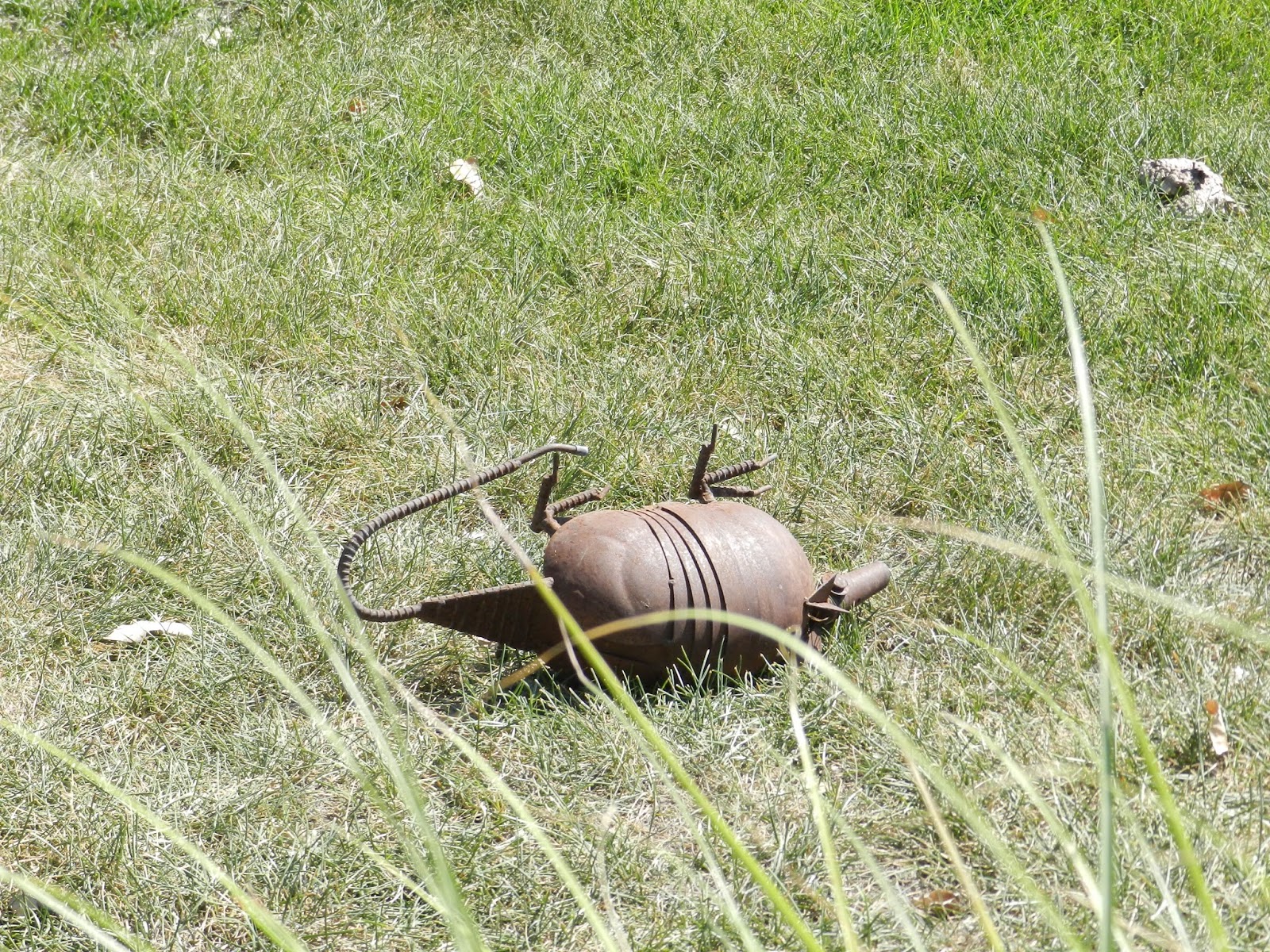
My fearless spouse watched these floating dive-bombers long enough to realize they’d colonized my favorite armadillo sculpture sitting on an old ice cream parlor chair for effect. He knew he’d have to move fast if he wanted to escape unharmed so while I was gone and the dogs were safely in the house, he dashed into trespasser territory and wreaked havoc. 

By the time I returned from work, my rusty armadillo lay on its back in the yard with a jillion little wasp apartments filling its innards. The upended chair rested nearby with a few more insect apartments glued to its underside. A can of hornet spray sat on the picnic table amidst winged carcasses. 

To discourage survivors from returning, my husband dumped the birdbath and water buckets we’d put out to encourage birds to visit. It reminded me that nature seems to frown on simple enjoyment of her pleasant side. If you have a picnic, ants will come. Apparently, if you welcome feathered friends, wasps think they’re invited too. 


Stalking a Hummer


If you watch the news, you’re aware that stalking has a negative meaning. You learn about creepy people who obsess over public figures and lurk in alleys or near back windows to sneak peeks. Possessed photographers trailing Princess Diana contributed to her fatal car accident. Hollywood loves the stalker theme and banks big bucks developing thrillers to keep us on the edge of our seats to discover whether the victim escapes in time.

While each of the previous examples sends a shiver up my spine just thinking about the topic, nature photographers have to borrow stalker skills so they can capture shots that make viewers say, “Wow!” Hiding in a bush, tree, or ghilley suit is sometimes the only way a shutterbug can snap an image of a beast, insect, or bird going about normal business. 

I recently got caught stalking hummingbirds in Meeker, Colorado. During our entire vacation, I wore my camera like a clunky necklace or carried it attached like Edward Scissorhand’s extra appendages. I wanted a picture of a hummer sipping nectar from a real flower, not a plastic bloom. Trying to capture a natural shot like that is much harder than you’d think.

Stopping in the city park so my husband could make phone calls while we had good reception began my adventure. As I waited for him to complete his contacts, I spied a nearby garden of spiky hollyhock stems, planted just west of the men’s restroom. Hummingbirds do love these tropical looking blooms, so I zeroed in on this locale.

Hidden in the front seat of the car, I noted a couple of torpedo shapes with needle beaks weaving in and out of the flowerbed. Not wanting to seem creepy and hang close to the door of the boy’s bathroom, I tried shooting pictures from the west and south sides of the garden. Unfortunately, the light was wrong, and all I collected on my SD card were washed out, blurry images of these summer charmers.

Gradually, I edged around the hollyhock bed ‘til I found just the right rays to capture clear pictures of zipping hummers. Waiting and watching for perfect shots took a toll on my back. To relieve the crick that was developing, I propped myself against the nearest available wall, not thinking about where I was or what someone might think.

For about 20 minutes, repeated camera clicks and whirs made it sound as if I were a National Geographic professional capturing one photo after another of delicate birds and blooms. This was a nice fantasy until a city employee interrupted my reverie and stared at me oddly.

It dawned on me that I was leaning against the boy’s restroom with camera in hand. Stammering with embarrassment, I explained I was shooting hummingbirds with my Nikon. Thank goodness, the man was a hunter and understood the concept of stalking game so he didn’t think I was a weirdo. I did see him walk away, shaking his head and smiling.

After I got home and uploaded my pictures on my computer, I discovered I took better shots than expected. Examining those hummingbird photos thrilled me. I realized I’d caught tiny feet resting on delicate petals, wings whirring in a dizzying blur, and long beaks sipping nectar. 

The results were worth that awkward moment when I saw the maintenance man wondering whether he needed to call in a stalker.


Sunday, August 25, 2013

Efficiency at Its Peak


We’ve enjoyed a lush garden this summer with tall corn, big cabbages, sweet potato vines that should be art, and towering tomato plants. Imagine our horror when we visited the garden one morning to find an interstate of raised trails weaving in and out our plantings. This was my introduction to a live mole.

Frankly, I didn’t know much about these creatures, other than that they don’t have much for eyes. I had no idea that in one night, a six inch mammal could tunnel through long rows of corn, cabbage, tomatoes, and potatoes. If I’d been betting, I’d have told you an army of mole engineers had worn themselves out moving all that earth. I’d have been wrong.

After we discovered our visitor, I did some research. They don’t eat roots, they eat insects—earthworms are a particular favorite menu item.  They are loners. The only time they get together with other moles is in February and March to, well, make other moles. Socialization is very low on their activity list. One source suggested five moles an acre would be a crowd.

Though they are small, a six inch torpedo-shaped mammal, they’re efficient.  As I first observed, these  critters are digging machines.  Their front feet look like miniature ping  pong paddles with Freddie Kruger nails. Apparently the muscles attached to these pink shovels are especially strong as these long nosed critters have a “lateral digging force equivalent to 32 times its body weight.”  An expert explained this compares to a 150 lb. man exerting a 4800 lb. lateral force.That’s some serious earth moving ability.

Not only can these guys tunnel earth at 18 feet per hour, their respiratory systems adapted to their underground existence.  They have twice as much blood and red hemoglobin as another mammal of their size. This enables them to thrive underground in a world with low oxygen and high carbon dioxide ratios.

Since they can’t see so well in their dark world, they don’t have much for eyes. In fact, looking at one, it’s hard to see an resemblance of these orbs that most humans take for granted.  If they can’t see potential food, they have to do something. And they do. Their noses work at optimum capacity, allowing them to smell an earthworm and latch onto it in no time. Their saliva contains a toxin to permit them to paralyze their prey so they can eat it lat their convenience.  As I noted earlier, they are a miniature model of efficiency. 


Knowing more about these dirt throwers gives me a new appreciation for them and their capabilities.  However, I don’t want to see their craftsmanship in my  garden, even if they aren’t eating the roots to my thriving greenery.

Sunday, August 4, 2013

County Fair Time

Sometimes Western Kansans get so caught up in getting through a day or the week, they forget something special occurs toward the end of summer. Those unique events are area fairs, which began a few weeks ago and wrap up over the next few weeks. They provide opportunities to socialize, eat good food while supporting local organizations, and explore 4-H and open class entries in categories from fashion review to animal showmanship. It’s a time for kids and adults to showcase favorite projects.

Growing up in a city, I didn’t participate in 4-H adventures.  However, during visits to my grandparents in SW Kansas, I’d see friends racing to complete sewing, cooking, and animal projects to submit before the entry deadline. This wannabe country girl loved watching farm buddies give calves, pigs, and sheep spa treatments as they trimmed, sheared, shampooed, blow dried, and combed out hair before polishing newly trimmed hooves. 

I loved when my summer visit overlapped the start of the Meade County Fair so I could wander up and down the exhibit aisles.  I longed to be a rural kid so I too could enter a freshly scrubbed critter or a platter of exactly- the-same-size-cookies made from a favorite family recipe.  Jealousy nearly ate my heart when friends would authoritatively state they had to clean a stall or groom their show animal. Though I laugh at my response now, those chores seemed exotic and grown-up to this gal.

Years later, after I became a Kansas country mother, my husband and I encouraged our daughters to raise 4-H sheep. The girls worked with a  handicap since neither parent had been childhood club members, but we muddled through building pens, buying feed, perfecting morning and evening walks down section roads to make well-muscled lambs.

We learned sheep don’t like to be alone, so we convinced our more reluctant daughter to join the fun with a lamb of her own.  I loved seeing my young Bo-Peeps in their nighties and wild bed hair as they paraded their flock of two up and down the long drive in the early morning coolness.

Fellow club members and their parents walked us through the list of preparations to get our daughters’ lambs to the fair. First we had to shampoo the critters. It’s only logical that you’d wash fleece with Woolite for the best effect, right? One young man brought his sheers to the house and showed us how to trim wiry wool into a lovely do.  Then he explained how to polish sharp little hooves to a dark shine.

The cleanliness ritual became fair fun as youngsters from various clubs took turns spritzing hot creatures on scorching August days and then drying and brushing their coats til they gleamed.  Not only were animals soaked, giggling big and little kids wandered about sporting drenched hair and t-shirts. 

While the rearing and preparation of the animal for judging was mostly fun, show time is all seriousness.  Club mentors coached our girls’ clothing selection as well as their interactions with judges, including possible questions they might ask.  On top of these stresses, most of these events occurred when the thermometer was well-over 100. These kids and their animals had to maintain composure in a furnace.


For our family, fair time was mostly about finishing projects and enjoying the experience.  The girls never won coveted ribbons. However, each has a slew of stories about this summer  ritual to tell their children.

Sunday, July 28, 2013

Insects Inspire Designers


Time for confession: I’m a female missing the fashion gene. While I love creativity, I prefer to wear plain jeans and t-shirts. Ironically, I sometimes watch What Not to Wear, but I’d drive Stacy and Clinton insane. I don’t always like the designs and patterns they convince the person-in-need- of-improvement to buy. Although I don’t always like the styles these fashionistas promote, I love interesting looking insects.

Since I began lugging a camera everywhere I go, I’m on the lookout for photographic subjects. I’ve snapped pics of squirrels and bunnies on morning walks until I have a full folder. I wanted something different--something fun to manipulate with editing software. My mom always said be careful what you ask for, which might be true in this case. I began noticing bugs--not just common creatures, but fantastic special-effects quality insects. Not only did I spot them, but also they let me take photos from various angles so I could use software to play with their appearance. 

Squirrels and bunnies are cute, but it’s hard to make their pictures unique. They’re good for an aw, how cute, and that’s it. Insects, on the other hand, have interesting parts.  Sometimes their wings constructions rival the windows in majestic European cathedrals. In addition, their mouths and antennae are often complex enough to crop into interesting compositions that  display only that body part.

After paying close attention to these overlooked critters that share my neighbhorhood, I’m certain their coloration and design configurations would delight the WNTW duo. They’d be over the moon when they saw the striking black on white of a cottonwood borer. If they looked at this creature under a microscope to note the white was actually fine hair, they’d want to reproduce the positive/negative relationship as well as the texture into a garment one of their clients would model. I can see Stacy capturing the sheen of the legs and antenna in a stylish handbag or fashion boot.

Dragonflies might also inspire creativity in New York’s garment district. First, using the array of jewel-tones on these insects would brighten clothing racks in every national clothing chain. Even I would buy dragonfly blue or ruby-hued shirts to top my denims. Recently, a coral, cream, and brown species skimmed ahead of me. As I watched it dance lightly above waving brome grass, I imagined buying sheets and a comforter capturing those warm colors.

A cicada isn’t as delicate or lovely as a dragonfly, but it’s worth examining closely. With unaided vision, I saw only dull green and black. However, its intricate wings looked like fine leaded glass. When I magnified my picture, hints of crimson, topaz, emerald, and sapphire emerged, making a bejeweled Hollywood monster. Tiffany glass manufacturers would   gladly claim the wings.


Forget buying current fabric designs. After seeing what some of the bugs in my neighborhood wear, I know they’d make the staff of What Not to Wear do a happy dance. Even I’d go shopping for more stylish duds. 

Sunday, July 14, 2013

Fireflies Looking for Love


            A hip-jutting, bold-shouldered posture made famous by actor James Dean, a flick of a hand through hair, extended eye contact, and a lingering second glance suggest a human’s interest in romance. Researchers have written entire books about body language people use when they want to hook up.
Not surprisingly, other species’ signals read just as obviously. In this region, we watch the spring strut where male turkeys fan tails and rattle feathers to attract hens. In a few remote locales, you might spy a prairie chicken dancing and booming to catch the eye and ear of his ladylove. Sitting outside on a summer eve, you hear nearby frogs trilling and croaking love songs to woo female amphibians.
On warm June and July nights, love is everywhere, even in the fireflies flitting about my backyard. Recently, I discovered these insects’ blinkers flash in search of romance. These light--then dark--then light beacons that enthrall me have everything to do with reproduction and nothing to do with my delight in their strobe effect. A little research helped me understand how fireflies control their lights. 
A scientist mentioned this insect’s ability to glow involves the chemical nitric oxide, which coincidentally helps control human heartbeats and memories. It’s interesting that a chemical that brightens a summer night also has something to do with maintaining brain cells that replay movies of times past. Humans may not glow and flash as fireflies do, but the elemental bond they share with this charming insect plays a critical role in their well-being.
It also intrigued me to learn that the two hundred species of fireflies each have unique signals that differentiate them from another variety of firefly. Using their specifically designed beacons, they attract appropriate mates. This is critical, considering the short time they have to find a partner.
While I’ve enjoyed fireflies for years, I didn’t realize their nightly Morse code involved propagation of their species. Those tiny flickers are nature’s way to make sure my favorite summertime insect continues to exist. In addition to discovering fireflies use their flashers to look for love, I also learned they spend two years in a larval state. In contrast to this long incubation, they exist for only two weeks in their beetle/firefly stage. It’s during this short period that they mate and lay eggs, according to a Tufts University study.
 Two weeks is not much time to start a family. Finding this out makes me feel guilty for the years I collected fireflies in glass jars to admire in a dark bedroom and for the summers I allowed our daughters to enjoy this childhood ritual. Though we released our insects the following morning, we reduced their baby making opportunities. 
This information has created a new resolve at this house. Those glowing bugs can have their whole beetle stage to find love and make more nighttime wonders. From now on, I won’t interfere in their romances. However, knowing these facts makes me feel like I invade their privacy when I watch their summer light shows.


Wednesday, September 12, 2012

How Many Critters Are Under That Tree?


All eyes in the stands focused on a bright yellow Volkswagen parked in the center of the Big top.  Both doors opened simultaneously, allowing two clowns wearing towering top hats and oversized, floppy shoes  to step into the spotlight.  Then two more clowns in bright, outsized  attire squeezed out, and then two more and two more and two more  like an out of control tube of toothpaste until there were 12 clowns crowding around that little  VW.  If those weren’t enough to dazzle the crowd, two more popped out. 

According to the internet, the actual record for clowns packed in an original Volkswagen is 17.  The circus I attended only had 14.  That feat generated a five minute round of applause and loud whistles that sent one little girl home wondering how 14 clowns packed themselves into that itty-bitty car.

I haven’t been so amazed by such an accomplishment until this summer.  Because of scorching heat, cattle and wildlife were desperate  for shade.  I marveled at how many large cows and little calves could pack themselves under a tiny cedar tree in the east pasture.  Several good sized cedars punctuate that plot, driving the herd  to divide into smaller groups to ooze into every inch of cool shadow thrown by those young trees.  The only things missing from the clown show I loved were floppy shoes and stove pipe hats.
It wasn’t only cattle seeking a cool place under a tree or next to a shed.  When we drove through Wyoming in late June, it was very warm.  We saw antelope lining up  single -file to rest in the lone shadow cast by a power pole.  Other practical pronghorns gathered near snow fences, maximizing those slender strips of shade.

We passed by one sun-drenched homestead where a  wobbly, old barn cast a dark silhouette.  A mule deer sporting a trophy rack crowded its massive body into anorexic dimness.  He had to turn his head sideways and rest his antlers against the rickety building to cool himself.  He probably would have gladly traded that magnificent crown for something much smaller to achieve a more comfortable position.

Back home, my chickens scratched out holes under the skinniest of branches.  Because these birds needed to let a breeze pass, they struggled to stay in these dim hideouts.  I watched them tuck themselves into the tiniest form possible while still extending their wings to capture passing drafts.
A juvenile squirrel braved proximity  to the house  and dogs so he could flatten his body into mud beneath the bird bath.  I’d watch the little guy panting in that tiny ribbon of relief and want to invite him into the air-conditioned house. 

The dilemma was that if I invited him in, I’d have to invite those panting cows and miserable deer.  Then the question would become, “How many critters would fit into my house?”  I didn’t want to find out.

Monday, August 6, 2012

Watering Holes Cool Local Critters


When public pools were first built during the WPA years, I am sure naysayers complained about  wasting water and effort.  However, in heat waves such as we have experienced this year, cool town pools draw young and old like a magnet draws iron filings.   On our hilltop, we’ve created the equivalent of the public pool for our bird residents.

As heat built, wicking away available moisture, we put pans of water in shady places for our chickens.  I expected local birds to visit, but the crowds approach Disney visitor proportions.  These pools are a haven for adult birds parenting just fledged adolescents, which leads to funny scenes at the local “pool.”

Young robins with mottled coloring and spindly bodies remind me of 6th and 7th graders who have reached adult height but haven’t filled out. Their parents come to drink and groom circumspectly.  The young come for a drink and end up splashing half the water out of the container. 

Orioles behave more cautiously regardless of their age.  Mature birds and adolescents come to the water alert and prepared to flee at the least disturbance.  When young robins join them, the bright orioles leave immediately. House finches and sparrows also tend to be businesslike in their drinking habits, focusing on the drink and skipping frivolity.

A flicker youngster and its mother refreshed themselves yesterday and discovered tasty insects in a nearby elm.  Watching mom teach her baby to search bark and pick out insects consumed at least 15 minutes of my morning. 

Mom successfully pecked gourmet delights out of the rough bark. However, her offspring hunted without victory until the mother regurgitated insect chunks into its wide open beak.  I imagine she will be glad when that full-size child finds its own dinner.

Raucous blue jays are a rowdy bunch at the water.  They never come one or two at a time.  A gang follows soon after the first jay lands on the dish’s edge.  It’s the equivalent of  neighborhood kids agreeing to meet at the pool at the same time.  Once the troublemakers arrive, even the chickens back off. 

These pretty but noisy birds are the equivalent of bullies who push and dunk everyone else.  By the time they finish splashing around, I have to rinse feathers out of the remaining water.

Ironically, one little visitor challenges the blue jays to the water.  We have a juvenile squirrel who sunbathes by the water pans.  He doesn’t mind the other creatures who come in to drink as long as the family dog is inside the house.

No matter how wild and crazy  the robins and jays splash, that little squirrel lays outside the dish, preening like he’s in the shower.  In between bird visits, he pulls himself up on the pan’s lip to slurp a good drink.

While the water dishes aren’t permanent like a WPA pool, they serve the same purpose in providing refreshment to the neighborhood.  The lady watching from inside an air-conditioned house gets plenty of entertainment as well.

Sunday, August 5, 2012

One Determined Turtle Looking for Nirvana


Walking at the local track in the cooler hours of morning, I see what one would expect to see: robins splashing in a sprinkler fountain, doves cooing from overhead lines, and clouds of newly hatched gnats hovering face high.  One morning, however, something unexpected distracted my exercise mission.

While my husband jogs, runs, sprints, and walks at a snappy pace, I maintain a steady four minute mile, quarter after quarter.  It’s fast enough to make me sweat, but it doesn’t make me dread working out.  It’s also slow enough I can notice who is driving by, which dogs are barking down the street, and the cool temp antics of  hungry  birds.  This particular morning, I noticed an intruder in lane six when I was 100 yards away.

When I first saw the larger than a hockey puck, shell toting critter ahead of me, I assumed it was an ornate box turtle.  We see plenty of them in our region, and it isn’t unusual to find them high and dry on road ways or trails.  Due to the extended dry spell, I have seen more and more Kansas state reptiles traveling to look for better living conditions. When I passed this determined fellow, it’s distinctive shell and coloring informed me it wasn’t what I thought it was. 

By the time, I’d finished a second lap, my slow-moving companion had cruised as far as lane four.  I’d have to catch my husband when he passed to get an accurate identification of this out-of-place reptile.  It looked more like a water turtle than a land dwelling tortoise.

My spouse slowed long enough to tell me it was a slider, which meant it usually called a muddy creek bank  or water-side log home.  Unfortunately for that traveler, the nearest creek and creek bank consisted of dried earth scabbing and peeling like someone with week-old road rash.

I realized this far-from-home visitor was looking for the nearest damp spot,  which was the sprinkled grass on the football field.  I gained new respect for turtle noses or hearing if this guy could smell  or hear water splashing onto manicured turf all the way from Big Creek.  It also gave me more respect for turtle stamina since this slow-moving, shell-lugging creature had navigated its way up hill, across a rocky drive, under a fence, and onto the track.  No wonder Aesop let the tortoise win in the “Tortoise and the Hare” fable.

As I continued circling the track, this little ninja continued its journey across every lane on the track and crawled into the end zone.  By the time I finished my three-mile walk, the green home-toter was at a damp 10 yard line heading for turtle nirvana under a splashing sprinkler.  I could imagine a Friday night crowd cheering him on.

Every time I go to the track, I look for a pancake-size lump creeping across the football field.  If it is occupying the twenty-yard line, it’s going to get the surprise of its life when practice begins.


Saturday, August 4, 2012

The Smartest Toads Live Here


            While my sixth grade classmates loved listening to our teacher read Wind in the Willows, I found it silly.  Toads talking and acting like people, no way.  This attitude toward anthropomorphic creatures was a childhood peeve.  I wanted critters natural. 

            To this day, I find stories with talking animals silly.  Despite this curmudgeonly attitude toward this genre, I do like toads. Fortunately, this summer has provided daily opportunities to observe a pair of toads residing in our patio planters.

            Looking at a toad, you wouldn’t think it overly bright, but these two must lead their class based on their behaviors.

            Before summer officially arrived, these fellows demonstrated their smarts.  Our little section of parched prairie made growing anything a challenge.  Instead of investing in a big flowerbed, I decided a few well-chosen pots with bright blooms would make it seem like summer even if I couldn’t justify the water needed to grow a lush flower garden. Those green gents determined which pots stayed cool and damp longest and moved in.  Initially, they lived separately, one in my mixed bloom bucket and the other in a geranium pot. 

As May days lengthened and warmed, the geranium toad must have checked out the mixed bloom pot because next thing I knew, I had two toads coming up for air out of the same hole when I watered.  Their toad hole was deep enough that one could rest on the other’s head and still leave the top toad covered in potting soil to his bulging eyeballs.

For a while they seemed content in the mixed bloom pot, but as it grew hotter and drier, both toads abandoned that pot for my herb garden.  I guess it was insulated a little better.  Watering time became an adventure.  I never knew exactly where I would find my garden buddies.

In addition to relishing comfortable living conditions, these guys exhibited the signs of a healthy appetite.  They are wider and longer than my palm--a result of their canny culinary skills. 
While other toads in our yard gather nightly under the yard light, these amphibians discovered the patio light draws insects equally well and  is not nearly so long a journey.  Intelligently, they waited until the cool of evening before emerging over the lip of their home one amphibian limb at a time.  Then they let the porch light work its magic. 

One night, I interrupted their fashionably late supper.  Both toads had rooted themselves directly under bright beams, gobbling beetle after beetle as insects dropped to the patio.

 While I watched, these big boys didn’t move more than a couple of inches as they went through a twelve-course meal’s equivalent.  I wish I had watched long enough to see them lug distended, white bellies back into the flower pot I found them in the next morning.

As much fun as I have had this summer watching my two patio toads, I may need to give Wind in the Willows another try.  Obviously, there is more to that story than I caught back in sixth grade.

Wednesday, August 1, 2012

Assistant Pollinator


Watching bees and butterflies with their hairy legs clothed in gold pollen pantaloons as they buzz my garden fascinates me. While I do not want to let my leg hairs grow until they can collect yellow nodules of plant magic, I have joined the effort to pollinate my tomato blooms.

Last year, I optimistically planted 15 tomato and 12 pepper plants in our raised-bed garden. In the early, hopeful part of summer, I anticipated making quarts and quarts of salsa to fill empty pantry shelves to bulging. Sadly, I harvested 15 tomatoes the whole summer. The heat decimated my garden, leaving my jars and pantry empty.

This year, I risked early frost to plant six  carefully selected tomato plants as well as two pepper plants in early April  To further guarantee more than a 15 tomato harvest, I planted three rows of flowers—one each of zinnias, cosmos, and bachelor buttons—to encourage more bees and butterflies to visit my prairie oasis.

So far, my efforts have been fruitful. We have harvested dozens of tomatoes with more on the vine. The dilemma is the heat. It tends to prevent pollination and thus, a ongoing crop.
I have read about heat’s effect on tomato development. However, I have not determined whether it is a result of heat affecting developing tomatoes or the temperature’s effect on insects that fertilize blossoms.

To determine the solution, I decided to play pollinator. No, I didn’t let my leg hairs grow to collect pollen to transfer from one blossom to another. I robbed my watercolor box of its paintbrush. 
With watercolor brush in hand, I visit my garden in dawn’s cool temperatures. Moving from bloom to bloom, I tickle stamens and pistils of tomato blossoms to assist resident pollinators. I also give the blossoms a little vibrating shake to trick them into thinking I am a great big bee or butterfly doing its job.

My big dilemma is that I cannot tell if the reason I have more tomatoes is that I planted rows of flowers to attract more insects to my garden or if it is because I use a paintbrush to transfer pollen from one plant to another. 

I do know that it is as hot day and night this summer as last, so something I am doing has made a difference in tomato production. We have harvested enough ripe fruit to make fresh salsa, tomato soup, BLT’s, along with a dessert of salted and peppered sliced tomatoes.
My hope is that six tomato plants will produce enough fruit to can a dozen jars of salsa. More than that is an overflow of blessings.

Regardless of whether an insect or paintbrush filament is pollinating my six plants this, tomatoes dangle from vines like green Christmas balls. That beats the heck out of 15 lovely plants producing nothing but green leaves and tomato worms.