Sunday, March 23, 2014

Who Decided to Switch the Clock?


I don’t know about you, but my system is still re-calibrating to Daylight Saving Time. You’d think with more than a half century to get used to my internal clock resetting two times a year that this semi-annual switch would go smoothly. Nope, the older I get, the more my carcass resents folks in high places not understanding that you can’t cut off one end of a blanket, sew it to the top, and say it’s longer. Not only do those in power mess with where you put this amputated hour, they all too frequently legislate change regarding when that reattachment takes place. It’s no wonder heart attack statistics increase in the days following this time shift.

Once I began researching DST I am more traumatized. I discovered I’ve been saying it incorrectly.  I thought it was called Daylight Savings Time, but, no—it’s Daylight Saving Time.  No second S. Some countries simply call it Summer Time.

Several informational sites credit Ben Franklin with DSTs existence, making participation seem patriotic. In reality, he was long in the grave before anyone actually adjusted a clock. This business began in England prior to WWI. Once hostilities occurred, Parliament enacted British Summer Time in 1916. Hoping to save energy here as well, America followed suit for seven months in 1918 and 1919. Due to lack of support for the time shift, lawmakers retracted it.

Time-pieces and humans ticked along satisfactorily until America once again went to war in 1942. Congress determined that this change would save energy to support the war effort so it was reenacted from February 9th of ‘42 to September 30th  of ‘45. After this date, states and localities adjusted clocks as they wished. If I’m cranky now, I can’t imagine what that did to people dependent on train and bus schedules. How would you be sure to arrive at a meeting on time?

I guess it was okay for individuals to miss schedules, but once TV and radio stations mainstreamed into American life, federal legislation regarding a consistent time change followed. The Uniform Time Act of 1966 ended confusion by starting DST on the last Sunday of April and ending it the last Sunday in October.  Except for Hawaii and Arizona, the rest of the nation jumped on that bandwagon.

Until the energy crisis of the 70s, those dates remained stable. Some of us remember the burble called the Arab Energy Embargo where we experienced eight months of Daylight Saving Time in ‘74 and ten in ‘75. While many believe agricultural interests support DST, lobbying by farm states and others returned it to End-of-April/End-of-October status.

Americans enjoyed predictability until 1986 when President Reagan signed into law PL 99-359. This act changed the beginning of DST to the first Sunday in April. It’s ending date remained the same. Nearly twenty years later, Congress passed the Energy Policy Act of 2005, which, starting in 2007,altered the beginning date to the current second Sunday in March and extended its run to the first Sunday in November.

Interestingly, medical studies reveal a number of concerns regarding this cha-cha with the clock. With each change, heart attacks and accidents increase. Classroom and work productivity decrease. Humorist Dave Barry gets cranky. And so do I.

I’m for punchin’ the same clock that Arizona and Hawaii do. I want time out of Congress’s hands.


Saturday, March 15, 2014

Sore Hands No More


Frigid temperatures do more than raise the gas bill. Cold, frosty days redden and roughen flesh, leading to splitting skin on fingers and hands that hurts as bad as or worse than a paper cut. No matter how much girly girl lotion and cream I applied in January and early February, I couldn’t smooth out either the hangnails that snagged on bulky sweaters and hoodies or soothe away those painful, weather-induced wounds that formed at the edges of my finger and thumbnails and over the tops of knuckles.

I suspect that even if I never left my house during frigid temperatures, the effects of the furnace on my skin would lead to some discomfort. However, I was going outside and coming in several times each day while washing up at least once an hour to discourage flu and cold germs. This combination is a prescription for hamburger hands.

In desperation to ease the increasing pain, I used tried and true remedies that had worked in the past—even sleeping with cotton socks over grease-coated hands and buying dish soap guaranteed to heal raw skin. None of the products worked, and they depleted my bank account as I attempted to halt this attack on my body.

A fellow employee saw me gently massaging lotion into my irritated flesh and told me to avoid products containing petroleum products. She explained those unguents felt soothing when first applied, but they actually dried out skin. That explained why even though I’d just bought a brand new tube of something in that merchandise line a few days before, my hands were now bleeding. No wonder my almost raw digits weren’t improving.

I hadn’t found a cure, and the splits in my hands and fingers grew more painful by the minute. Unexpectedly, during a trip to get my mom some cold medicine, I spied a new product at a local drugstore. The sign above the display case promoted that it healed working hands that crack and split. Just what I needed. As a teacher, I hadn’t considered myself as a person with working hands since most of my labor takes place inside cozy buildings. However, my hands sure acted as if they were an outdoor laborer’s appendages.

When I asked the clerk about this ointment, she said farmers and road crew workers were coming in droves to buy it. After hearing this testimonial, I was sure I’d found the cure to my dry, cracked, bleeding hands. 

Sure enough, the ingredient list didn’t contain petroleum. Glycerin, water, and a whole bunch of words I can’t pronounce but didn’t have to do with the banned item filled up the component list. It didn’t smell, it wasn’t gooey, and it most importantly, it worked. Within a couple of days, craters that kept widening and growing tender to the point they awakened me from sleep began to disappear. Within five days, I could barely remember why I’d whined so much.

The lesson here is don’t go to the beauty product aisle when you’re dealing with outdoor hands. Hit the feed store or the place local farmers shop. These folks know what cures winter-roughened hands.


Sunday, March 9, 2014

Secrets Leafless Trees Share


One of my favorite features of winter is being able to see bird nests in leafless trees. I like to figure out what species lives in a particular area so I can look for it when days lengthen, temps warm, and foliage hides those cobbled together nurseries.

Last winter, I spied a huge nest in a lone tree tucked off Highway 9. It was so large, I thought it might belong to an eagle, but my husband quickly let me know our national birds build more ambitious nurseries for their young—maybe big enough to contain a small human. I later saw an actual eagle nest with its family occupying it in Colorado and realized he was right. That still left me wondering what creature hatched its young in this particular locale.

Patience pays off.  I kept my eye on this haphazard collection of branches and twigs throughout the winter. Finally, I spied an occupant—or at least the top of an occupant.

I love to watch the sunrise as I drive to school and pay particular attention to anything silhouetted by that rosy morning glow. Imagine my surprise last week when I spotted two backlit pointed protrusions on either side of a rounded head peeking over the edge of that raggedy, round collection of sticks. I don’t know what creature originally assembled this contraption, but this year, a great horned owl is incubating her clutch of eggs.

Seeing this sight reminded me of a pair of great horned owls that spent much of late January and early February whispering sweet nothings to one another outside the bedroom window of our previous home. Once they’d mated, silence reigned until their eggs hatched in March. Then noise levels increased astronomically as hungry babies competed loudly for the first serving of regurgitated bunnies or other prairie delicacies. After they’d eaten, I’d often fall asleep listening to mom murmuring whooty nursery rhymes to soothe her offspring.

Happy to spot this new owl incubating eggs, I’m hoping the latest cold spell hasn’t put a damper on her nesting inclinations. I’m eager to observe mom and her offspring as days get warmer and the owlets grow big enough to fledge. If I’m lucky, that tree won’t leaf out before I drive by of a morning to see young birds perched on the edge of the nest, flapping wings as they mature.

Considering its location, I wonder if this is the owl or its mate that I saw last fall atop power poles that line that section of road. Usually, the big bird was just a black outline against the sky, but every now and then, I’d see it framed in my headlights as it dove after a rodent racing across the asphalt. 

Who knows how much longer I’ll be able to watch this new family in the making. Until either they fly away or unfurling leaves hide their home, I’ll appreciate this view twice a day, Monday through Friday. Those who say Kansas is boring haven’t discovered the treasures tucked into our landscape.


Sunday, March 2, 2014

Gatherin’ Place


Some people like cities. They like the anonymity of blending into a crowd. They like choosing where to shop, dine, and have fun. Being unknown to a server is a relief rather than a blessing. For these folks, the intimacy of living in a small town where everyone knows your name and your business is too personal. On the other hand, there are people like me who love going into a local eatery where the wait staff knows my name and what I’m going to order. These establishments are the heartbeat of tiny towns.

In the same way that local schools weave together the warp and weft of a community , the local gatherin’ place—coffee shop—hometown restaurant-- links people’s lives like a quilter stitching one block to another or tying the top to the lining. It creates beauty and stability. Comings and goings at the local java stop establish a rhythm that outsiders soon learn so they too can join the club.

Area residents gather before hitting the office, their fields, or pastures. It’s good to down a cup or two of coffee while checking in with neighbors. It’s site for a mid-morning Bible study to gather.  It’s a place the Lions, Rotary, and Kiwanis meet, share a meal, and settle business in the middle of the day. It’s a interlude in a long afternoon.

In a world overtaken by impersonal connections these informal assemblies warm the belly and the heart as individuals look one another in the eye and ask, “What’s going on?” Then they listen. It’s sometimes the first place a person hears that someone needs help and arranges to offer aid. Somehow, it’s more powerful than reading a post on a phone or computer screen.

It’s a good place to hear who’s getting married or who had a baby, even before the preacher announces it from the pulpit or the local paper runs the article. You might find out whose heart is breaking so you can offer a meal or a kind word. People long out of the classroom and off the sporting field keep up with area youngsters’ successes. Some might say it’s gossip. I like to think it's connectedness.

Since I work, I forget how pleasant it is to join a kaffee klatch. This weekend I got  reminded how this daily ritual makes a person feel like he or she belongs. I returned to Ellis to meet a couple of friends for breakfast and a quick catch up. In Hays, we would have been anonymous. In that little town where I lived for thirty-six years, I knew everyone in the café.

A former student came to our table to introduce his little brother and girlfriend, telling them we were his former teachers. A past school board member dropped by to say hey, a neighbor from our newly wed year updated me on her life. It had been decades since we shared the same block, but we cared about what was going on in one another’s lives. It was wonderful to connect with folks who enrich my life.

It was a blessing the way that little visit reminded me that I still belonged even though I have a new address and new place to lift a cup. These little establishments are a hidden pleasure of small town living. Put this stop on your bucket list.


Sunday, February 23, 2014

Slidin’ Through Time--Playground Memories


Recently, I recollected playing on playground swing sets during my early school days. Sometimes other kids beat me to the swings, and the line for a turn was greater than my patience could bear. I’d scamper over to the slide that towered over our asphalt empire and join the folks waiting there. It required more time to climb the ladder than it took to shoot to the scooped out dirt belong the bottom of that old metal treasure, so I knew I’d get a few thrills in before the bell called us back to our seats.

Height and speed loving youngsters dutifully waited their turn to climb that towering slide. If they were lucky, the well-worn metal undulated in the middle, which added a little lift to those jetting down on cotton clad fannies. Other slides were straight shots to the ground and anyone zipping down with legs pressed together to increase speed had to be ready for the sudden landing at the bottom that often propelled them to a gravelly face plant.

Under teacher supervision, we followed the one at a time rule.  After school, on weekends, and during the summer, we learned physics by risking our lives. Someone would walk up the incline while another daredevil whizzed down the slide through legs or had a head on collision. 

That adventurous equipment offered other challenges. How many youngsters could form a train to race down its slick metal? The person serving as the engine had to press both legs hard against the narrow sides to stay in place until everyone was in line. At the bottom, participants landed in a giggling dog pile or sometimes a crying mess if someone landed on someone else’s hand or finger.

One time, only my brother was available to play. I had the brilliant idea to put him in front on the slide and tell him to hang his cowboy booted legs over each side. Before we started down, I put my arms around him and pushed off, anticipating the crash landing at the bottom. Imagine my surprise when he swooped out of my arms and over the side while we were still near the top.

Once at the bottom, I expected to see him Humpty Dumpty-like on the pavement. Instead, I found him hanging upside down with one booted foot caught in the side-stabilizing bar. I tried to reach him to tug him out of his shoe, but this was a tall slide, and I was a little girl. I tried pulling him up from the top but that hurt his ankle too much. Finally, I left him dangling while I dashed to get our parents. Thank goodness, we lived within a block and my dad was able to lift him out of that trap into my mother’s arms. 

To this day, I can’t look at one of those old slides without feeling hot or freezing metal against my back side or seeing  a vision of a little boy in cowboy boots dangling upside down, hollering for help. It’s a wonder my brother ever let me talk him into climbing trees or diving into swimming pools after that adventure.


Sunday, February 16, 2014

Valentine Memories


It’s hard to ignore Valentine promotions. Big box stores dedicate aisles to red and pink candies, stuffed animals, balloons, tableware, and other items most of us don’t need. Flower shops depend on profits generated by lovers sending bouquets to their sweethearts. Card stores tempt us to send our partners expensive cards declaring true love. It’s the February assault on our winter-dulled senses, and we’re all gullible—me included. I love getting posies from my husband.

Despite my adult vulnerability to this over-promoted holiday, kids really know how to celebrate it best. They spend considerable time using construction paper, crayons, and glue to craft personal mailboxes for their friends to fill with corny cards signed in childish scrawl, which are then folded, and tucked into thin envelopes that would never make it through the U.S. mail.

As much as I loved room-mother hosted Halloween and Christmas parties in primary school, the Valentine bash is the one I most anticipated. In the weeks before the event, I hoarded scraps of colored paper, bits of lace or rick-rack, and dug about in drawers hoping I might find some hidden glitter.

The weekend before the big day, I spent in my room, constructing my treasure box. First, I sorted through old shoe-boxes to find one that wasn’t too bashed in from being Barbie or Ken’s race car. It also needed a lid so I could use my tiny scissors to open a Valentine Card size slit.

Once I had the mail opening in a suitable carton, the wrapping challenge began. My mom would help if needed, but she believed children design their own projects, which sometimes led to some interesting corners and edges in the finished product. Until I was a teacher, I couldn’t understand why some of my friend’s containers had such sharp and perfect lines. They’d had a great deal of adult assistance.

Covering the rectangle in red or pink paper was only the beginning. Once I accomplished that, the real fun began. I got to snip around dozens of little embellishments: hearts, lips, dorky cupids, and fluffy clouds. My imagination was the only limit to the possibilities. At that point, I’d never heard of white space in a design, so I went whole-hog in applying my little cutouts everywhere I could dab a glob of glue.

After ornamenting my once plain shoe box, I set it up to dry. I then tackled picking out the prettiest cards for my best friends from the little box of Valentines mom and I selected at the dime store. I had to be sure I didn’t give any too friendly ones to boys with cooties.

 In those days, kids didn’t learn to write their names until kindergarten, so my handwriting still looked an awful lot like chicken scratches in first and second grade. It took a while to sign off on those annual missives to my classmates.

The best part of Valentines was coming home with the now scraggly container filled with little white envelopes. Some of the kids had added a sucker or a candy heart to their notes. I loved sitting on my bed and opening each one. I savored admiring the clever drawings, figuring out the funny sayings printed on each card, and deciphering my class-mates crooked lettering. I’m sure more than once, I fell asleep surrounded by this sweet dream-generating loot. 

My husband might want to save himself some money and send me a dorky little handmade Valentine this year. It would bring back memories of some very good old days.


Sunday, February 9, 2014

Golden Hour in Good Hands


Rapid care in the golden hour after an accident or major health issue such as a stroke or heart attack gives hope to patients and their loved ones. For those of us who live in remote areas, time between when a cardiac incident or traumatic injury occurs and treatment begins depends on how swiftly emergency services arrive on scene. For most of us living on the high plains, that means we depend on neighbor/volunteers during crises.

When 911 systems and dispatchers send that initial page to first-responders, recipients drop what they’re doing to head for either an ambulance or fire station. That first call may wake an EMT or firefighter out of exhausted slumber or buzz as a volunteer is working at the top of a grain elevator. Maybe one of those local heroes is cuddling a grandchild while sharing a favorite storybook. These individuals set aside normal life and switch into lifesaver mode, which allows them to focus on providing the best emergency care possible to increase survival chances for the patient.

In big cities, emergency crews usually aid strangers. That’s not true in small towns like ours. Often the responders know the casualty and his or her family well. Their children play ball together, or they worship in the same church on Sundays. Sometimes they’re even related, which adds an extra poignancy to what they do. I asked a friend who serves as a first-responder if knowing their client causes more concern when they go on an emergency run. He said, “No, the first thought is to get there and help.”

I recall the time our youngest daughter blacked out and turned blue as a toddler. My fingers could barely punch the required 911 into the wall phone. From the moment I reached the dispatcher to the second those whirling lights pulled into our drive, I felt less alone. What a comfort that people I knew provided oxygen and assessed my baby’s condition as they raced her to the emergency room. Their concern and professionalism reassured a frightened little girl and her mother as we sped toward Hays. Later, their calls to make sure our child was okay lent additional support.

This is a difficult job performed under rugged conditions. By the time an ambulance crew arrives on site and begins treatment, it’s still a long way to a trauma center with facilities necessary to care for serious medical situations. These rescuers make snap decisions with minimal resources to care for complicated emergencies that involve friends and loved ones. They understand the feelings of grandparents waiting  at home praying for injured grandchildren. They can contact an accident victim’s loved one without looking it up on a computer. Maybe that person’s number is listed on their own cell phone.

In communities with dwindling populations, we’re fortunate so many sacrifice to receive the necessary training to perform emergency treatment. Once they learn these skills, we’re blessed they wear that pager and respond when it buzzes. It’s good to know that golden hour is in the hands of people with hearts of gold.


Sunday, February 2, 2014

Just a Swingin’

Once upon a long time ago, children played on asphalt or gravel playgrounds filled with tall metal swing sets and finger pinching chains. Those thick links froze little hands November through February and roasted those same palms July through September.

Anyone afraid of heights elected to play foursquare, jacks, jump rope, or cling to red brick walls every recess rather than get in line for a chance to test the laws of gravity. Those swing sets inspired the careers of many an astronaut and future jet pilot as boys and girls escaping wood and metal desks raced to be the first to claim a wooden slat or canvas sling.

 Once on board, wannabe acrobats pushed off and began earnestly pumping jeaned or bare legs to launch themselves into the stratosphere. Little girls wore shorts under their dresses to prevent boys from seeing their underpants as they flew higher and higher. After a swinger achieved peak arc, you’d hear a shrill “Cowabunga” and see a frail body hurtling earthward before they assumed a last second untrained parachute landing fall position.

Wishful watchers stood beyond the contact zone, judging those gravity-defying acts with approving oohs and awes or derisive raspberries. Once that swing was empty, another brave soul got in position for an arms wide, leg-paddling leap toward the sun. Later in sophomore English, the myth about Daedalus defying his father to fly too close to that golden orb made perfect sense when I recalled my primary school playground adventures.

 Swinging high enough to bail and twirling around metal side poles until we were dizzy enough to fall down were the extents of our daring while teachers were on duty. Once school was over and adults left the premises, neighborhood kids gathered to challenge one another to creative and dangerous feats.

More than once, I found myself first pulling and pushing monkey-like until I reached the horizontal support pipe that connected both ends of the swing set. Upon reaching that goal, our rule was to straddle the casing, inch the entire distance across, and slide down the other side, fireman style. It was doubly daring since girls often wore dresses that caught in swing chains or on peeling aluminum paint. I still remember friction burns on the inside of my legs.

I was luckier than some of my friends because I never experienced a bone-breaking fall. A few hard landings unnerved me and chipped a front tooth, but I didn’t require a cast. More than one buddy left school holding an arm chest-close while sobbing in pain. A day or two later, that little daredevil returned,   brandishing bright white plaster that begged for autographs. Though I longed to have everyone crowd round me waiting to write names on my arm, I didn’t want to spend six to eight weeks standing against the wall watching others play.


It’s funny to look back on these adventures. Somehow, over the decades, I’ve lost every ounce of thrill seeker I ever possessed. In fact, standing on chair to dust a ceiling fan causes vertigo. Good thing modern playgrounds aren’t nearly as thrilling as they used to be. I’d hate to rescue grandkids from the top of an old-school swing set.

Sunday, January 26, 2014

Blasting the Winter Blahs


I don’t know about you, but for me, January is the longest, dreariest month of the year. Daylight hasn’t increased enough to improve my outlook on life, it’s cold, and it’s either brown or white. I have to self-talk my way through this 31-day marathon with adages like “spring is around the corner, and days are growing longer.”

If those pep talks don’t inspire me, I resort to a baking spree. That adds to my depression when I realize I have to lose added pounds because I self-medicated my doldrums with a pan of brownies or chocolate chip cookies.

A third low-calorie solution is to take mini-vacations to banish these post-holiday pity parties. You might think that’s expensive or impossible when you work. Nope, this part of Kansas has wonderful and free or inexpensive museums and galleries a short distance from your home. You can clean house, do laundry Saturday morning, and still find time to check out a local historical society or art collection.

A previous Dane G. Hansen Display
Anyone living near Hays can visit the Hays Historical Society, Sternberg Museum, Moss Thorns Gallery on campus, or the Hays Arts Council exhibits. Hays Medical Center and the library also display outstanding art for public viewing.

Stay on I-70 and drive to Russell to investigate the Oil Museum or head west to Wakeeney to learn more about homesteading on the High Plains and then to  Oakley to view the Fick Fossil Collection and the Buffalo Bill Statue. If you have extra time, tour Main Street for a peek at the past and maybe sample an old-fashioned sundae at a real soda fountain.

Those who live north can explore their community stories as well. A trip to Phillipsburg to check out Fort Bissell Museum with its Kingery Gun collection and Rock Island railroad memorabilia housed in the old Glade Depot won’t disappoint locals or visitors. A lively business district invites attention as well. 

The crown jewel in Phillips County is the no-fee Dane G. Hansen museum with its permanent gun and Asian collection and traveling art exhibitions. It’s easy to think we’re too rural to see famous art, but that’s not true in Logan. Several times a year, the small museum hosts exhibits on loan from major institutions, including the Smithsonian.

The current display from Ohio’s Springfield Museum of Art is Associated American Artists by Subscription. Sketches of every day American life by artists including Thomas Hart Benton, John Steuart Curry, Grant Wood, Mabel Dwight, Lawrence Beall Smith, and other early and mid-20th century artists will sweep the winter cobwebs from the corners of your brain. If you want to see this exhibit, hurry to Logan in the next couple of weeks. While you’re in town, tour the charming downtown and the historical society displays.

 If you’re feeling clever, turn one of these mini-escapes into a scavenger hunt or funny photo shoot with inventive backgrounds. It might take extra work, but the memories will be worth it.

Some of us are bound to suffer from winter blues, but we don’t have to give in. With a little effort, we can banish them with dinosaur days, pioneer times, oil boomtowns, or excellent art. Plan a blah-blasting holiday soon. 

Saturday, January 18, 2014

A Dog with a Secret Talent

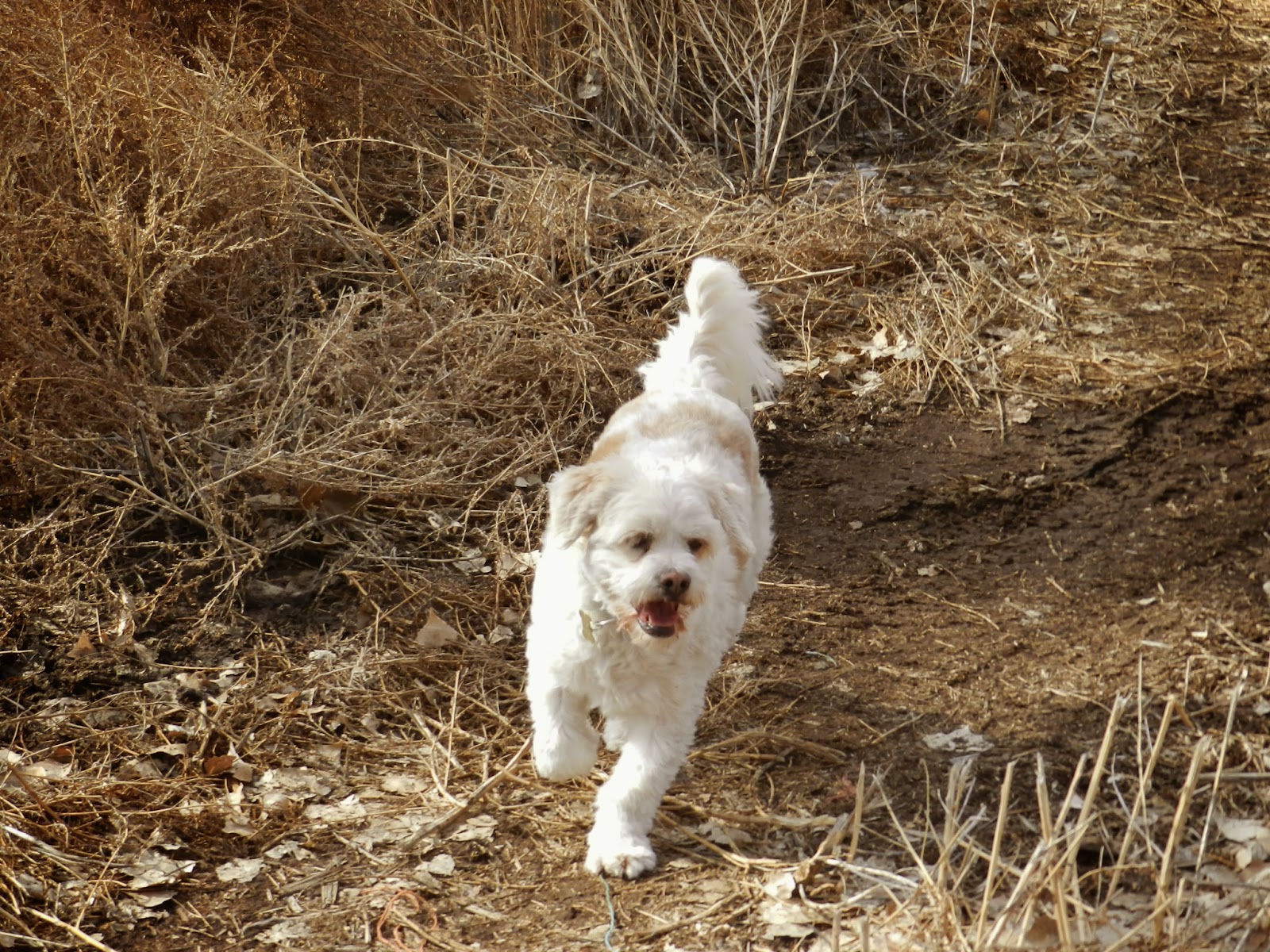
Our last dog came to us as a mature hand-me-down. Our daughter adopted him as a furry, white puppy with appealing eyes. He was small enough to fit in her housecoat pocket. His mom was Shih Tzu and reportedly his dad was Lhasa Apso, so Dudley should have remained tiny and cuddly. Six years later, he weighs 45 pounds and comes to my very tall knee. While he isn’t purse pet material, he’s still lovable.

He ended up at Grandma and Grandpa’s because he didn’t want to share his world with our first born grandchild. Initially, his presence was an act of duty—we couldn’t risk that his growls wouldn’t turn to bites as little Grace learned to crawl and grab soft, curly fur. We also didn’t want our kids to make a tough choice about their beloved pet. Now he’s part of our pack, and we can’t imagine life without him.

Although some of Dudley’s distant ancestors originated in the royal courts of China, he came to us from a farm. Instead of being a pampered pet who spent days warming a lady’s lap, this guy knew outdoors offered premium fun. He understood cattle pens and chicken yards contained interesting critters. What he didn’t understand was hunting.

The moment he joined forces with our Jack Russell, boot camp began. Buster immediately taught Dudley how to find packrat nests and demolish them. The two roamed our property, searching out piles of leaves and sticks and then capturing those vile rodents. While Dudley hadn’t been a barker before, the little terrier made it clear this activity required strident vocalization. We knew when they hit pay dirt by the intensity of their yaps.

In no time, Buster also instructed Dudley in squirrel games. The two dogs would sit at the dining room window spying on a nearby elm. As soon as they saw old Bushytail exploring a branch or using it as a path to the bird feeder, a  race to the back door began.  I’m surprised they didn’t wear a path in the linoleum, considering how often they spotted these visitors.

After we moved, the boys joined my husband every morning as he ventured out on his own hunts. Buster had accompanied him for years, scenting game and alerting his master. Taking him along was a pleasure because he followed commands, waited patiently, and worked in tandem with his human.
 Dudley, on the other hand, didn’t have clue about hunting procedures. He didn’t know how to wait, he ran too far in advance, and he had absolutely no nose. As a result, he constantly piggybacked on Buster’s finds, much to the smaller dog’s disgust.

What Dudley did quickly learn how to do was roll down the passenger window so he could cruise down the road while wind rippled his silky coat. Our terrier had ridden shotgun for years and never messed with the up and down buttons on the door handle. A week of Dudley constantly lowering the glass forced my husband to solve the problem: duct tape over the control panel or leave the fur ball at home.

Apparently, he couldn’t resist those pleading brown eyes as he and Buster hit the road each morning. Now folks who hop in the passenger seat discover they have to ask the driver to roll down the window. 

When they ask, “Kid lock?”

My spouse answers, “Nope, Dudley lock.”

Now that Dudley’s mastered this little trick, we’re optimistic we can teach him to hunt—with Buster’s help, of course.


Sunday, January 12, 2014

Joining the Big Sister Club

People join clubs for different reasons, and sometimes they gain membership because of something someone else did. That’s certainly the case for those initiated into the big sister or brother club. Affiliation with this organization has nothing to do with a child’s intentions. Involvement is totally a result of parental action. 

First off, mom and dad had you before they had another baby. If you’re the eldest in the family, everything was rolling along beautifully until the day your momma took her swollen belly to the hospital. When you finally visited, her tummy had shrunk considerably and there was doll-size creature wrapped in a pink or blue blanket and wearing a tiny stocking cap. It squeaked and mewed like your best friend’s kitten. When it did that, everybody in the room, including your momma, paid immediate attention. What was this thing that drew everyone’s eyes like a magnet draws iron filings?

Did it have anything to do with the new t-shirt you wore that said, “I’m a big sister”? Could you trade that interloper for the puppy you really wanted? Could Mom and Dad leave that bundle at the hospital and take you home so everything could go back to normal?

For all of us who have younger siblings, entry into that elite organization changed our lives forever. In an instant, we were no longer the center of our parents’ lives. Suddenly, we had to share attention, toys, snacks, beds, and more. Routines we’d come to count on changed overnight. Mommy and Daddy didn’t have as much time to color or play games. Mommy’s lap was now a shared haven, not a private outpost.

That word share became the mantra over the next months. Toys and cups that used to be just ours suddenly were now community property. That baby had a stake in our stuff.

After my brother was born, I discovered I not only had to share toys and parents, but depending on where we lived, I sometimes had to share a room. As we got older, we drew imaginary lines across the floor to designate one another’s territory. Supposedly, we couldn’t trespass, but you know how that goes when siblings aren’t in sight. Both of us invaded foreign  space to play with one another’s  games, dolls, and trucks.

For a toddler, learning  to share is a tough lesson. It took years before I decided my sibling was a blessing. Now, I can’t imagine life without him.

He’s the only one who knows what it was like to move and make new friends often. He’s the only one who shares memories of our secret hiding places. He’s the only one who recalls me coaching him to jump from a swing at its highest arc and the resultant crash landing. I can mention long vanished places, friends, and loved ones, and he relates immediately without any explanation. He understands joys and grief connected to our early years that my husband can’t.


Our granddaughter is still confused to find her mom and dad’s arms occupied by someone else. Looking back on my entry into the big sister club, I advise her to give it a few months or maybe even years. Over time, she’ll realize brother is way more fun than any puppy could be.

Sunday, January 5, 2014

Gabbles from Gooseland

When I was a kid, I lived 11 miles from Disneyland. I took for granted that I’d visit the happiest place on earth several times a year. And I did. Due to immaturity, I didn’t understand why my out of state cousins were so excited to visit Southern California and the Magic Kingdom. They were giddy about meeting Mickey and exploring Adventureland, and their enthusiasm for something so commonplace as Disneyland escaped me. After all, it was just a big amusement park with a bunch of costumed characters walking around waving at folks.

If I’m not attentive, it’s easy to have that same take-it-for-granted-attitude about living in the Central Flyway. The CF is a place where those in the know can observe a wealth of bird species that are either migrating through or live here. Those of us who live in mid and western Kansas have opportunities to enjoy birding and bird hunting that few share. Most of the time, we don’t have to travel much distance in order to add another species to our birding list or to bag our limit of geese, duck, or teal. A step out our doors and we are in Gooseland.

This time of year, it’s necessary to go outside to enjoy the gabbling coming from south of the house. I’m not throwing open the windows in these icy temperatures in order  to hear thousands of snow and Canada geese that hang out near our water treatment lagoons  and sound like a stadium full of cheering fans. I’m sure the designer of these ponds had no idea how perfectly suited these water holes are to host multitudes of honking birds, but if they had intended to lure geese close to town, they couldn’t have planned better.

Not only is my neighborhood home to scores of winged, web-footed creatures, but so is Ellis. For decades, the city lake has drawn hordes of Canadas into town. Some of these long-necked critters walk around the community looking as though they wonder why all these humans and their houses and vehicles are in the way. Sometimes, they’re downright unfriendly in the way they honk and peck at their human neighbors. These actions end up getting them transported to a less populated neighborhood…or into a roasting pan.

Not all geese want to land so near to human beings. During my long drive home from school, I frequently see several thousand birds settling into either stubble or green wheat fields for their evening roost. When this many snow geese land in the same place, it’s easy to see how they got their name. Packed in tight, they look like a wintry landscape that happens to move. They might be able to use their deceptive camouflage except they can’t be quiet. When I stop to watch them, I can hear their nattering even before I roll the window down.

When I rode into the countryside with my husband the other day, he pointed out geese far in the distance. Initially, I didn’t see what he was directing me to see. I thought I was looking at corn stalks rising from prairie soil. After zooming in with my telephoto lens, I realized what I thought were upright canes were actually geese craning their necks to look my way. They wanted to see what was in the distance every bit as much as I wanted to examine them.

My spouse told me to keep my eyes peeled because I might see some eagles as well. A pair of them were ranging the area, probably hoping to feast on goose stragglers. That would have been a real bonus if I’d gotten to photograph an eagle along with the honkers. I was reminded again of how lucky we are to live amongst such amazing bird diversity.

I hope I always remember how fortunate I am to call the Central Flyway home. I’m glad I traded Gooseland for Disneyland every time I see those Vs needling across the blue horizon or hear their raucous cries.


Sunday, December 22, 2013

Basking in the Glow

Lovers of sun light, rejoice. Soon, the winter solstice will pass for another year. Even though days grow longer only a few minutes at a time, we’ll soon enjoy more sunshine than darkness in a 24-hour span. Unfortunately, it takes a month or so of incremental minutes before longer days are noticeable, so until then let’s bask in the glow of Christmas lights.

For those who call North Central and Northwest Kansas home, residents can thank small town leaders for honoring this season with festive street decorations. Depending on the size of the village, those lights can be an illuminated bell, wreath, or star on each Main Street light post. A central focus like a giant Christmas tree or manger scene accents the center of some communities.

Bogue, Wakeeney, and Phillipsburg have Christmas trees in the middle of Main Street. In the first two, the big decoration is literally in the middle of an intersection. Anyone cruising main gets the full effect of driving past a triangle of lights. In Phillipsburg, that huge tree is actually on the courthouse square, but it’s so large, it brightens the entire block. In addition to these cheerful centerpieces, smaller decorations add festive flair to the central drag. If you drove downtown in a grumpy mood, you’d leave smiling after seeing the pretty lights.

Once you exit the Interstate in Ellis, illuminated poles guide folks home or to the center of town where a lovely manger scene appears among festively draped trees and bushes on the old green. After you reach this peaceful park, it’s easy to forget you’re in the middle of flyover country. It seems more like Mayberry USA.

After dark, Christmas lighting adds even more charm to Damar’s quaint French village-style main street. Once dusk falls, it’s hard to remember you’re in Kansas when you look south at the silhouette of a French style cathedral spire or read French words painted on the sides of tiny shoppes.

Further north on Highway 9, the tiny burg of Edmond electrifies and wreathes its city park. Coming into town from either direction after dark is an aha moment when you realize you don’t need much population to string lights and hang greenery. It’s a pleasant surprise on a lonely road.

Fifteen miles east down the same road, you run into Logan. Bright bulbs zigzag up Main Street, linking one radiantly decorated light pole to another. Residents add their own touches that add warmth to cold December nights. It’s clear this is a special time of year in this town.

Fifteen miles later, you hit Glade and spy all four Christmas stars brightening the quadrants of the main drag before you leave town. If you stay on 9, Kirwin’s colorfully lit old town square would charm even Scrooge.

No matter what direction you drive across the prairie, you’ll find Christmas alive and well in towns big and small. Residents ante up the change to both buy the bright decor and to pay for extra kilowatts used this time of year. 

Yes, prairie folks are antsy for longer days, but we know how to do a little brightening of our own until Mother Nature turns the light on.


Saturday, December 14, 2013

December Needs Another Holiday


I know some of you might think heavens no; December doesn’t need another holiday. After all, it has Christmas and New Year’s Eve, but for those of us living in deer country, we need to make opening day of firearms deer season the kind of holiday that frees kids from school and employees from a day of work.  Even for people who don’t hunt, there are advantages.

For those families that put meat on the table the old-fashioned way, the first Wednesday in December is a red-letter day on the calendar. This date signals the opportunity for every licensed hunter in the house to provide pure, unadulterated protein for the family. Diners who eat venison harvested in the wild don’t have to worry about growth hormones or antibiotics leaching into their systems through the meat they consume. Protein in this form is also low in fat so it’s better for folks whose docs have told them to cut back on marbled beef.

Family hunts build bonds between spouses and among parents and children. Spending time on a frosty morning waiting to see a nice buck or fat doe come by creates memories and stories that liven up family gatherings for decades down the road. The meat in the freezer may be long gone, but tales of difficult shots or of recovering a deer from a field far from the road make great fireside tales year after year.

Not only are these times to create family legends, they are also moments to teach patience and respect for nature. Youngsters too young to carry a gun can learn to sit quietly waiting for game to come in range. Every hunt provides a wealth of lessons about the outdoors from studying wind patterns to discovering how still you can be when a skunk wanders near your hiding spot.

Once a successful hunt is over, family bonding and learning continue as youngsters help prepare the carcass for butchering. Much of my understanding of anatomy occurred as I helped either my dad or my husband cut up a deer. Helping field dress a fresh carcass made high school biology dissections look easy. These experiences have made me appreciate my source of meat so much more than buying a shrink-wrapped package in a grocery store.

For non-hunters and vegetarians, reducing deer populations through controlled harvests make driving down roads safer. In addition, managing populations is better for the herd health. Too many deer in an area not only makes driving dangerous, it also means more depredation on crops and native plants. A pitiful sight for any who have experienced is a sick herd. In regions where residents discourage hunting, disease whittles populations in a season or two.  

While the idea of an official holiday is tongue in cheek, I do love to hear stories of families that make this day and the rest of the season an annual event. Not only do these folks reduce deer populations that make driving to work a game of real life pinball with the car as the flicker and the deer as the puck, but they also strengthen family bonds, provide healthy protein for meals, and teach respect for nature.


Sunday, December 8, 2013

Christmas Magic


As a little girl, I loved reading old-time stories about Yuletide. One of the traditions mentioned in those favorite tales was that after parents put little ones to bed the night before Christmas, they’d  go to work making magic in what had been a simple family room. When boys and girls awakened in the morning, they’d tiptoe downstairs to find the parlor softly lit by candles clipped to evergreen branches.

My childhood family didn’t decorate for Christmas on the day after Thanksgiving, but our folks didn’t make my brother and me wait until Christmas morning to enjoy the soft glow of a string of bright lights wrapped around our Christmas tree. While I was glad we spent those extra days wandering around a semi-dark house lit only by colored bulbs in early dawn, the tales I read about Christmas magically appearing overnight appealed to my old-fashioned heart. I always wondered what it would be like to wake up one morning to a twinkling wonderland.

After all these years, I got my wish. I’m sure this has happened on many December Sundays in my life, but for some reason December 1, 2013, I noticed the magic. 

Last week when we left church, it was modestly decorated for Thanksgiving. This Sunday, I entered a quiet sanctuary with my arms filled with after-service hospitality goodies and nearly dropped them. My eyes must have been the size of dinner plates as I recognized my Christmas fantasy had arrived long after I outgrew girlhood. Artful and spirited decorators had draped lintels and wrapped altar rails with greenery and red ribbons. They set white candles into evergreen centerpieces on each windowsill. In addition, they placed a lovely Advent wreath with brand new candles at the front of the altar.

I don’t know how long it took and who had to climb the ladder but these miracle workers set up a towering tree full of tiny white lights behind the organ. This ancient symbol of eternity spoke louder than all the glitz in the world could about a Savior born in a humble stable who brought light to a dark world. The simplicity of this beautiful evergreen balanced the poinsettia memory tree placed opposite of it.

Though the subtly lit evergreen was taller, the bright red commemorative tree created by stacking dozens of poinsettia plants wrapped in gold foil was bold and eye-catching. Knowing each living plant making up that tree was a reminder of loved ones passed on connected me to everyone in that sanctuary. We share our sorrows as well as joys.

I know this instance was not the same as those little children in my favorite stories creeping down the stairs to see a lit tree surrounded by gifts, but for some reason it was magical to me. I’m grateful for those individuals who gave their time and efforts to turn a pretty but simple sanctuary into a festive worship place for the next few weeks. 

Although the initial moment of surprise has passed, my heart looks forward to enjoying more moments of Christmas enchantment. Let the carols ring.


Sunday, December 1, 2013

To Grandmother's House We Go

Over the river and through the woods,
To grandmother's house we go;
The horse knows the way to carry the sleigh,
Through (the) white and drifted snow!
Over the river and through the woods,
Now Grandmother's cap I spy!
Hurrah for the fun! Is the pudding done?
Hurrah for the pumpkin pie!

I remember singing this song in fourth grade and thinking how it reminded me of visiting my grandma. We didn’t often make it to Kansas for Thanksgiving, but if we did, Grandma made sure the trip was worth it. When we couldn’t travel, my mother served feasts that had everyone in the house wandering through the kitchen to savor the scents emerging from the oven and simmering pots on the stovetop. Watching my mom cook her mom’s recipes made me want to be part of this cycle of kitchen magic.

Once I returned to Kansas, Grandma’s house became Thanksgiving Central. Mom, my family, and anyone else in the vicinity met in Meade for this annual feast. A few years after Grandma gave up her role as main chef, I designated our house as the place to be on Turkey Day. However, last year, we were moving so my mom invited us to her house for Thanksgiving. It was nice once again to eat mom’s roast turkey, candied sweet potatoes, and pie. While I loved that dinner, I missed preparing favorite recipes that connect me to loved ones.

This year, I get to host dinner for our gang, and I had so much fun shopping. I picked out a big turkey so there will be plenty of leftovers. I love to send platters of goodies home with my children and mom so the feast continues for several days. I loaded up on potatoes and stuffing supplies as well. We have a longstanding family tradition of overloading on carbohydrates, so we’ll continue that with bowls of buttery mashed potatoes, fried noodles, candied yams, savory stuffing, and homemade oatmeal rolls.

Mom brings fresh veggies along with her famous sweet potatoes. I’ve tried to make them the way she does, but without success. I’m not sure what I leave out, but Mom’s candied yams topped with golden marshmallows are my Thanksgiving favorite.
Her relish tray is amazing: bite-size carrots, celery, broccoli, cauliflower, black olives, and jicama. When they were little, our girls put olives on their fingers like black fingernails and flitted around the kitchen pretending they had witch fingers. Maybe our granddaughter will be big enough this year to carry on this tradition.

The turkey is a Cinderella wannabe. It existed only for this day. Like the real Cinderella, the dressing makes the bird. Foods both pale and wan when placed in the pan emerge from the roaster glowing golden brown and perfuming the house with herbed aromas that pull everyone into the dining room like a magnet draws iron filings.

Following dinner, fresh pumpkin mixed with cream, sugar, eggs, spices, and molasses and poured into a butter and flour crust turns into a grand finale that pushes our carb load over the top. How can something that emerged from an orange gourd in strings turn into such a succulent dessert? 

Thanksgiving is my favorite holiday, not only because I love to prepare a meal that makes my family’s taste buds tap dance, but also because it’s the time of year that we focus on blessings that enrich our lives. It’s also a time to remember other Grandma’s houses at Thanksgiving.

.

Sunday, November 24, 2013

Simple Food--Great Memories

Simple Food—Great Memories

While living out of a suitcase has definite drawbacks, one of the bonuses of visiting new places is trying local foods. Because my family both moved and traveled a great deal as I grew up, I learned early the joy of sampling regional delights every time I hit the road.

Around central Kansas, I love taste-testing bierocks, green bean dumpling soup, galuskies, and kolaches in different communities. If I’m lucky, a community feast also offers fried noodles as a side dish to accompany these delights.

In Rocky Mountain mining country, I look for eateries that dish up traditional pasties. This choice food of the men who work deep underground every day has a flaky crust that reminds me of pie. The filling of chopped roast beef, potatoes, turnips, and onions simmered in brown gravy is like visiting Grandma’s for lunch after church on Sunday.

These miner specialties worked as bierocks did in our region. On their way out the door to work in the morning, men tucked the warm meal in their pockets to keep fingers toasty. At lunch, the former hand warmers served as belly fillers, providing energy to finish a day’s hard labor.

In Texas and New Mexico, I venture from restaurant to restaurant searching for the perfect chile relleno. Nothing beats a hand-dipped and cheese stuffed poblano pepper fried in sizzling oil. The savory topping adds even more kick to a taste-bud exploding meal.

Every one of the regional specialties I’ve mentioned is memorable, but my all-time favorite is Indian fry bread. I love it hot from a grease bath and slathered with honey. At Twin Rocks Trading Post in Bluff, Utah, I ate it in the form of a sheepherder’s sandwich. The cook used two pieces of fry bread to create a roast beef, cheese, and onion hot sandwich. When I make it at home, we eat it smothered with hot chili and topped with cheese, lettuce, and tomatoes in a Navajo taco. I coat leftovers with cinnamon and sugar. It’s even delicious plain. I don’t think I’ve eaten freshly made fry bread I didn’t like.

A sad aside about this food favorite is that it came into existence when native tribes were forced to give up nomadic  lives to enroll at Indian Agencies to receive government subsidies. People who  hunted, gathered, and sometimes grew their own crops successfully for centuries had to depend on federally issued bacon and weevil y white flour to fill their stomachs. Using these unfamiliar ingredients, they learned bacon rendered fat, and flour and water created dough.

With a bit of ground wheat, leavening agent, salt, water or milk, and a pan of bubbling grease, cooks created a food that enabled them to nourish masses of people. This reminds me of Jesus feeding the multitudes. From another perspective, Native American author Sherman Alexie fondly remembers great fry bread cooks of his youth on the Spokane Reservation in his novels.

While each of my regional favorites has a unique flavor, they share a common factor. Bierocks, galuskies, green bean dumpling soup, kolaches, pasties, chile rellenos, and fry bread use easy-to-find ingredients, and they aren’t hard to make.


Hitting the road isn’t only about seeing new sights. It’s also about sampling new foods and picking up new recipes.  I never know when I’ll find a fresh favorite.

Sunday, November 17, 2013

Thank You to Our Veterans


One of the bonuses about living where we do is that most area communities celebrate Veteran’s Day. City crews and volunteers rise early to hang Old Glory on one light pole after another down Main Streets in little towns. Often times, local residents add their own flags to the mass of fluttering red, white, and blue. 

In some towns, school kids construct floats to honor local heroes. Students and teachers spend an afternoon assembling patriotic displays to show their appreciation for the sacrifices these veterans made. Often times the people honored are relatives so youngsters have heard the stories behind the uniforms they see at this event.

In addition to parades and similar events, local newspapers and radio stations run tributes to heroes so anyone who cares can learn something about these patriots. For many, these annual special pages are reminders of friends and loved ones’ sacrifices. Readers can view an elderly neighbor or relative photographed in the bloom of uniformed youth.

These annual celebrations are one way that small towns across the plains link generations. It reminds me of joining green and red strips of paper together to make a Christmas garland. In the case of Veteran’s Day tributes, the glue happens to be the stories younger generations learn from older ones.
Over the years, my students have interviewed veterans and recorded remarkable accounts. After every one of these assignments, kids came to class surprised to learn that people in their community had witnessed history before it was in history books.

In my own family, one uncle survived the bombing of Pearl Harbor and continued fighting in the Pacific until the war was over. Another uncle protected supply ships in the Pacific. My dad joined the Marines and fought in Korea. A cousin did two tours of duty in Vietnam. A nephew served in Romania. Two second-cousins have served in Iraq and Afghanistan. 

Many area residents recite similar litanies. I’ve joined family, students, colleagues, and friends in the waiting and praying for loved ones to return safely from current war zones. These warriors’ stories are our towns’ stories as well. Veteran’s Day reminds us of this.

It’s good to know details so we realize that people we see as ordinary citizens are more than that. They are extraordinary. One area WW II vet serving on a ship in the Pacific witnessed the atom bomb exploding over Hiroshima. Another man, whom many would consider a small town Everyman, was one of the first Americans to enter newly liberated Dachau. Another visited Hitler’s final residence not long after his suicide. An area resident survived the war as a German POW. The kindest man I’ve ever met survived horrific conditions in the Pacific and returned determined to make other people’s lives better. His list of successes was long. A colleague’s father survived every major battle in the European theater and came home to raise a fine family.

Veteran’s Day celebrations remind us that unsung heroes walk amongst us. Some people we see simply as neighbors, fellow employees, and loved ones are people who lived Omar Bradley’s definition of bravery. He said, “Bravery is the capacity of perform properly even when scared half to death.”

Thank you to all who serve.


Sunday, November 10, 2013

Where Did Raptors Perch Before There Were Power Poles?


For you and me, 150 years seems like a long time. However, from the beginning of our planet until now, that span is probably equivalent to less than a tick of a second hand on an old-fashioned wristwatch. While that century and a half is a tiny interval in the big picture of our world’s existence, it’s been busy in regard to change.

 In the nearly 5 billion seconds since permanent settlement vs. nomadic occupation began in earnest, plows have turned over a goodly portion of approximately 52 million Kansas acres. Railroads, Interstates, highways, and country roads crisscross our state. Cities and towns with their accompanying concrete and pavement exist where only grass grew 15 decades ago. Fence posts and wire mark off sections and quarters while scores of tall telephone and power poles guide eyes far into the shrinking distance like an artist’s perspective lines direct the eye in a sketch.

It’s hard to imagine a world without these improvements. It’s equally difficult to envision what birds of prey did before man provided handy watchtowers for these sharp-eyed stealth machines.
Every time I spy an owl or hawk hurtling toward a mouse running across the road, I’m startled. Where’d that come from, I wonder. A glance toward lofty shafts running parallel to the highway reminds me these creatures have front row seats for the dinner show occurring in front of my vehicle.

While driving at dusk a few nights ago, I spied three electric poles in a row topped by great horned owl silhouettes. An interior decorator couldn’t have selected better finials as accessories. At the same time, a submarine shape trailed by a long tail raced into the brightly lit pavement before my car. In less time than it takes lightning to flash and dissipate, one of those former black shapes transformed into a swift torpedo heading for that gray target spotlighted in my high beams.

A tap on the brake prevented me from hitting either mouse or raptor. Mulling this almost collision between machine and feathers, I realized this near miss explained the frequent broken owl and hawk carcasses I see littering Kansas byways.

What it didn’t explain was the next question that popped into my mind. In the ages before settlement and development, where did such creatures perch to scan the grasses for furry morsels? Was all their reconnoitering on the fly?

Did the same species of feathered predators live on the prairie as do today? Did they eat as well as they do now? How has modern life altered the existence of native inhabitants? I’ve been led to believe that human encroachment is bad, but in certain scenarios, do some animals and birds benefit from humankind’s additions to the landscape—such as power pole watch towers?


I’ll keep posing these questions until I get some fact-based answers. Instead of bats in my belfry, I have owls and hawks flitting about inside my head, telling me to learn more about changes settlement has wrought on our landscape. Someone surely has answers that will get these birds back where they belong—watching for their next entrée from atop a power pole.

Sunday, November 3, 2013

Living Life between the White Lines

Some of us rise long before dawn breaks the horizon and hit narrow two lane highways in night’s deepest black. For these folks, life between the white lines balances boredom caused by limited visibility  with edge of the seat, adrenaline-rushing thrills.

Early each morning I turn east on Highway 9 and immediately shrink to a blip on the universe’s radar. If satellites actually watch cars passing down remote roads, I ‘d hardly be visible in my silver Toyota that blends in with a worn asphalt ribbon  connecting one shrinking farm town to another. I’d show up as two tiny eastward moving light rays.

To help me see better, I hit my high beams and begin a journey bordered by KDOT applied parallel stripes. Even on bright, my headlights don’t extend much outside those margins, so I take aim and stay within their confines.

It’s easy to succumb to the monotony of a daily journey over a known road, but on shoulderless highways like 9, it’s wise to keep to the path. Too many accidents begin with a veer over that asphalt lip, followed by a corrective jerk of the steering wheel that actually sends the car out of control. Not wanting to become a statistic, I let those edges work like the guide on a sewing machine to keep me on the straight and narrow. 

While the headlights focus mostly on the road between those strips and the calf scour yellow broken or continuous center lines, spilled light reveals tawny bluestem or waving brome outside those borders. My eyes continually scan that little Serengeti for bits of reflected green. This little tell may be my only warning before a car/deer collision.

I’ve been driving this route long enough to recognize distinctive headlights. A small car with only one headlight shining  like a bright-eyed Cyclops meets me every morning about ten miles out of town. Though I wouldn’t know the driver if I met him or her, I recognize that vehicle’s familiar wink when I see it coming over a hill.

Ditch grasses stand as silent witnesses to passersby and kamikaze creatures that fling themselves into grills and under wheels. One morning, four raccoons had met their end in a thirty-six mile stretch. Sometimes, all that remains is an unrecognizable speed bump.

It isn’t just hitting a critter that gets a driver’s adrenaline rushing. Those near misses raise heartbeats as well. It took a few controlled breaths to still my own pump after a coyote raced in front of me the other morning. Lucky for him, he lived to eat another rabbit. If I were faster, he’d have been carrion.
 
Lowering speeds to 55 or 60 isn’t always enough to avoid wildlife between those white lines. One morning I dodged a buck sprinting across the highway only to run into a herd of deer up the road. I saw them soon enough to slow, but not soon enough to halt. One less doe will produce a fawn next spring.


In a world confined by dark edges, life between the white lines is more than a little exciting. Despite the narrow boundaries, adventure and thrills await.