Sunday, January 26, 2014

Blasting the Winter Blahs


I don’t know about you, but for me, January is the longest, dreariest month of the year. Daylight hasn’t increased enough to improve my outlook on life, it’s cold, and it’s either brown or white. I have to self-talk my way through this 31-day marathon with adages like “spring is around the corner, and days are growing longer.”

If those pep talks don’t inspire me, I resort to a baking spree. That adds to my depression when I realize I have to lose added pounds because I self-medicated my doldrums with a pan of brownies or chocolate chip cookies.

A third low-calorie solution is to take mini-vacations to banish these post-holiday pity parties. You might think that’s expensive or impossible when you work. Nope, this part of Kansas has wonderful and free or inexpensive museums and galleries a short distance from your home. You can clean house, do laundry Saturday morning, and still find time to check out a local historical society or art collection.

A previous Dane G. Hansen Display
Anyone living near Hays can visit the Hays Historical Society, Sternberg Museum, Moss Thorns Gallery on campus, or the Hays Arts Council exhibits. Hays Medical Center and the library also display outstanding art for public viewing.

Stay on I-70 and drive to Russell to investigate the Oil Museum or head west to Wakeeney to learn more about homesteading on the High Plains and then to  Oakley to view the Fick Fossil Collection and the Buffalo Bill Statue. If you have extra time, tour Main Street for a peek at the past and maybe sample an old-fashioned sundae at a real soda fountain.

Those who live north can explore their community stories as well. A trip to Phillipsburg to check out Fort Bissell Museum with its Kingery Gun collection and Rock Island railroad memorabilia housed in the old Glade Depot won’t disappoint locals or visitors. A lively business district invites attention as well. 

The crown jewel in Phillips County is the no-fee Dane G. Hansen museum with its permanent gun and Asian collection and traveling art exhibitions. It’s easy to think we’re too rural to see famous art, but that’s not true in Logan. Several times a year, the small museum hosts exhibits on loan from major institutions, including the Smithsonian.

The current display from Ohio’s Springfield Museum of Art is Associated American Artists by Subscription. Sketches of every day American life by artists including Thomas Hart Benton, John Steuart Curry, Grant Wood, Mabel Dwight, Lawrence Beall Smith, and other early and mid-20th century artists will sweep the winter cobwebs from the corners of your brain. If you want to see this exhibit, hurry to Logan in the next couple of weeks. While you’re in town, tour the charming downtown and the historical society displays.

 If you’re feeling clever, turn one of these mini-escapes into a scavenger hunt or funny photo shoot with inventive backgrounds. It might take extra work, but the memories will be worth it.

Some of us are bound to suffer from winter blues, but we don’t have to give in. With a little effort, we can banish them with dinosaur days, pioneer times, oil boomtowns, or excellent art. Plan a blah-blasting holiday soon. 

Saturday, January 18, 2014

A Dog with a Secret Talent

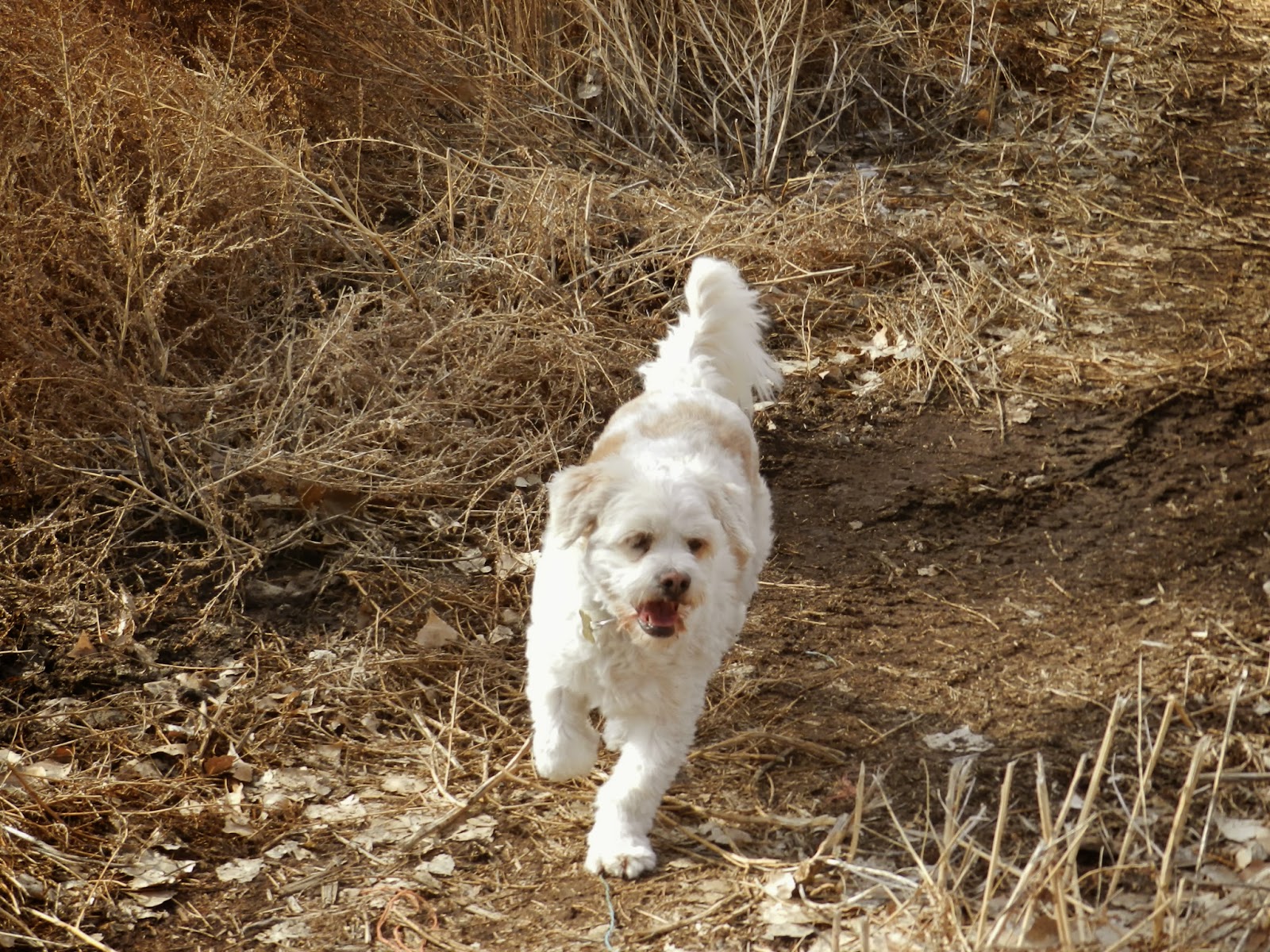
Our last dog came to us as a mature hand-me-down. Our daughter adopted him as a furry, white puppy with appealing eyes. He was small enough to fit in her housecoat pocket. His mom was Shih Tzu and reportedly his dad was Lhasa Apso, so Dudley should have remained tiny and cuddly. Six years later, he weighs 45 pounds and comes to my very tall knee. While he isn’t purse pet material, he’s still lovable.

He ended up at Grandma and Grandpa’s because he didn’t want to share his world with our first born grandchild. Initially, his presence was an act of duty—we couldn’t risk that his growls wouldn’t turn to bites as little Grace learned to crawl and grab soft, curly fur. We also didn’t want our kids to make a tough choice about their beloved pet. Now he’s part of our pack, and we can’t imagine life without him.

Although some of Dudley’s distant ancestors originated in the royal courts of China, he came to us from a farm. Instead of being a pampered pet who spent days warming a lady’s lap, this guy knew outdoors offered premium fun. He understood cattle pens and chicken yards contained interesting critters. What he didn’t understand was hunting.

The moment he joined forces with our Jack Russell, boot camp began. Buster immediately taught Dudley how to find packrat nests and demolish them. The two roamed our property, searching out piles of leaves and sticks and then capturing those vile rodents. While Dudley hadn’t been a barker before, the little terrier made it clear this activity required strident vocalization. We knew when they hit pay dirt by the intensity of their yaps.

In no time, Buster also instructed Dudley in squirrel games. The two dogs would sit at the dining room window spying on a nearby elm. As soon as they saw old Bushytail exploring a branch or using it as a path to the bird feeder, a  race to the back door began.  I’m surprised they didn’t wear a path in the linoleum, considering how often they spotted these visitors.

After we moved, the boys joined my husband every morning as he ventured out on his own hunts. Buster had accompanied him for years, scenting game and alerting his master. Taking him along was a pleasure because he followed commands, waited patiently, and worked in tandem with his human.
 Dudley, on the other hand, didn’t have clue about hunting procedures. He didn’t know how to wait, he ran too far in advance, and he had absolutely no nose. As a result, he constantly piggybacked on Buster’s finds, much to the smaller dog’s disgust.

What Dudley did quickly learn how to do was roll down the passenger window so he could cruise down the road while wind rippled his silky coat. Our terrier had ridden shotgun for years and never messed with the up and down buttons on the door handle. A week of Dudley constantly lowering the glass forced my husband to solve the problem: duct tape over the control panel or leave the fur ball at home.

Apparently, he couldn’t resist those pleading brown eyes as he and Buster hit the road each morning. Now folks who hop in the passenger seat discover they have to ask the driver to roll down the window. 

When they ask, “Kid lock?”

My spouse answers, “Nope, Dudley lock.”

Now that Dudley’s mastered this little trick, we’re optimistic we can teach him to hunt—with Buster’s help, of course.


Sunday, January 12, 2014

Joining the Big Sister Club

People join clubs for different reasons, and sometimes they gain membership because of something someone else did. That’s certainly the case for those initiated into the big sister or brother club. Affiliation with this organization has nothing to do with a child’s intentions. Involvement is totally a result of parental action. 

First off, mom and dad had you before they had another baby. If you’re the eldest in the family, everything was rolling along beautifully until the day your momma took her swollen belly to the hospital. When you finally visited, her tummy had shrunk considerably and there was doll-size creature wrapped in a pink or blue blanket and wearing a tiny stocking cap. It squeaked and mewed like your best friend’s kitten. When it did that, everybody in the room, including your momma, paid immediate attention. What was this thing that drew everyone’s eyes like a magnet draws iron filings?

Did it have anything to do with the new t-shirt you wore that said, “I’m a big sister”? Could you trade that interloper for the puppy you really wanted? Could Mom and Dad leave that bundle at the hospital and take you home so everything could go back to normal?

For all of us who have younger siblings, entry into that elite organization changed our lives forever. In an instant, we were no longer the center of our parents’ lives. Suddenly, we had to share attention, toys, snacks, beds, and more. Routines we’d come to count on changed overnight. Mommy and Daddy didn’t have as much time to color or play games. Mommy’s lap was now a shared haven, not a private outpost.

That word share became the mantra over the next months. Toys and cups that used to be just ours suddenly were now community property. That baby had a stake in our stuff.

After my brother was born, I discovered I not only had to share toys and parents, but depending on where we lived, I sometimes had to share a room. As we got older, we drew imaginary lines across the floor to designate one another’s territory. Supposedly, we couldn’t trespass, but you know how that goes when siblings aren’t in sight. Both of us invaded foreign  space to play with one another’s  games, dolls, and trucks.

For a toddler, learning  to share is a tough lesson. It took years before I decided my sibling was a blessing. Now, I can’t imagine life without him.

He’s the only one who knows what it was like to move and make new friends often. He’s the only one who shares memories of our secret hiding places. He’s the only one who recalls me coaching him to jump from a swing at its highest arc and the resultant crash landing. I can mention long vanished places, friends, and loved ones, and he relates immediately without any explanation. He understands joys and grief connected to our early years that my husband can’t.


Our granddaughter is still confused to find her mom and dad’s arms occupied by someone else. Looking back on my entry into the big sister club, I advise her to give it a few months or maybe even years. Over time, she’ll realize brother is way more fun than any puppy could be.

Sunday, January 5, 2014

Gabbles from Gooseland

When I was a kid, I lived 11 miles from Disneyland. I took for granted that I’d visit the happiest place on earth several times a year. And I did. Due to immaturity, I didn’t understand why my out of state cousins were so excited to visit Southern California and the Magic Kingdom. They were giddy about meeting Mickey and exploring Adventureland, and their enthusiasm for something so commonplace as Disneyland escaped me. After all, it was just a big amusement park with a bunch of costumed characters walking around waving at folks.

If I’m not attentive, it’s easy to have that same take-it-for-granted-attitude about living in the Central Flyway. The CF is a place where those in the know can observe a wealth of bird species that are either migrating through or live here. Those of us who live in mid and western Kansas have opportunities to enjoy birding and bird hunting that few share. Most of the time, we don’t have to travel much distance in order to add another species to our birding list or to bag our limit of geese, duck, or teal. A step out our doors and we are in Gooseland.

This time of year, it’s necessary to go outside to enjoy the gabbling coming from south of the house. I’m not throwing open the windows in these icy temperatures in order  to hear thousands of snow and Canada geese that hang out near our water treatment lagoons  and sound like a stadium full of cheering fans. I’m sure the designer of these ponds had no idea how perfectly suited these water holes are to host multitudes of honking birds, but if they had intended to lure geese close to town, they couldn’t have planned better.

Not only is my neighborhood home to scores of winged, web-footed creatures, but so is Ellis. For decades, the city lake has drawn hordes of Canadas into town. Some of these long-necked critters walk around the community looking as though they wonder why all these humans and their houses and vehicles are in the way. Sometimes, they’re downright unfriendly in the way they honk and peck at their human neighbors. These actions end up getting them transported to a less populated neighborhood…or into a roasting pan.

Not all geese want to land so near to human beings. During my long drive home from school, I frequently see several thousand birds settling into either stubble or green wheat fields for their evening roost. When this many snow geese land in the same place, it’s easy to see how they got their name. Packed in tight, they look like a wintry landscape that happens to move. They might be able to use their deceptive camouflage except they can’t be quiet. When I stop to watch them, I can hear their nattering even before I roll the window down.

When I rode into the countryside with my husband the other day, he pointed out geese far in the distance. Initially, I didn’t see what he was directing me to see. I thought I was looking at corn stalks rising from prairie soil. After zooming in with my telephoto lens, I realized what I thought were upright canes were actually geese craning their necks to look my way. They wanted to see what was in the distance every bit as much as I wanted to examine them.

My spouse told me to keep my eyes peeled because I might see some eagles as well. A pair of them were ranging the area, probably hoping to feast on goose stragglers. That would have been a real bonus if I’d gotten to photograph an eagle along with the honkers. I was reminded again of how lucky we are to live amongst such amazing bird diversity.

I hope I always remember how fortunate I am to call the Central Flyway home. I’m glad I traded Gooseland for Disneyland every time I see those Vs needling across the blue horizon or hear their raucous cries.


Sunday, December 22, 2013

Basking in the Glow

Lovers of sun light, rejoice. Soon, the winter solstice will pass for another year. Even though days grow longer only a few minutes at a time, we’ll soon enjoy more sunshine than darkness in a 24-hour span. Unfortunately, it takes a month or so of incremental minutes before longer days are noticeable, so until then let’s bask in the glow of Christmas lights.

For those who call North Central and Northwest Kansas home, residents can thank small town leaders for honoring this season with festive street decorations. Depending on the size of the village, those lights can be an illuminated bell, wreath, or star on each Main Street light post. A central focus like a giant Christmas tree or manger scene accents the center of some communities.

Bogue, Wakeeney, and Phillipsburg have Christmas trees in the middle of Main Street. In the first two, the big decoration is literally in the middle of an intersection. Anyone cruising main gets the full effect of driving past a triangle of lights. In Phillipsburg, that huge tree is actually on the courthouse square, but it’s so large, it brightens the entire block. In addition to these cheerful centerpieces, smaller decorations add festive flair to the central drag. If you drove downtown in a grumpy mood, you’d leave smiling after seeing the pretty lights.

Once you exit the Interstate in Ellis, illuminated poles guide folks home or to the center of town where a lovely manger scene appears among festively draped trees and bushes on the old green. After you reach this peaceful park, it’s easy to forget you’re in the middle of flyover country. It seems more like Mayberry USA.

After dark, Christmas lighting adds even more charm to Damar’s quaint French village-style main street. Once dusk falls, it’s hard to remember you’re in Kansas when you look south at the silhouette of a French style cathedral spire or read French words painted on the sides of tiny shoppes.

Further north on Highway 9, the tiny burg of Edmond electrifies and wreathes its city park. Coming into town from either direction after dark is an aha moment when you realize you don’t need much population to string lights and hang greenery. It’s a pleasant surprise on a lonely road.

Fifteen miles east down the same road, you run into Logan. Bright bulbs zigzag up Main Street, linking one radiantly decorated light pole to another. Residents add their own touches that add warmth to cold December nights. It’s clear this is a special time of year in this town.

Fifteen miles later, you hit Glade and spy all four Christmas stars brightening the quadrants of the main drag before you leave town. If you stay on 9, Kirwin’s colorfully lit old town square would charm even Scrooge.

No matter what direction you drive across the prairie, you’ll find Christmas alive and well in towns big and small. Residents ante up the change to both buy the bright decor and to pay for extra kilowatts used this time of year. 

Yes, prairie folks are antsy for longer days, but we know how to do a little brightening of our own until Mother Nature turns the light on.


Saturday, December 14, 2013

December Needs Another Holiday


I know some of you might think heavens no; December doesn’t need another holiday. After all, it has Christmas and New Year’s Eve, but for those of us living in deer country, we need to make opening day of firearms deer season the kind of holiday that frees kids from school and employees from a day of work.  Even for people who don’t hunt, there are advantages.

For those families that put meat on the table the old-fashioned way, the first Wednesday in December is a red-letter day on the calendar. This date signals the opportunity for every licensed hunter in the house to provide pure, unadulterated protein for the family. Diners who eat venison harvested in the wild don’t have to worry about growth hormones or antibiotics leaching into their systems through the meat they consume. Protein in this form is also low in fat so it’s better for folks whose docs have told them to cut back on marbled beef.

Family hunts build bonds between spouses and among parents and children. Spending time on a frosty morning waiting to see a nice buck or fat doe come by creates memories and stories that liven up family gatherings for decades down the road. The meat in the freezer may be long gone, but tales of difficult shots or of recovering a deer from a field far from the road make great fireside tales year after year.

Not only are these times to create family legends, they are also moments to teach patience and respect for nature. Youngsters too young to carry a gun can learn to sit quietly waiting for game to come in range. Every hunt provides a wealth of lessons about the outdoors from studying wind patterns to discovering how still you can be when a skunk wanders near your hiding spot.

Once a successful hunt is over, family bonding and learning continue as youngsters help prepare the carcass for butchering. Much of my understanding of anatomy occurred as I helped either my dad or my husband cut up a deer. Helping field dress a fresh carcass made high school biology dissections look easy. These experiences have made me appreciate my source of meat so much more than buying a shrink-wrapped package in a grocery store.

For non-hunters and vegetarians, reducing deer populations through controlled harvests make driving down roads safer. In addition, managing populations is better for the herd health. Too many deer in an area not only makes driving dangerous, it also means more depredation on crops and native plants. A pitiful sight for any who have experienced is a sick herd. In regions where residents discourage hunting, disease whittles populations in a season or two.  

While the idea of an official holiday is tongue in cheek, I do love to hear stories of families that make this day and the rest of the season an annual event. Not only do these folks reduce deer populations that make driving to work a game of real life pinball with the car as the flicker and the deer as the puck, but they also strengthen family bonds, provide healthy protein for meals, and teach respect for nature.


Sunday, December 8, 2013

Christmas Magic


As a little girl, I loved reading old-time stories about Yuletide. One of the traditions mentioned in those favorite tales was that after parents put little ones to bed the night before Christmas, they’d  go to work making magic in what had been a simple family room. When boys and girls awakened in the morning, they’d tiptoe downstairs to find the parlor softly lit by candles clipped to evergreen branches.

My childhood family didn’t decorate for Christmas on the day after Thanksgiving, but our folks didn’t make my brother and me wait until Christmas morning to enjoy the soft glow of a string of bright lights wrapped around our Christmas tree. While I was glad we spent those extra days wandering around a semi-dark house lit only by colored bulbs in early dawn, the tales I read about Christmas magically appearing overnight appealed to my old-fashioned heart. I always wondered what it would be like to wake up one morning to a twinkling wonderland.

After all these years, I got my wish. I’m sure this has happened on many December Sundays in my life, but for some reason December 1, 2013, I noticed the magic. 

Last week when we left church, it was modestly decorated for Thanksgiving. This Sunday, I entered a quiet sanctuary with my arms filled with after-service hospitality goodies and nearly dropped them. My eyes must have been the size of dinner plates as I recognized my Christmas fantasy had arrived long after I outgrew girlhood. Artful and spirited decorators had draped lintels and wrapped altar rails with greenery and red ribbons. They set white candles into evergreen centerpieces on each windowsill. In addition, they placed a lovely Advent wreath with brand new candles at the front of the altar.

I don’t know how long it took and who had to climb the ladder but these miracle workers set up a towering tree full of tiny white lights behind the organ. This ancient symbol of eternity spoke louder than all the glitz in the world could about a Savior born in a humble stable who brought light to a dark world. The simplicity of this beautiful evergreen balanced the poinsettia memory tree placed opposite of it.

Though the subtly lit evergreen was taller, the bright red commemorative tree created by stacking dozens of poinsettia plants wrapped in gold foil was bold and eye-catching. Knowing each living plant making up that tree was a reminder of loved ones passed on connected me to everyone in that sanctuary. We share our sorrows as well as joys.

I know this instance was not the same as those little children in my favorite stories creeping down the stairs to see a lit tree surrounded by gifts, but for some reason it was magical to me. I’m grateful for those individuals who gave their time and efforts to turn a pretty but simple sanctuary into a festive worship place for the next few weeks. 

Although the initial moment of surprise has passed, my heart looks forward to enjoying more moments of Christmas enchantment. Let the carols ring.


Sunday, December 1, 2013

To Grandmother's House We Go

Over the river and through the woods,
To grandmother's house we go;
The horse knows the way to carry the sleigh,
Through (the) white and drifted snow!
Over the river and through the woods,
Now Grandmother's cap I spy!
Hurrah for the fun! Is the pudding done?
Hurrah for the pumpkin pie!

I remember singing this song in fourth grade and thinking how it reminded me of visiting my grandma. We didn’t often make it to Kansas for Thanksgiving, but if we did, Grandma made sure the trip was worth it. When we couldn’t travel, my mother served feasts that had everyone in the house wandering through the kitchen to savor the scents emerging from the oven and simmering pots on the stovetop. Watching my mom cook her mom’s recipes made me want to be part of this cycle of kitchen magic.

Once I returned to Kansas, Grandma’s house became Thanksgiving Central. Mom, my family, and anyone else in the vicinity met in Meade for this annual feast. A few years after Grandma gave up her role as main chef, I designated our house as the place to be on Turkey Day. However, last year, we were moving so my mom invited us to her house for Thanksgiving. It was nice once again to eat mom’s roast turkey, candied sweet potatoes, and pie. While I loved that dinner, I missed preparing favorite recipes that connect me to loved ones.

This year, I get to host dinner for our gang, and I had so much fun shopping. I picked out a big turkey so there will be plenty of leftovers. I love to send platters of goodies home with my children and mom so the feast continues for several days. I loaded up on potatoes and stuffing supplies as well. We have a longstanding family tradition of overloading on carbohydrates, so we’ll continue that with bowls of buttery mashed potatoes, fried noodles, candied yams, savory stuffing, and homemade oatmeal rolls.

Mom brings fresh veggies along with her famous sweet potatoes. I’ve tried to make them the way she does, but without success. I’m not sure what I leave out, but Mom’s candied yams topped with golden marshmallows are my Thanksgiving favorite.
Her relish tray is amazing: bite-size carrots, celery, broccoli, cauliflower, black olives, and jicama. When they were little, our girls put olives on their fingers like black fingernails and flitted around the kitchen pretending they had witch fingers. Maybe our granddaughter will be big enough this year to carry on this tradition.

The turkey is a Cinderella wannabe. It existed only for this day. Like the real Cinderella, the dressing makes the bird. Foods both pale and wan when placed in the pan emerge from the roaster glowing golden brown and perfuming the house with herbed aromas that pull everyone into the dining room like a magnet draws iron filings.

Following dinner, fresh pumpkin mixed with cream, sugar, eggs, spices, and molasses and poured into a butter and flour crust turns into a grand finale that pushes our carb load over the top. How can something that emerged from an orange gourd in strings turn into such a succulent dessert? 

Thanksgiving is my favorite holiday, not only because I love to prepare a meal that makes my family’s taste buds tap dance, but also because it’s the time of year that we focus on blessings that enrich our lives. It’s also a time to remember other Grandma’s houses at Thanksgiving.

.

Sunday, November 24, 2013

Simple Food--Great Memories

Simple Food—Great Memories

While living out of a suitcase has definite drawbacks, one of the bonuses of visiting new places is trying local foods. Because my family both moved and traveled a great deal as I grew up, I learned early the joy of sampling regional delights every time I hit the road.

Around central Kansas, I love taste-testing bierocks, green bean dumpling soup, galuskies, and kolaches in different communities. If I’m lucky, a community feast also offers fried noodles as a side dish to accompany these delights.

In Rocky Mountain mining country, I look for eateries that dish up traditional pasties. This choice food of the men who work deep underground every day has a flaky crust that reminds me of pie. The filling of chopped roast beef, potatoes, turnips, and onions simmered in brown gravy is like visiting Grandma’s for lunch after church on Sunday.

These miner specialties worked as bierocks did in our region. On their way out the door to work in the morning, men tucked the warm meal in their pockets to keep fingers toasty. At lunch, the former hand warmers served as belly fillers, providing energy to finish a day’s hard labor.

In Texas and New Mexico, I venture from restaurant to restaurant searching for the perfect chile relleno. Nothing beats a hand-dipped and cheese stuffed poblano pepper fried in sizzling oil. The savory topping adds even more kick to a taste-bud exploding meal.

Every one of the regional specialties I’ve mentioned is memorable, but my all-time favorite is Indian fry bread. I love it hot from a grease bath and slathered with honey. At Twin Rocks Trading Post in Bluff, Utah, I ate it in the form of a sheepherder’s sandwich. The cook used two pieces of fry bread to create a roast beef, cheese, and onion hot sandwich. When I make it at home, we eat it smothered with hot chili and topped with cheese, lettuce, and tomatoes in a Navajo taco. I coat leftovers with cinnamon and sugar. It’s even delicious plain. I don’t think I’ve eaten freshly made fry bread I didn’t like.

A sad aside about this food favorite is that it came into existence when native tribes were forced to give up nomadic  lives to enroll at Indian Agencies to receive government subsidies. People who  hunted, gathered, and sometimes grew their own crops successfully for centuries had to depend on federally issued bacon and weevil y white flour to fill their stomachs. Using these unfamiliar ingredients, they learned bacon rendered fat, and flour and water created dough.

With a bit of ground wheat, leavening agent, salt, water or milk, and a pan of bubbling grease, cooks created a food that enabled them to nourish masses of people. This reminds me of Jesus feeding the multitudes. From another perspective, Native American author Sherman Alexie fondly remembers great fry bread cooks of his youth on the Spokane Reservation in his novels.

While each of my regional favorites has a unique flavor, they share a common factor. Bierocks, galuskies, green bean dumpling soup, kolaches, pasties, chile rellenos, and fry bread use easy-to-find ingredients, and they aren’t hard to make.


Hitting the road isn’t only about seeing new sights. It’s also about sampling new foods and picking up new recipes.  I never know when I’ll find a fresh favorite.

Sunday, November 17, 2013

Thank You to Our Veterans


One of the bonuses about living where we do is that most area communities celebrate Veteran’s Day. City crews and volunteers rise early to hang Old Glory on one light pole after another down Main Streets in little towns. Often times, local residents add their own flags to the mass of fluttering red, white, and blue. 

In some towns, school kids construct floats to honor local heroes. Students and teachers spend an afternoon assembling patriotic displays to show their appreciation for the sacrifices these veterans made. Often times the people honored are relatives so youngsters have heard the stories behind the uniforms they see at this event.

In addition to parades and similar events, local newspapers and radio stations run tributes to heroes so anyone who cares can learn something about these patriots. For many, these annual special pages are reminders of friends and loved ones’ sacrifices. Readers can view an elderly neighbor or relative photographed in the bloom of uniformed youth.

These annual celebrations are one way that small towns across the plains link generations. It reminds me of joining green and red strips of paper together to make a Christmas garland. In the case of Veteran’s Day tributes, the glue happens to be the stories younger generations learn from older ones.
Over the years, my students have interviewed veterans and recorded remarkable accounts. After every one of these assignments, kids came to class surprised to learn that people in their community had witnessed history before it was in history books.

In my own family, one uncle survived the bombing of Pearl Harbor and continued fighting in the Pacific until the war was over. Another uncle protected supply ships in the Pacific. My dad joined the Marines and fought in Korea. A cousin did two tours of duty in Vietnam. A nephew served in Romania. Two second-cousins have served in Iraq and Afghanistan. 

Many area residents recite similar litanies. I’ve joined family, students, colleagues, and friends in the waiting and praying for loved ones to return safely from current war zones. These warriors’ stories are our towns’ stories as well. Veteran’s Day reminds us of this.

It’s good to know details so we realize that people we see as ordinary citizens are more than that. They are extraordinary. One area WW II vet serving on a ship in the Pacific witnessed the atom bomb exploding over Hiroshima. Another man, whom many would consider a small town Everyman, was one of the first Americans to enter newly liberated Dachau. Another visited Hitler’s final residence not long after his suicide. An area resident survived the war as a German POW. The kindest man I’ve ever met survived horrific conditions in the Pacific and returned determined to make other people’s lives better. His list of successes was long. A colleague’s father survived every major battle in the European theater and came home to raise a fine family.

Veteran’s Day celebrations remind us that unsung heroes walk amongst us. Some people we see simply as neighbors, fellow employees, and loved ones are people who lived Omar Bradley’s definition of bravery. He said, “Bravery is the capacity of perform properly even when scared half to death.”

Thank you to all who serve.


Sunday, November 10, 2013

Where Did Raptors Perch Before There Were Power Poles?


For you and me, 150 years seems like a long time. However, from the beginning of our planet until now, that span is probably equivalent to less than a tick of a second hand on an old-fashioned wristwatch. While that century and a half is a tiny interval in the big picture of our world’s existence, it’s been busy in regard to change.

 In the nearly 5 billion seconds since permanent settlement vs. nomadic occupation began in earnest, plows have turned over a goodly portion of approximately 52 million Kansas acres. Railroads, Interstates, highways, and country roads crisscross our state. Cities and towns with their accompanying concrete and pavement exist where only grass grew 15 decades ago. Fence posts and wire mark off sections and quarters while scores of tall telephone and power poles guide eyes far into the shrinking distance like an artist’s perspective lines direct the eye in a sketch.

It’s hard to imagine a world without these improvements. It’s equally difficult to envision what birds of prey did before man provided handy watchtowers for these sharp-eyed stealth machines.
Every time I spy an owl or hawk hurtling toward a mouse running across the road, I’m startled. Where’d that come from, I wonder. A glance toward lofty shafts running parallel to the highway reminds me these creatures have front row seats for the dinner show occurring in front of my vehicle.

While driving at dusk a few nights ago, I spied three electric poles in a row topped by great horned owl silhouettes. An interior decorator couldn’t have selected better finials as accessories. At the same time, a submarine shape trailed by a long tail raced into the brightly lit pavement before my car. In less time than it takes lightning to flash and dissipate, one of those former black shapes transformed into a swift torpedo heading for that gray target spotlighted in my high beams.

A tap on the brake prevented me from hitting either mouse or raptor. Mulling this almost collision between machine and feathers, I realized this near miss explained the frequent broken owl and hawk carcasses I see littering Kansas byways.

What it didn’t explain was the next question that popped into my mind. In the ages before settlement and development, where did such creatures perch to scan the grasses for furry morsels? Was all their reconnoitering on the fly?

Did the same species of feathered predators live on the prairie as do today? Did they eat as well as they do now? How has modern life altered the existence of native inhabitants? I’ve been led to believe that human encroachment is bad, but in certain scenarios, do some animals and birds benefit from humankind’s additions to the landscape—such as power pole watch towers?


I’ll keep posing these questions until I get some fact-based answers. Instead of bats in my belfry, I have owls and hawks flitting about inside my head, telling me to learn more about changes settlement has wrought on our landscape. Someone surely has answers that will get these birds back where they belong—watching for their next entrée from atop a power pole.

Sunday, November 3, 2013

Living Life between the White Lines

Some of us rise long before dawn breaks the horizon and hit narrow two lane highways in night’s deepest black. For these folks, life between the white lines balances boredom caused by limited visibility  with edge of the seat, adrenaline-rushing thrills.

Early each morning I turn east on Highway 9 and immediately shrink to a blip on the universe’s radar. If satellites actually watch cars passing down remote roads, I ‘d hardly be visible in my silver Toyota that blends in with a worn asphalt ribbon  connecting one shrinking farm town to another. I’d show up as two tiny eastward moving light rays.

To help me see better, I hit my high beams and begin a journey bordered by KDOT applied parallel stripes. Even on bright, my headlights don’t extend much outside those margins, so I take aim and stay within their confines.

It’s easy to succumb to the monotony of a daily journey over a known road, but on shoulderless highways like 9, it’s wise to keep to the path. Too many accidents begin with a veer over that asphalt lip, followed by a corrective jerk of the steering wheel that actually sends the car out of control. Not wanting to become a statistic, I let those edges work like the guide on a sewing machine to keep me on the straight and narrow. 

While the headlights focus mostly on the road between those strips and the calf scour yellow broken or continuous center lines, spilled light reveals tawny bluestem or waving brome outside those borders. My eyes continually scan that little Serengeti for bits of reflected green. This little tell may be my only warning before a car/deer collision.

I’ve been driving this route long enough to recognize distinctive headlights. A small car with only one headlight shining  like a bright-eyed Cyclops meets me every morning about ten miles out of town. Though I wouldn’t know the driver if I met him or her, I recognize that vehicle’s familiar wink when I see it coming over a hill.

Ditch grasses stand as silent witnesses to passersby and kamikaze creatures that fling themselves into grills and under wheels. One morning, four raccoons had met their end in a thirty-six mile stretch. Sometimes, all that remains is an unrecognizable speed bump.

It isn’t just hitting a critter that gets a driver’s adrenaline rushing. Those near misses raise heartbeats as well. It took a few controlled breaths to still my own pump after a coyote raced in front of me the other morning. Lucky for him, he lived to eat another rabbit. If I were faster, he’d have been carrion.
 
Lowering speeds to 55 or 60 isn’t always enough to avoid wildlife between those white lines. One morning I dodged a buck sprinting across the highway only to run into a herd of deer up the road. I saw them soon enough to slow, but not soon enough to halt. One less doe will produce a fawn next spring.


In a world confined by dark edges, life between the white lines is more than a little exciting. Despite the narrow boundaries, adventure and thrills await.

Sunday, October 27, 2013

Changes That Confuse: Language Isn't Static


Hemlines rise and fall, lapels and ties get wider and skinnier, and pant legs flare or narrow with or without cuffs. People expect to see fashion change every year, and some even save old clothes, knowing that favorite colors and designs will recycle into popular style once again. While humans understand this truth about what they wear, they don’t always see a correlation to how language changes as well.

Still in my mid-twenties and early in my teaching career, I experienced my first lesson about how words and memories dear to me meant nothing to my students. I reenacted a once popular Dr. Pepper commercial to help a class of sixteen-year-olds connect to what I was teaching. I was certain that as soon as they recognized the metaphor in my perfect example they would understand my lesson.

As I stood before them enthusiastically reciting the little ditty that had made me a fool for carbonated prune juice, I saw only blank looks staring back at me. That commercial had never run during their lifetimes. Those dull gazes turned my catchy lines into something awkward like, “I guess you’ve probably never seen that before.”

Their choreographed nodding from left to right confirmed my fear. We had a major disconnect. At a youthful, pre-motherhood twenty-five, I felt ancient standing before individuals who were only nine years younger than I.

Time has not softened the shock of realizing my understanding of the world is a distant planet from my students’ realm. That moment when I think I’m using a relevant example, but I’m not, occurs often enough that I now pause to consider where teens might have heard a phrase before I write a quote on the board.

To warm brains up, I like to jot challenges on the white board at the front of my room—even saying white board instead of chalkboard is one of those new planet concepts. Students now don’t know what chalk boards are—they’ve’ never seen them outside a museum. I’ll post examples similar to 100yds=1 ff or 52 C=1 D, hoping I’ll hear, “Hey, 100 yards equals a football field and there are 52 cards in a deck.”

Increasing the difficulty, I’ll post teasers such as A S L than W, T and T W f N M, or A S in T S 9. Today’s students swiftly answer, “Actions Speak Louder than Words.” After some time, they figure out “Time and Tides wait for no man.” The tide part challenges them, but they’ve heard the rest of that aphorism. The stumper was the one I thought would have been the easiest, “A Stitch in Time Saves Nine.”

Once I told my classes what A S in T S 9 meant, several questioned the meaning of that adage, putting me on the spot. Heavens, neither my students’ nor my generation have mended hand-knit socks to make them last. We buy our socks in packages and toss them in the ragbag when they get a hole. Jeans that folks buy today further confound matters. It seems getting an extra hole is a bonus, not something we race to stitch-up.

Some things about people don’t change. Everyone needs love and acceptance. Everyone needs a meaningful occupation. Everyone needs healthy food and protective shelter. However, fashion and language use do change. What one generation understands can confuse a different generation. 


Just wear your old zoot suit or bell bottoms and explain something to your grandchild  like that's the bees knees or that's groovy, which made sense to you as a kid, depending on your generation.

Sunday, October 20, 2013

Creativity Doesn’t Have Age Limits

After my juniors finished a unit over Native American creation stories, I challenged the class to create their own worlds and write narratives explaining their inventions. I never get tired of seeing what teenagers come up with and how they share it. After some deep thinking, one young woman focused on her love of movies. Another developed a tale based on her love of farming while several young men put together stories centered on the outdoors or sports. These youngsters’ efforts made me think about what realm I’d produce given the opportunity.

At the time my students were working on their projects, I enrolled in a Joy of Painting class at the Dane G. Hansen Museum. This particular course provides a pre-selected subject for the artwork. Using various brushes and paints, each artist chooses how to develop his or her own piece. If there are 30 artists in a class, there are 30 different paintings.

When I first arrived, I examined the teacher’s model of that day’s subject, a huge whitetail. I was eager to learn to paint a big buck surrounded by pines and dark, cloudy skies, but I noted a few details I wanted to tweak. I visited with the instructor to be sure my changes were something I could manage without taking more time than the class allotted. When she gave the go ahead, my brain went into overdrive considering what I needed to do to make this painting mine—in essence to do what I’d charged my students to do-- to create my own world.

That is what artists get to do. Writers, musicians, sculptors, painters, movie makers, photographers, and other creators take charge, for a little while at least, to produce an existence of their own making. For that instant, an individual gets to pick words, rhythms, mediums, color, characters, and other details necessary to manufacture something unique to that spirit. If an artist is lucky, his or her creation will connect someone else’s spirit, and he or she’ll get to enjoy a moment of appreciation.

We live in a world that seems to me to get further and further away from individuals creating. We enjoy other folks’ constructions—video games, movies, and music, but it doesn’t seem that we are active participants in actually creating a finished product. Maybe I’m longing for something that never really existed, but when I listen to elders’ stories or read books about the good ol’ days, one thing folks did together was create. 

If there was a gathering, anyone who could play an instrument joined in a little impromptu music making. Women gathered to construct beautiful quilts out of leftover scraps, and communities put on plays and declamations. People didn’t think they needed lots of classes before they were willing to participate in something like sewing, painting, or playing an instrument.

Young or old, it’s good to create. It’s necessary to encourage youngsters and grownups to dabble in imaginative endeavors from making radishes into roses and creating sculpture from spaghetti and marshmallows to painting and playing instruments. Getting older shouldn’t inhibit people from making new worlds. Creativity doesn’t have age limits. Look at Grandma Moses.


Sunday, October 13, 2013

The Best Part of Each Day

A friend who rises early to paint each morning’s sunrise inspired me to capture photos of Merry Old Sol’s first peek over the horizon for the last year. I’m not as diligent as Debbie is at capturing every dawn, but I’ve seen enough now to make some observations.

Some mornings are not remarkable, but it’s worth getting up early to check. Sometimes I spy lingering stars fading from night’s canvas and make a wish or two to begin the day. Morning moons are softer and gentler than they were a few hours earlier. They’re a nice reminder that time softens hard edges and feelings. Always, always there’s a bird singing. Even when dawn begins in grays, happy trills and coffee make everything right. 

Some sunrises are a flashing neon message from God that I’m in the middle of a wonderful blessing. Usually a scarlet or deep apricot color infuses blues and lavenders. Then a brilliant glow backlights one cloud or several so it looks like a special effects artist is working overtime with a neon paintbrush. At this point, the effects can develop in several ways.

Sometimes those scarlet or apricot tinges bleed slowly outward into gesturing fingers. When this occurs, I’m reminded of Homer’s epic poem The Odyssey where he repeatedly refers to the rosy fingers of dawn or dawn’s rosy fingers. Over two thousand years ago, Greek sailors enjoyed the same kinds of sunrises that dazzle me. The world has changed in so many ways, but dawn’s early light still works its magic on those of us willing to get up to see the display.

Other mornings, it’s as if the sky explodes. There’s no slow, gentle bleeding of color or light. It’s a nuclear flash of brilliance, and the day has begun. It’s a no-turning-back, continue-charging-forth moment that gets adrenaline pumping and hearts singing.

On rare occasions, morning light manifests itself in odd little peep shows. One of those occurred last week. In general, the sky was gray with bits of buttery gentle light peeping through every now and then.  Suddenly, a tiny square of orange ripped its way onto the stage and directed itself on an old farmstead in its path. I kept expecting more light, but it seemed content to shine through like a flame glowing behind isinglass.

We’ve all seen movie sunrises where celestial music plays as clearly defined rays break and spread over the horizon like a giant crown. When I’m outside watching those displays, I’m always disappointed that I hear only birds or crickets. It seems an orchestra ought to perform so loudly no one could sleep through it. I saw one of those sunrises last week as well and turned the radio down just in case I was missing angel music.

Not everyone is a morning person, but I’m sure a few weeks of watching dawn arrive in the eastern sky might convince a few slow risers to enjoy a front row seat to see the best part of the day.


Sunday, October 6, 2013

We’re More Connected than We Realize

A vacation in the Rockies is a trip to another world for Kansans and Nebraskans. The geography is unlike our plains in every way. Towering peaks draw eyes heavenward and then remind us we can’t see beyond them. Racing rivers and streams rip down craggy declines so fast that water foams and spews. Evergreen forests shade hiking trails and scent air with non-prairie-like perfumes. Morning and evening temperatures demand jackets be included in summer wardrobes. Torrents of water and high altitude bird song replace the sounds of wind soughing through dry river and creek beds and meadowlark trills.

The differences between the two landscapes vary so much that it’s easy to forget they are connected. That is until some powerful force of nature reminds us that more than interstates and highways link lives and geography.

News of recent flooding in Rocky Mountain National Park and Boulder captured our attention and hearts as we watched families lose homes and loved ones. Reports of communities cut off from safe drinking water and regular food supplies reminded us how quickly life can change from being like an ongoing vacation to everything turning miserable and frightening.

Despite concern for victims and hastily sent donations to Red Cross and the Salvation Army, raging water and its damage seemed far away, much like summer memories of pleasant mountain villages are in dreary February. However, a short drive to the Platte River in Nebraska revealed another story. Waters that wreaked havoc in the Rockies deliver hope to those living in the heartland.

Each March the Platte River is home to the annual sandhill migration. Most folks consider the region of the river where these favorite birds stage for six to 10 weeks a lazy stream filled with sandbars and small islands, a main reason that cranes rest there. Swift moving river is not a descriptor one would use to describe this landmark.

In the weeks since pouring rains washed out Colorado roads and housing divisions, raging waters have followed ancient waterways eastward. Not long after the floods, the South Platte raced out of it banks funneling this wealth of moisture toward the larger Platte. Fields in Easter Colorado bore the brunt of that overflow, leaving farmers with ruined harvests this season but water surpluses for next year.

As the waters neared Nebraska, irrigation districts opened channels to direct the abundance toward dry fields and ponds. Even with the extra efforts, more than plenty of water filled the Platte, erasing islands and sandbars and washing through stands of willows growing along the shallow banks. If it were migration time right now, cranes couldn’t find a dry roost in the river.

When I heard that the Platte was high, I wanted to see it out of its banks. Despite its reputation as a meandering, shallow stream, it’s currently a racing river full of surging currents. I wasn’t alone in my eagerness to view this rare event. To prevent sightseers from jamming traffic, road crews posted “No Parking” signs on major bridges. 


A steady stream of foot traffic going and coming from the walking bridge in Fort Kearney State Park keeps the trail occupied. It’s as busy as it is during peak crane migration visits. Fellow sightseers did what I did: they marveled at seeing so much water delivering hope to a drought-stricken land.

I suspect they also felt what I did when I considered at what cost this water came to us. What have those who call the mountains home lost in order for us to receive this blessing? It takes monumental events such as this deluge to remind us that each region is connected. We aren’t alone in this adventure called life.


Sunday, September 29, 2013

Late Season Cow Dipping


While calendars tell us summer is over and fall has begun, hordes of giant dragonflies ride still-warm breezes and wasps hover over ripe fruits. Summer birdsong tricks us into believing there’s plenty of time for a second round of ripe tomatoes and okra or many late season dips in a lake or pond. The reality is that frosty mornings are not far off. It won’t be long before summer tunes are silent, insects and birds will vanish, green leaves will turn to dry husks, and ice will crust ponds and lakes.

Driving to school in the shadow of a setting harvest moon on the final day of summer reminded me that morning sunrises would soon silhouette bare branches instead of peep through foliage. Currently, on my morning route, gold tones tint cottonwood leaves. Flocks of vultures congregate on elevators and tall antennae but no longer stretch wings to welcome sunrise. It’s too chilly. Mist or low lying clouds rise and float just above stubble fields and farm ponds, telling me ground and water temperatures differ from those of morning air. 

Despite signs that we are on the cusp of seasonal change, most of us enjoy the moment and postpone thoughts of icy roads and water tanks, snow covered driveways and sidewalks, and winter heat bills. We turn our faces to capture last warm rays and savor final cicada serenades. Some creatures literally immerse themselves in these last moments.

While cool temperatures created a smoke-on-the-water effect over a big pond on my morning path, by the time of my late afternoon return, those mists were long gone. The sun’s reflections glittered on the steel blue water as a heron stood sentinel on a dead tree branch. It was so pretty I stopped to take pictures.

Backlit by fall’s bright yellow sun, a herd of black cows crowded the water’s edge, mucking about in mud. Suddenly, one stepped into the pond and continued heading west. In the way that only cows know, the rest chose to follow their leader.

At first, the train of bovines waded in knee (do cows have knees?) deep. Slowly, water covered those ungainly bodies to the point I saw only ears and noses moving forward. Several times, even those dipped below the surface until I wondered who saved drowning cattle. Although I had been a lifeguard decades ago, I knew these huge beasts were beyond my rescue abilities.

Despite my concern, V’s of ripples continued moving across the pond until two black ovals and a big black squared reappeared from each. A bit at a time, the rest of those cumbersome forms emerged, shaking water droplets from their hides. Each spray reflected sunlight until it looked as if diamonds splintered off the black shapes.

I only watched the first members of the herd complete their swim across the deep pond before I drove off, smiling. It won’t be long before that water is too cold or too frozen for even thick hided Angus to cross. Watching cow dipping was a great way to enjoy my last day of summer 2013. 


Sunday, September 22, 2013

Hummingbird Saved from Praying Mantis Ambush


Despite the hot temperatures that scorched yards and fields up until a few days ago, autumn is in the air. One reason for that involves behaviors of birds and insects. 

While more bees hover over late-blooming plants to gather end of season nectar, cicadas sing louder each evening, trying to squeeze last notes out of their noisy carcasses. Cricket choruses are also more evident inside and outside the house. Vultures gather in ever-larger groups to prepare for autumn journeys south. Birds we normally don’t see in this region wing through. One of those migrating species is the humming bird. Those with feeders out are seeing action for the first time.

While mountain residents enjoy hummers all summer long, Western Kansans enjoy a short visit sometimes in the spring and often in the fall as the tiny birds make their way to and from nesting territory. I’ve maintained a feeder all season in hopes I’d see these little migrants. Changing that sugar nectar finally paid off. Two or three iridescent green tornadoes have drained the feeder fluid levels the past few days.

The first day I saw my flitting visitors, I also noted a praying mantis. It posed solemnly along the edge of the clear container full of sweetened water that I offered to lure in long awaited guests. If I hadn’t seen a photo on the internet showing how these large, Martian-looking bugs kill and eat hummingbirds, I wouldn’t have given its presence a second thought. However, I’d read the headlines even though I hadn’t viewed the gruesome photos. I also observed the tiny calliope hummingbird hesitating before it approached the plastic flowers at the base of the bottle.

Time for Grandma to intervene. A thunk of a broom handle sent that brown, 5-inch long predator tumbling to the ground, scurrying for cover. I added a few whacks with the bristle end of my weapon to make sure he didn’t want to set up c amp again on my hummingbird feeder.

Normally, I encourage these garden sentries who protect my veggies from damaging insects. Just looking at that triangular head with those strong jaws lets you know this guy means business when it comes to devouring prey. A close look at its legs to see how the mantis uses them to spear or confine its dinner reveals sophisticated abilities to disable victims. This is one powerful insect. It’s understandable why a tribe in Africa deified such a critter.

According to the internet site where I first saw these common garden protectors threatening hummingbirds, the mantis waits patiently for the hummer to come close. The insect then spears the small bird with a powerful foreleg. After killing the hummer, it dines on its soft belly side. Someone videotaped this predator vs. prey incident and posted it on YouTube. I couldn’t bear to watch the entire video, but I saw enough to know I wanted that big, ol’, ugly bug back in the cabbage patch.


Over decades, I’ve learned autumn is the time of year when I’ll see insects, birds, and animals most focused on their own survival. They don’t have long to store ample reserves to make it through winter’s dark, cold months. Despite knowing this, I say hummingbirds are off limits. Their visits are too infrequent to allow a predator make a meal of one.

Sunday, September 15, 2013

Uninvited Guests


Nothing is more satisfying than frying chicken, making potato salad, cutting up carrots and celery, and baking a pan of brownies for a family picnic. While I’m at the stove, I imagine the perfect spot to place our blanket or cover a table so that we can savor blue skies, warm sun, and laughing kids while we feast. My fantasies about perfect outdoor meals are always ruined by uninvited guests—ants. An army of marching three-part bodies always finds the goodies and sends me scrambling to store lunch safely out of their and my reach. I recently discovered ants aren’t nature’s only uninvited guests.

To lure feathered creatures into our yard, my hubs and I set up birdbaths and hung feeding stations near the back porch. It wasn’t long before our efforts paid off with finches, orioles, robins, grackles, and sparrows visiting several times a day for drinks and snacks. 

I could watch their acrobatics from my shady porch swing, or I could hide in the sunroom where they couldn’t see me. Over the summer, hours flew by as I spied on splashing robins and timid house finches hiding among leaves. Small creatures perched on the edge of our pooches’ water bucket and tipped into it to sip delicately like one of those old-fashioned toys where the bird toppled forward and then popped back into place. At our woven net feeder, up to six tiny creatures would cling to the webbing as they ate and chattered. I’m not sure, but I think birds can talk with their mouths full.

With a small investment of money and time, I received a revolving show that ran all hours of the day. Unfortunately, uninvited guests appeared and put a damper on my fun. Not only do birds like fresh water daily, but wasps do also. 

Before long, those lazy bird watching sessions turned into wasp dodging adventures.  On the way to my corner swing, I would see hordes of striped, yellow wasps flying around the patio. At first, I thought they were just buzzing through, and then it became apparent they lived in the neighborhood and their numbers were increasing. My husband noticed as well, and, being braver than I, began to hunt for the source. 

Not only did I have a soft swing to make the patio my own little getaway, I decorated with baskets of flowers so there was plenty of nectar to sweeten the deal for the unwelcome invaders. I placed hollow yard art around the borders to add visual interest to my surroundings. Who would have thought last April as I decorated my little escape area that those wasps would find the water, blooms, and hollow statues a perfect home for themselves.

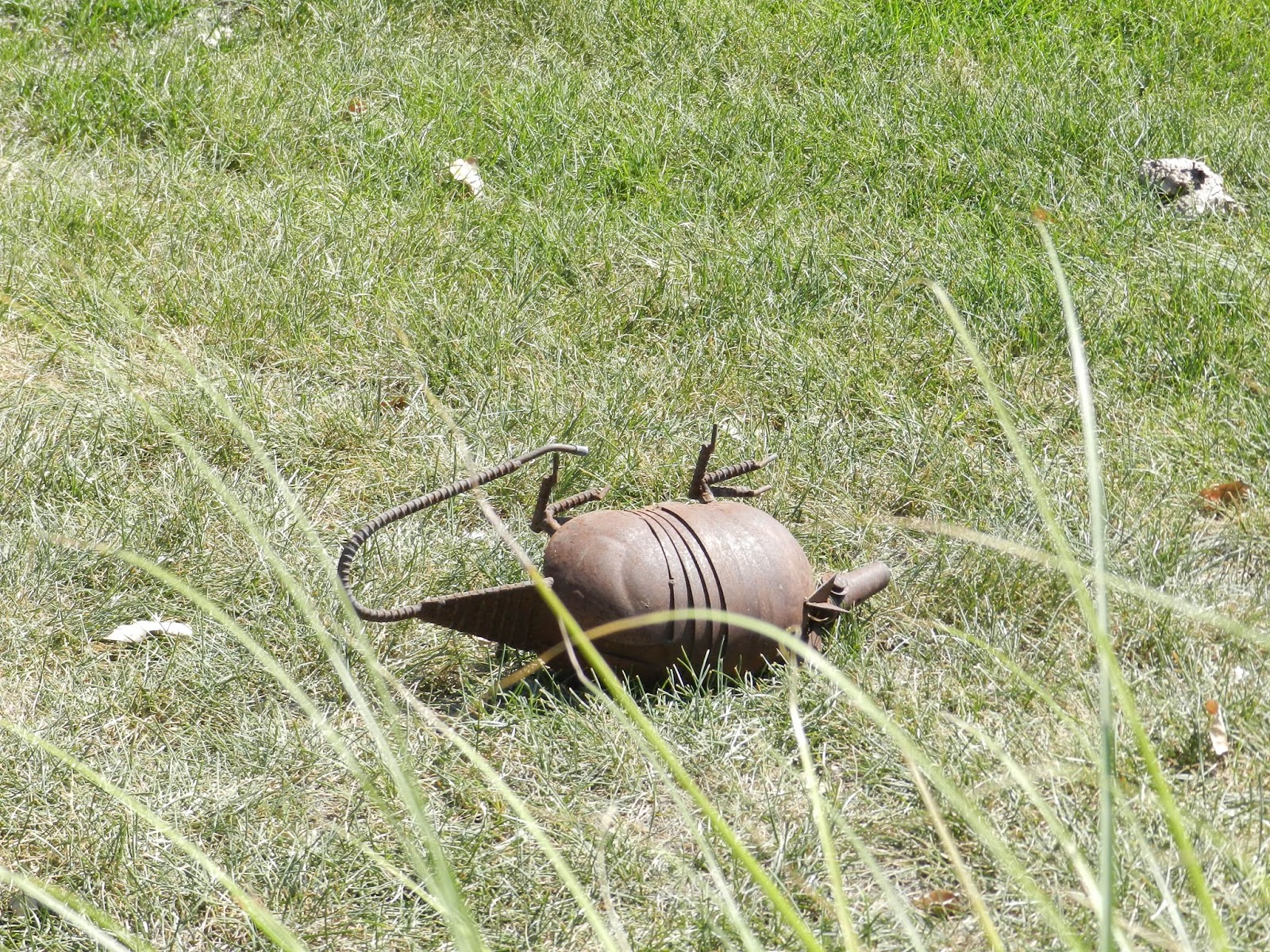
My fearless spouse watched these floating dive-bombers long enough to realize they’d colonized my favorite armadillo sculpture sitting on an old ice cream parlor chair for effect. He knew he’d have to move fast if he wanted to escape unharmed so while I was gone and the dogs were safely in the house, he dashed into trespasser territory and wreaked havoc. 

By the time I returned from work, my rusty armadillo lay on its back in the yard with a jillion little wasp apartments filling its innards. The upended chair rested nearby with a few more insect apartments glued to its underside. A can of hornet spray sat on the picnic table amidst winged carcasses. 

To discourage survivors from returning, my husband dumped the birdbath and water buckets we’d put out to encourage birds to visit. It reminded me that nature seems to frown on simple enjoyment of her pleasant side. If you have a picnic, ants will come. Apparently, if you welcome feathered friends, wasps think they’re invited too. 


Stalking a Hummer


If you watch the news, you’re aware that stalking has a negative meaning. You learn about creepy people who obsess over public figures and lurk in alleys or near back windows to sneak peeks. Possessed photographers trailing Princess Diana contributed to her fatal car accident. Hollywood loves the stalker theme and banks big bucks developing thrillers to keep us on the edge of our seats to discover whether the victim escapes in time.

While each of the previous examples sends a shiver up my spine just thinking about the topic, nature photographers have to borrow stalker skills so they can capture shots that make viewers say, “Wow!” Hiding in a bush, tree, or ghilley suit is sometimes the only way a shutterbug can snap an image of a beast, insect, or bird going about normal business. 

I recently got caught stalking hummingbirds in Meeker, Colorado. During our entire vacation, I wore my camera like a clunky necklace or carried it attached like Edward Scissorhand’s extra appendages. I wanted a picture of a hummer sipping nectar from a real flower, not a plastic bloom. Trying to capture a natural shot like that is much harder than you’d think.

Stopping in the city park so my husband could make phone calls while we had good reception began my adventure. As I waited for him to complete his contacts, I spied a nearby garden of spiky hollyhock stems, planted just west of the men’s restroom. Hummingbirds do love these tropical looking blooms, so I zeroed in on this locale.

Hidden in the front seat of the car, I noted a couple of torpedo shapes with needle beaks weaving in and out of the flowerbed. Not wanting to seem creepy and hang close to the door of the boy’s bathroom, I tried shooting pictures from the west and south sides of the garden. Unfortunately, the light was wrong, and all I collected on my SD card were washed out, blurry images of these summer charmers.

Gradually, I edged around the hollyhock bed ‘til I found just the right rays to capture clear pictures of zipping hummers. Waiting and watching for perfect shots took a toll on my back. To relieve the crick that was developing, I propped myself against the nearest available wall, not thinking about where I was or what someone might think.

For about 20 minutes, repeated camera clicks and whirs made it sound as if I were a National Geographic professional capturing one photo after another of delicate birds and blooms. This was a nice fantasy until a city employee interrupted my reverie and stared at me oddly.

It dawned on me that I was leaning against the boy’s restroom with camera in hand. Stammering with embarrassment, I explained I was shooting hummingbirds with my Nikon. Thank goodness, the man was a hunter and understood the concept of stalking game so he didn’t think I was a weirdo. I did see him walk away, shaking his head and smiling.

After I got home and uploaded my pictures on my computer, I discovered I took better shots than expected. Examining those hummingbird photos thrilled me. I realized I’d caught tiny feet resting on delicate petals, wings whirring in a dizzying blur, and long beaks sipping nectar. 

The results were worth that awkward moment when I saw the maintenance man wondering whether he needed to call in a stalker.