Friday, February 15, 2013

When Nature Calls—Don’t Answer


Despite a flu shot and obsessive hand washing to avoid this season’s germ, it found me.  If folks tell you it’s bad, believe them.  If they add it lasts forever, it’s true.  After a week and a half indoors, struggling to overcome primary and secondary symptoms, cabin fever set in.  Climbing the walls had new meaning. I needed a dose of outdoor therapy to help me battle sniffles, coughs, and headaches left in the wake of this super virus.

Feeling sorry for me, my husband let me tag along on one of his expeditions. I think he was tired of listening to me whine and hoped sunshine and walking across open prairie or along a stream would distract me even if it didn’t cure me.

On a mission to improve my attitude, he drove along the North Solomon so I could photograph that morning’s beautiful hoarfrost before it disappeared.  A heavy fog and freezing temperatures had combined to turn the landscape into a winter wonderland that looked like a designer Christmas.  
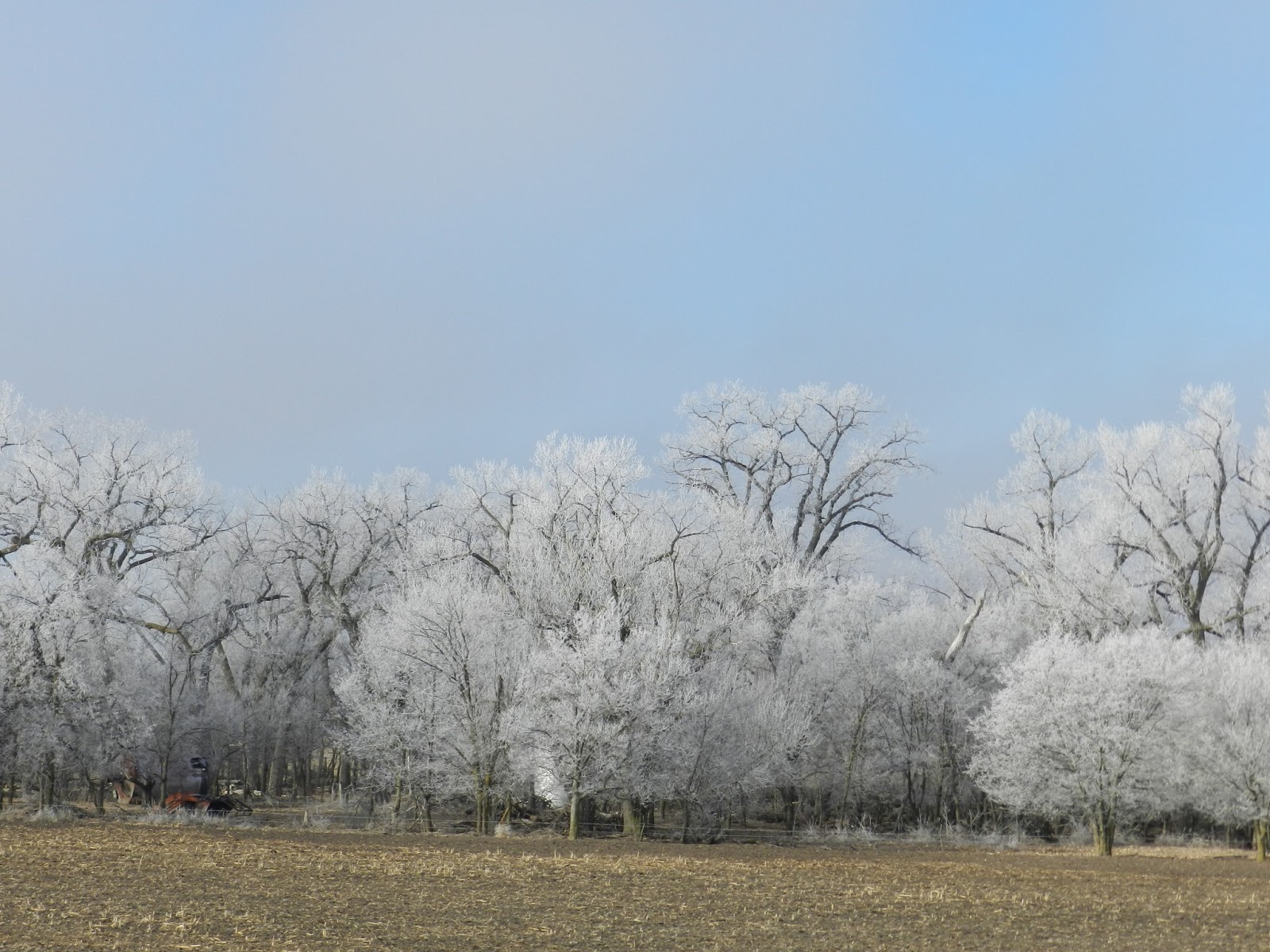
Following this adventure, he intended to take me home, but I’d had enough of that place and insisted on continuing with his  journey, however long it lasted.  Sunshine channeled through the truck windows  and warmed me, making me feel better than I had for days.  Even better, he was going somewhere I had yet to visit.

Once we got to the area where he anticipated working, the dogs and I hopped out to hike.  This particular site has a number of huge trees, standing and lying on the ground.  I enjoyed the challenge of seeing what kinds of photos I could get with Old Sol directly overhead. 

An aged farmstead distracted us so we wandered down another trail to see what treasures we could capture with the Nikon.  Rusty hinges and windmill gears occupied me for some time.  Then I wanted to see what my lens would do with shadows inside a fallen barn and an old shed. 

About that time I noted a meandering stream full of fallen leaves that begged to be saved as images on an SD card.  Snow still lay on the ground, which reminded me it was frigid despite the sun beaming on top of my head.  The cold and the running water prompted me to recall the extra coffee I’d sipped that morning and how long we’d been away from home.

I grew up as an outdoors kid so finding relief in nature is not an issue.  However, there was a road not far away, and I didn’t know how well-traveled it was. I dismissed my discomfort, but every bush from then on screamed my name.

It took all my willpower to ignore my insistent bladder while I marched back to the truck where my spouse was storing supplies.  “Hey, is there a good place to answer nature’s call?” I asked.

He scanned the area and grinned an ornery grin.  “Sure, just look for trail cams.”

Holy cow! I hadn’t thought about game cameras.  Suddenly my fortitude strengthened so I could make it home.  Four walls and cabin fever didn’t seem nearly so bad when nature was hollering.

Saturday, February 9, 2013

An Unlikely House Call


City dwellers take for granted easy access to all sorts of services.  With strip malls in urban areas sprouting like weeds in a wet summer, finding a groomer and pet care is as easy as taking a drive around a section is for me. During that four mile drive in a city, people have to choose which business to patronize.  In small prairie towns on two-lane highways where customers are in short supply, it requires ingenuity to meet people’s needs and make a living at the same time—that’s how a groomer who makes house calls came to be.

When we first moved to a small town bordering Highway 9, I figured I’d continue to drive our shih tzu- mix beast to his regular hair care professional. That wasn’t a serious problem because this kind woman understood Dudley’s issues about having his hobbit-like feet touched, his mouth shaved, and his ears cleaned, but it was long drive in bad weather.

 If you miss your appointment at  a good groomer, you wait until your next one for relief.  As winter-weather advisories began appearing on the radar, concern prompted me to see what was available in my new home town before I had to deal with a dog with dreadlock fuzz.

My investigation revealed an inventive neighbor in a nearby community .  This pet loving woman devised a mobile grooming palace using an old delivery vehicle—the kind with a passenger door like a school bus for easy entry with a pet in arms.  Inside, she has lighting, a water supply and large tub for bathing dogs, a grooming table, generator-driven blow dryers, shears and clippers, as well as a high tech nail file. 

You make your appointment, she shows up in your drive, picks up your furry critter, and returns him in less than two hours, clean and sleekly groomed—in Dudley’s case, feeling soft as an old-fashioned chenille bedspread.  I expected to continue to drive an hour to my previous groomer in rain, snow, and ice rather than suffer through his knots and tangles.  Then a little word of mouth advertising clued me into this gypsy-wagon inspired business.  

This canine stylist travels to each small town in our region at least once a month, making sure rural pets look as spiffy as any big city dog.  She goes several times a month to larger towns like Norton and less often to smaller communities.  She also grooms out of her home and provides boarding services for folks who don’t want to travel with their pets

Obviously, when someone parks a big vehicle bearing a Groomingdale’s sign in your small town driveway, there’s no secrecy about your pet’s appearance.  “Saw the dog lady at your house today,” comments everyone you see.  It’s embarrassing to admit you can’t shear your own pet, but it’s true.  I’m afraid I’ll hurt Dudley while trimming around his mouth, eyes, ears, and . . . the other end. 

 Another reason the groomer’s name is on speed dial is because friends  and family accused me of using a blender to cut our golden retriever’s hair every summer when he was still alive.  Even Tucker was ashamed to reveal himself in public until his hair grew out enough to hide the bald and uneven spots.

As long as this clever businesswoman is willing to make house calls to bathe and trim our fur ball at a reasonable price, she’ll have our business.   Dudley’s grateful too.

Friday, February 1, 2013

A Cure for Winter Doldrums


Cabin fever, winter blues, Seasonal Affective Disorder, and temporary insanity are terms that describe the blahs most of us experience this time of year.  Symptoms include paleness, sluggishness, restlessness, and downright irritability.  Fortunately, a cure exists, and it doesn’t require a Caribbean or Aegean Cruise (although those sound enchanting as I strain my brain to write.)

The good news is  Kansans don’t have to travel to experience the exotic.  It comes to our backyard. We only have to know where to find it in order to spice up dreary January and February days.  Google Kansas eagle migrations to start your exploration.  On a lake near you,  a few of  the approximately 1000 eagles that migrate here each winter have taken up temporary residence.   After arriving sometime in October, they spend their days soaring over open water or perching on ice floes or in high trees to search for dinner prior to returning to summer residences in March.

Once you’ve identified a locale that hosts visiting eagles, prepare yourself to  spend hours spying on them.  A good pair of binoculars or spotting scope will increase your viewing pleasure.  It’s more fun to see distinctive features rather than huge, dark blobs cruising over blue-white water or ice.   A camera with a telescopic lens isn’t essential.  However, looking at photos you took of birds perching and in flight allows you to discover details you didn’t spot during your initial investigation.

Anyone who’s spent much time out of doors in Kansas knows you need to keep warm while you scan sky and horizon.  Heavy parka, gloves, a hat or facemask, and insulated boots make this a more enjoyable experience.  If you’re warm, you can spend your time counting eagles, geese, and ducks as well as identifying species.  If you’re cold, well, it’s hard to keep binoculars still when you’re shivering.

A thermos of hot cocoa, coffee, or tea provides a nice break in this mini-vacation.  Add a sandwich or bag of cookies, and you can add an hour or two to your get-away.  While the goal is to watch eagles, you’ll see other birds as well, so take an identification guide to help you recognize other travelers to wintry Kansas water holes. 

Bird watching, especially cold weather bird watching is one of those Zen things.  Being still enough to watch eagles congregate either in a stark, towering cottonwood, or far out on a lake near an open pool of water without disturbing them requires intentional tranquility.  Those moments of purposeful attention are part of the rejuvenation you’ll experience on this little break from winter boredom. 

Ironically, your pulse will race upon seeing these majestic national icons snag a fish swimming too close to the surface or using knife-sharp talons to capture a slow duck.  It’s a thrill you’ll never forget.

Because it takes effort to enjoy winter eagle watching, it’s essentially a solitary endeavor.  Since you don’t have much human or mechanical sound competing with nature, the honking or quacking of a flock of geese or ducks rising from the lake or a nearby field drowns out all other noises.  It’s so loud you become part of the racket.
Very few places in Kansas are more than couple hours from a lake accommodating winter eagles.  Put your coat on, grab your binocs, and head for a few hours of winter blues blasting bird watching. 

You’ll find yourself smiling all the way home and at odd times for the next week or two.  Let folks wonder what you did to conquer the blahs.

Saturday, January 26, 2013

Grandma's Cooking Secret


As a self-appointed foodie, I often watch Diners, Drive Ins, and Dives for cooking inspiration. Guy Fieri’s success at seeking out eateries with reputations for amazing fare motivates me to look for excellent dining on road trips.  Because of my research, I have a list of favorite restaurants. However, none of these culinary institutions matches the quality or flavor of my all-time preferred place to eat, Grandma Lottie’s kitchen.

I suspect every one of my readers has a family member who manufactures unforgettable meals out of a bit of nothing. That person in our family was an apron-clad Mrs. Santa look-alike who could turn the simplest ingredients into  feasts for kings.  I can’t think of anyone whose salivary glands didn’t kick in overdrive just thinking about a meal at Lottie’s table.

She’s been gone for more than a decade, so I’ve had time to consider what made her food so memorable. Her ingredients were common staples: eggs, flour, butter, dried beans, inexpensive cuts of beef, chicken, ham hocks, milk or cream, and sugar.  She would have been uncomfortable in a big city deli-grocery with aisles displaying fish, adobo, or wasabi sauces.  A trip past a meat department show-casing octopus, squid, or raw sushi ingredients would have left her shuddering.

After seeing a Face Book post requesting Grandma’s hot roll recipe, I think I’ve identified what made her cooking noteworthy.  She made everything from scratch.  She cracked the eggs and added the flour that turned into noodles and dumplings she added to her chicken or beef broth. Her combination of meat, broth, and noodles ladled over a heaping mound of hand-peeled, hand-mashed potatoes was the true ambrosia of the gods. She created everything filling the huge bowls setting in the middle of her table.  Nothing came from a jar, can, sack, or box.

I recall standing beside her  as she kneaded her famous bread dough that turned into airy dinner rolls, comforting bread slices that were palettes for homemade jellies, or legendary cinnamon rolls.  I’d ask for her recipe, and she’d say, “Oh, I use a little of this and a bit of that and mix it til it sounds like I’m patting a baby’s bottom.” 

It took me 1000s of mistakes before I understood I didn’t have to use exact measurements when cooking.  I, too, could mix a little of this and a lot of that to create breads, noodles, dumplings, and pies that reminded me of Grandma’s.  All that practice was an opportunity to feel like a girl again, watching Lottie transform Gold Medal flour and eggs into golden strips of rich dough or whisking eggs, milk, sugar, and cocoa together to turn an empty pie crust into a chocolate meringue wonder. 

Grandma couldn’t afford fancy ingredients or kitchen gadgets.  She made do with inexpensive recipe components and trusted that her sense of taste and touch would turn those into something special to feed family and friends.  Those of us lucky enough to sit at her table will confirm she succeeded time after time at proving she was a wizard in the kitchen.

The lesson for those who knew her was that it isn’t sophisticated ingredients that make a meal tasty. It’s time spent making dishes by hand that creates family legends.  Every moment I stir, roll, cut, and otherwise produce meals connects me to a woman who blessed so many with her gift of turning the common into the uncommon. The pay-off for preparing homemade food is life-long memories.

Friday, January 18, 2013

No Place for Sissies


We once invited a French exchange student to share our lives for six weeks one summer. Her first question after she deposited her luggage in the bedroom was, “Do you have tornadoes here?”

I paused a moment and answered thoughtfully, “Not many, and we always have plenty of warning.”  I reminded her she was very brave to fly from Paris through several U.S. airports.  If she could do that by herself, she shouldn’t worry about Kansas twisters.

The next day we walked around the section surrounding our house to introduce her to our country neighborhood.  She promptly spotted orange construction fencing around a pile of rubble in the east pasture.  That triggered a heavily accented, “What happened there?

“Oh, a tornado blew through last spring and took out our well house.  That’s all that remains,” I responded. “Look at that cottonwood lying  in the field.  It used to be right here by the road.”

Her brown eyes drilled into my green peepers as she demanded, “Did you know it was coming?”
We stopped walking while I considered her question.  “What? The tornado? Well . . . not really.  The weatherman missed on that one.”  It was a good thing Tucker, a golden retriever/greyhound cross walking beside us , couldn’t report.  He’d been caught in the storm, and when we found him afterward, his long yellow fur was entangled with leaves and grass.  We never knew exactly where he was when the winds hit.  What we did know was that he didn’t want to be outside in storms after that.

“But . . . I thought you said you had plenty of warning.” Imagine her strong French accent mixed with agitation as she confronted me.

I thought that was the end of our storm talks until we were driving down Old Forty toward Hays one morning.  Alexandra immediately zeroed in on the twisted windmill on the south side of the road and the ¼ mile of mutilated tree row on the north side of the highway. “So what happened there?”

“Oh that. That was a tornado a few years back.  It’s been a while.  Nothing to worry about.”
I’m pretty sure I heard something rude mumbled in a foreign language, but I ignored it and reminded her we don’t have many tornadoes around here. 

Another day during her visit, we headed toward Ogallah on Old Forty.  I’ve driven that road a thousand times and never thought about the farmstead surrounded by torn and damaged elms.  Our exchange student didn’t miss a beat before turning to me and asking in her quaint manner, “Another tornado that doesn’t happen very often around here?”   

“Right,” I smiled tightly,” realizing I didn’t want to drive her home on the Interstate that passed a farm twice damaged by tornadoes over the last decade.  I also didn’t want to take her south of Ellis where she could view the foundation of a farmstead where a tornado sucked the house off while a family sheltered in the basement.

Our exchange student flew back to France without experiencing a single weather front that forced us to cower and pray in the basement.  Looking back, I’m certain she experienced  nothing more  disconcerting than a few hot July days; however, she made me reconsider life on the western Kansas prairie.  It’s not a place for sissies.


Thursday, January 10, 2013

Freezing Up a Memory


A friend’s Facebook post of her daughters holding a big bowl of fresh snow and smiling expectantly reminded me wintry weather isn’t only about driving carefully, shoveling drives, and making snowmen.  It’s also about adding milk, sugar, and vanilla to jillions of miniscule crystals to create something that glides across taste buds and slides into memory.

Who forgets the first time their mom or dad  watched huge flakes fall, saying, “Hope there will be enough to make snow ice cream.”   If deep drifts formed, that parent headed to the cupboard containing  mixing bowls and extracted the big one.  After that, a voice commanded, “Put on your hats, coats, gloves, and boots.  It’s time.”

Once outside, a picky grown-up identified  piles of clean snow and demonstrated how to collect a vessel full of pure goodness to carry into the warm kitchen.  Just gathering scoops of white intensified the shared experience as a result of silly jokes about putting uncontaminated snow in the bowl.  That always triggered laughter in families with pets as they raced their dogs to the deep drifts.

After giggling family members filled their container with heavenly gleanings, they hurried inside, wriggling swiftly out of coats and mittens.  Instead of begging to stand outside with tongues extended to catch still falling flakes, children begged to add ingredients that turned frigid molecules into a magical dessert. 

For each gallon of snow,  the chef poured close to two cups of milk into a little pitcher and stirred in a big tablespoon of vanilla extract.  They placed that on the counter while mixing a cup of sugar into the bowl containing those freshly gathered six-sided crystals.  Soon after, they added the blend a bit at a time while gently swirling a spoon through the concoction. Some families added flavorings such as chocolate or pureed fruit during this part of the procedure.  When the recipe reached a satisfactory consistency, they quit pouring and set the jug back on the counter.

By then, noses and fingers had warmed considerably.  Vanilla or other scents teased their way upward until it was time to dip servings into individual dishes and dig into this soon-to-be-a-memory delight.  When the clink of spoons hitting bottom changed to silence, the sensation of that cold, sweetness reminded everyone of eating cotton candy.  It was on the tongue one moment, and the next it vanished, leaving behind only a pleasant reminder.

Part of snow ice cream’s appeal is its total randomness.  Folks can’t predict when there will be enough snow until it has fallen.  Then they have to be in the right place at the right time with the right people and right ingredients to create a delicacy that prompts little ones to sing, “Yummy, yummy, yummy.”

 It isn’t just icy flavors cruising over hyped-up taste buds that produce this memorable experience.  It’s the combination of perfect snowfall, family time, frosty noses, added to insanely short-lived sugary impressions that turn this delectable goody into a lifelong reminiscence.  Test the power of this recollection by asking older relatives about their first batch of snow ice cream and watch their faces light up.

Monday, January 7, 2013

Janus Says Look Back to Look Forward


Like many folks, my nature is drawn to new beginnings.  That explains my love of sunrises, newborns of any species, and January 1.  It also explains why Janus, the Roman god of new beginnings--with his two faces--one looking back and one forward, appeals to me.  Since I first studied mythology, this odd looking fellow has intrigued me.  As 2012 winds to an end, that promise of a new start is more powerful than usual. Our move to a new home with a big garden spot suggests unlimited summer delights.

I’m not the only person in America who starts planning next summer’s garden the day after Christmas.  Before the lady who delivers my mail recovers from stuffing boxes with Christmas cards and last minute packages, seed companies inundate the postal service with scores of catalogues promising giant pumpkins and award winning tomatoes. Over the next few weeks, USPS employees with aching elbows and thumb joints will distribute millions of documents promising amazing summer harvests.

As much as I enjoy receiving Christmas letters, I love getting garden catalogues even more.  I haven’t checked with my mom, but I bet I now spend more time pouring through Burpee’s colorful ads than I did looking at the Monkey Ward catalogue as a little girl. Imagining what might grow from those bright seed packets is so much more exciting than looking at the picture of a finished product on a glossy page.

 You are probably wondering how ol’ two-mugged Janus plugs into my green thumb musings. Remember, he looks back and forward.  He reminds people like me to face reality when we really like to dwell in the land of hope and what might be.   That is the nature of a gardener after all.

Thinking of this two-faced god reminds me to recall last summer and my hopes for my tomato and pepper plants as I first tucked them into plowed earth. Even before tilling, I’d stashed dozens of mason jars, planning on serious salsa making.   To help the bees and wind fertilize  blossoms, I visited my garden each morning with paint brush in hand.  My efforts worked fine until extreme July temperatures halted production until nighttime temperatures cooled in mid-August. 

That’s the looking back face. Now for the forward looking Janus.  I’m scouring pages to find drought resistant seeds.  Heat Wave II tomatoes promise flavorful orbs even in sizzling temperatures.  Even more promising, black-eyed peas, spineless okra, cantaloupe, pole beans, jalapeño and poblano peppers, Sugar Baby watermelons, eggplant, and New Zealand spinach also thrive during hot, dry conditions.

Even though we have better soil at our new home, we must take additional measures to guarantee a good harvest. One early season action includes adding compost to our garden. This will nourish plants and help retain moisture.  Even if we escape record-breaking temps, adding broken-down plant material will maximize the plot’s potential. More strategies to survive drought conditions include adding a deep mulch layer and using soaker hoses once a week to water deeply. 

With Christmas a recent memory and January’s namesake Janus reminding me to learn something from last summer’s gardening experience,  I’m scoping out every seed catalogue I get my hands on and dreaming about working up a sweat picking baskets of produce.

Thursday, December 20, 2012

Holiday Baking Cooks Up Memories


As soon as nights get longer and colder, I find myself scouring cook books and magazines for festive recipes.  The irony is that I may whip up one of two of these temptations, but always, always, I return to childhood standbys.  While new flavors tease family taste buds, traditional recipes comfort and connect us to loved ones and times long gone.

A perfect example is my faded and speckled fudge recipe written on a tiny scrap of yellow paper.  I remember as a new bride calling my mom  for instructions to make my husband our family’s old-fashion fudge.  Every time I place that yellow square by the stove, I recall standing at the phone  that night, connecting with home which was hundreds of miles away.  I had a new little house and loving husband, but talking to my mother reminded me of the family that nurtured me and of happy childhood Christmases. 

Recently, I discovered the original fudge recipe printed in my great-grandmother’s Searchlight Cookbook, which my grandmother gave to me. It made me wonder how many aunts, cousins, and other relation had  mailed or called either Great Grandma or Grandma to learn to make this family favorite.  How many of them felt momentarily transported to their loved one’s kitchen and then stood over their own stove while feeling their mom’s or grandma’s presence.

Not only did my mother make amazing holiday fudge, she also let my brother and me help her bake red and green sugar cookies each Christmas.  We would add ingredients she had measured, and then we’d watch as she turned flour, sugar, eggs, and more into  a soft, sweet dough that she’d let us roll into  small balls.  (I wonder if she knows how many of those pre-baked cookies we sampled . . .) 

Once Kent and I laid out even lines of cookies  in a 3 x 4 design on her rectangular baking sheet, Mom would carry out three little dishes—one filled with red sprinkles, one with green, and one with a drizzle of water.  She gave us each a flat-bottomed glass to dip first in the water and then in one color of sprinkles.  Our job was to flatten the dough ball, imbedding the colored sugar.  To this day, Christmas brings those sparkling green and red cookies to mind.

Marriage means more than joining lives, it means joining traditions, so I added my husband’s favorite cookie to my baking repertoire.  His famiy emigrated from Switzerland in the early 1900s and brought their linzer tart recipe with them to Kansas.  That concoction of ground almonds, flour, cinnamon, sugar, egg whites, and strawberry jam now graces Christmas plates in Kansas and Tennessee.  

Cream candy, forgotten cookies, frosted sugar cookies, fudge, linzer tarts, and more keep not only our house but our daughters’ smelling like  holiday confectionary shoppes.  However, it isn’t just the scent of baking that permeates the air, it’s  generations of family memories tickling our noses. 

I like to think that I’m not the only one who reminiscences while cooking.  When my daughters use family recipes, I hope they sense their mom, mom-in-law, their grandmas, their greats, great-greats, and great-great-greats in the kitchen.  No wonder it sometimes feels a little crowded during holiday baking. 

Sunday, December 16, 2012

Christmas Magic: Turning a Tumbleweed into a Christmas Tree


Despite stickers embedded in fingers and palms, I don’t want to give up my beautification project.  Nope, I’m not digging backyard sandburs.  I’m decorating a Prairie Christmas tree. Yep, I’ve gone Laura Ingalls Wilder, and I’m turning a tumbleweed into a showcase for curling green, gold, and red ribbons accented by shiny ornaments.

A girlfriend invited me to celebrate an old-fashioned Christmas at the Nicodemus Township Hall, which included designing a tumbleweed Christmas tree followed by homemade soup and cookies.  How could I turn down that offer?

The catering crew buzzed our senses the moment we walked in the door. Homemade gingersnaps and peanut butter cookies, old-fashioned peppermint sticks, fresh-brewed coffee, hot cider, and ham and beans distracted participants from the mountain of tumbleweeds piled on the stage.

On a table below that heap of well-traveled Russian thistles, an assortment of colored Christmas ribbon, miniature ornaments—round, bell, and bulb shaped--tinsel, and cans of powdery snow challenged participants to fashion something lovely from prickly stems.  

Over the years, I’ve read books and magazine articles touting turning a common prairie invader into an elegant Christmas decoration.   I’ve even visited homes where the artistic host produced a centerpiece out of these Russian interlopers.  While admiring such creativity, I’ve never tried to craft such holiday magic myself.  That changed Saturday, December 8th.

While many wannabe decorators selected huge orbs, I chose a lean example that had one main stem with a few straggly protuberances.  I couldn’t imagine it doing much serious rolling over a pasture, even during a big wind. It looked more like  Charlie Brown’s Christmas tree than an actual tumbleweed, although I’m certain DNA testing would confirm its origins.

My first challenge was stabilizing its stem in the red Solo cup provided.  Toby Keith had no idea the real purpose of the RSC was to provide a stand for a prairie Christmas tree. During that little procedure, at least a hundred stickers dug their way into my thumbs.

Once I had the “tree” set up, I analyzed it’s festivity potential.  With so few branches, it seemed best to go with a less is more motif.  While some folks slathered on spray snow, ribbon, ornaments, and tinsel with grand success, I suspected that would overwhelm my sparse example of drought-inspired plant life.

Using scissors the park service provided, I curled red, green, and gold ribbon and tied  them one to a branch.  Completing that task, I tied a mass of eight colorful ribbons to top my straggly collection of spikes.  To enhance my design, I added  contrasting Christmas ornaments.  It was simple, yet elegant.  Who says that about a sticker bush?

When I thought I was done, I wasn’t.  The weight of the colorful orbs caused it to tumble to the floor where several glass bulbs shattered.  After cleaning up my mess, I re-evaluated and resorted to western Kansan’s favorite standby—duct tape.  

I stabilized that tree with long strips of gray adhesive in every direction.  Of course, those weird spider webs begged to be hidden.  That drove me to a sack of cotton balls and a bottle of school glue.  Yes, my decorating skills now depended upon techniques perfected in kindergarten.  I glued cotton balls over the duct-tape until it looked like my imprisoned weed sprouted from a fuzzy snow bank atop a red Solo cup.

What began as a lark became a three hour challenge.  I nearly forgot to hit the snack table in my attempt to turn a straggly stem into something festive.  I question the beauty of my little tree , but the stickers irritating my hands make surprisingly lovely designs.

You Can't Take the Girl Out of the Hunter


Not so long ago, if memory serves me right, most  people considered serious women hunters a rarity.  Their appearances on the outdoor channels were uncommon, and you couldn’t find camouflage or blaze orange specifically designed to fit female anatomy. 

The last ten or fifteen years has changed  that.  Google “Women on the Outdoor Channel,” and you’ll visit multiple sites showcasing Tiffany, Gina, Vicki, Julie and more females scouting, harvesting, and showcasing hard-won trophies.  You’ll also find ad after ad promoting Real Tree Camo designed for feminine shapes.  While the fairer sex may be joining or leading males in the field of hunting, be aware that gals who stalk trophy bucks still like glittering gems and whip up prize-winning cookies. 

The first Saturday of deer season, I spent the morning at an area craft fair.  It spotlighted local vendors and hosted a cookie walk that made me salivate just looking at the assorted baked goods.  I traveled from booth to booth, examining ornate woodwork, afghans and quilts, potato bags, cookware, jelly nails, and several styles of jewelry.  

During my journey around the venue, a couple of blaze orange jackets and hats caught my eye.  Trained in old school thinking, I expected to see a couple of guys in town for lunch.  Instead, two lovely hunters took a midday break to check out beautifully displayed necklaces, rings, and bracelets.  Why not, I thought.  You may be able to take the hunter out of the girl, but you can’t take the girl out of the hunter. It reminded me of a friend who commented that his wife’s manicure kit was as well stocked as her tackle box.  Ladies need their girl stuff.

I confirmed  that thought a few hours later at another Christmas festival in a different location.  This one hosted a cookie contest that required  recipes to include chocolate.  I hadn’t attended this event before, so I paid close attention to participants and their activities.  

After we delivered  my friend’s cookies to the competition directors, we joined the crowd playing Santa Bingo.  Only a couple of tables away, I spotted a young woman dressed in camo from neck to toe.  Obviously, she’d taken a break from her stalk to celebrate the season with a bingo card and corn kernel markers. 

 Within an hour, I understood even better why she’d interrupted her hunt.  Finished sampling dozens of chocolaty confections delivered by hopeful prizewinners, three judges emerged with full bellies and happy smiles to announce the winners.  A previously noisy room became silent as we awaited  their verdicts.  

Declaring a 13 and under winner, a judge called  out a name.  From my peripheral vision, I saw familiar camouflage  duds striding confidently up the aisle between packed tables.  This young woman had taken time from stalking this season’s contribution to the deep freeze to collect a $25 award.  According to the announcer, this wasn’t her first win.  She’d earned the prize in the past as well.

Western Kansas women amaze themselves and their men all the time.  One of their talents is that ability to follow their bliss into the woods after a huge white tail  or muley and then come home to cook a delicious meal followed by scrumptious cookies.  It shouldn’t come as a surprise that she may have a new bauble on her finger that sparkles when she passes the cookie tray.